

A linear tattoo, also called a one-line tattoo, is a design created with one continuous stroke: the tool is never lifted completely or drawn back over a part that has already been drawn. This constraint defines the style more than the line’s thickness or the type of motif. Before choosing which design to try or where to place it on the body, it helps to understand how that single stroke is constructed and why a curved surface affects it differently from the way it looks in a flat sketch.
- What sets it apart: the topology of the stroke (a single path without lifting or retracing), not the line’s thickness, which is what defines fine line.
- Which motifs work best: silhouettes with a natural, closed path, such as a coiled animal or a symbol that is already an uninterrupted curve.
- What to check before choosing a placement: where the line changes direction and whether those points align with a fold or natural curve in the skin.
- What it is not: a semi-permanent or temporary tattoo shows size, shape, and how the design fits the body’s curve, but does not predict the pain, healing, or final appearance of a permanent tattoo.
What is a linear (one-line) tattoo, and how is it created?
In a one-line design, the path is conceived from beginning to end as a single line: every curve, angle, or detail has to be resolved without lifting the tool from the surface, which means simplifying the subject to its essential gesture before starting. This same idea comes from a broader drawing tradition known as continuous contour drawing, in which the artist traces the subject’s silhouette without lifting the tool from the paper, relying more on the feel of the stroke than on close observation of every detail (source: Contour drawing — Wikipedia).
Sculptor Alexander Calder applied a similar principle to a different material: he made wire sculptures described as “drawing in space,” treating a single continuous line as a complete form without fill or shading (source: Alexander Calder — Wikipedia). In a tattoo, this logic explains why a one-line design can read as a recognizable face, hand, or animal without shading: the silhouette does all the work, so choosing the motif matters as much as choosing the placement.
How it differs from fine line and a simple outline
It’s easy to confuse one-line with fine line because both look delicate, but the difference lies elsewhere. Fine line is defined by the thickness of the stroke: a thin line that can be combined with several parallel lines, dots, or soft shading within the same design. One-line is defined by the topology of the path—that is, by the fact that the entire motif is created in a single stroke without lifting it. It can be drawn with a fine stroke or a somewhat thicker one and is still one-line as long as the stroke isn’t broken or retraced.
A simple outline, by contrast, can involve lifting the stroke several times to add separate details—a eye here, a leg there—without affecting the result. One-line doesn’t allow for that: any detail that doesn’t fit into the single path is left out of the design. If you’re interested in stroke thickness and how to try different widths at actual size, the article dedicated to the fine-line style covers that topic, and the fine-line tattoo guide goes into more depth about line thickness and how to check it before deciding.
Motifs that work well as a single line
Not all motifs lend themselves equally well to a continuous stroke. Those that work best already have a natural, closed path, without branches that would require lifting the line. A coiled snake is a good example: its body forms a continuous spiral that can be followed from beginning to end without interruption, as seen in the Graceful Snake design.

Symbols that are naturally an uninterrupted curve fit this logic even more directly. The infinity symbol combined with an arrow, as in the Infinite design, is a clear example: the shape itself is already created in a single stroke that crosses over itself once, with no need to simplify it to adapt it to the style.

Profile faces, intertwined hands, and animals with simple outlines also work well, as long as their silhouette can be traced from one end to the other without lifting the stroke or going back over a part that has already been drawn. Designs intended for couples can split a single continuous line between two small pieces that only become complete when placed together; this specific idea is explored in the article about couples’ tattoos.
Geometric motifs: the compass example
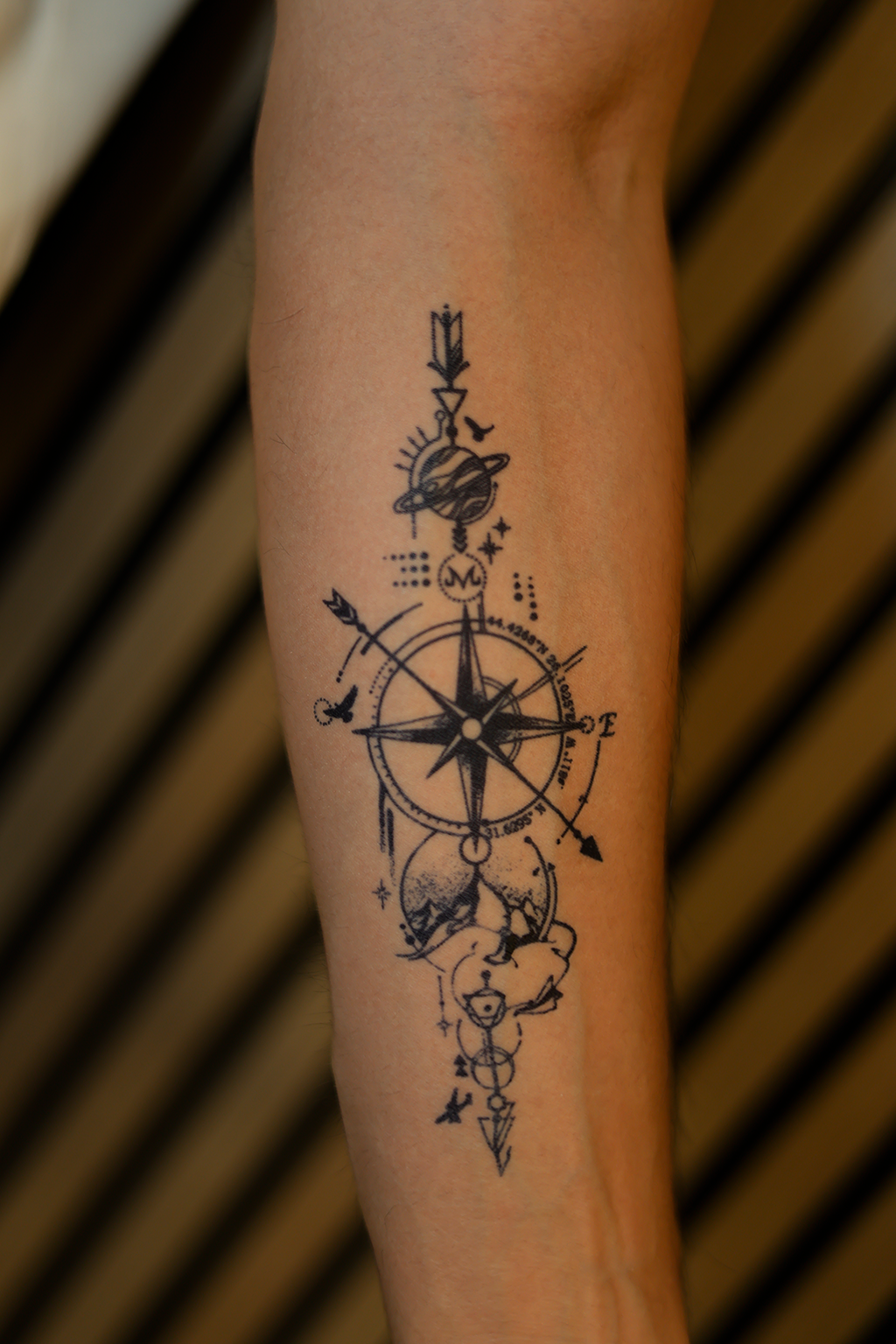
A compass with its cardinal points and needles is a good example of a geometric motif that can be created in a single line, as long as the design reduces the elements to one continuous path rather than separate shapes. To learn more about the meaning and symmetry of these kinds of motifs, the geometric tattoo guide explores the topic in greater depth; here, the compass is simply an example of a silhouette suited to the one-line style.
Why the stroke should follow the body’s curves
A long stroke is almost always designed on a flat sketch, but it is placed on a surface with its own curve, and that difference changes how the result looks. Before choosing a body placement, it’s worth checking the exact points where the line changes direction and seeing whether those points align with a fold or the natural muscle curve of the chosen area. When they do, the design moves with the body instead of fighting against it.
When a line goes against the curve of the skin instead of following it, it tends to look compressed on one side and stretched on the other once placed, even if it looked perfectly proportioned in the flat sketch. That’s why it’s worth thinking of placement as part of the design, not as a later step: the same silhouette can work very well in one area and look unbalanced in another, depending on how it fits that particular curve.
Placement areas for a continuous line: forearm, ribs, and collarbone
The forearm offers a long, fairly even diagonal with few changes in curvature, making it a convenient area for a stroke that covers some distance continuously. It’s one of the most common areas for medium-sized designs, precisely because the surface naturally follows the path.
The ribs have a much tighter curve, so a vertical design usually follows that area better than a wide, horizontal one, which would tend to stretch unevenly across the side. The collarbone works well for a short, compact path, such as a small compass or a closed symbol that doesn’t need much room to unfold; its gentle curve suits short strokes better than long pieces.
How to check the design before deciding
Applying the chosen design as a semi-permanent tattoo lets you see, with your body in real motion, whether the stroke follows the area’s curve as expected when viewed on screen. Comparing two placements before deciding—for example, the forearm versus the collarbone for the same motif—means you don’t have to rely only on the flat sketch, which doesn’t always predict how the design will look on the skin. You can explore more one-line and delicate-stroke designs in the Fine line collection to compare options before trying one on your own body’s curve.
It’s worth being clear about what this test checks: size, shape, and how the design fits the body’s curve, not how a permanent tattoo with the same design would feel, heal, or look. These are two different questions, and the semi-permanent tattoo answers only the first. If you later decide to go ahead with a permanent design, the article about choosing your first tattoo explains how to approach that decision more carefully.
A linear tattoo rewards planning: choose a motif whose silhouette can be created in a single path, check where that line changes direction, and make it match the area’s actual curve before settling on the final size or position. That combination of motif and placement, more than the stroke’s thickness, is what makes a one-line design look clean and balanced on the body.