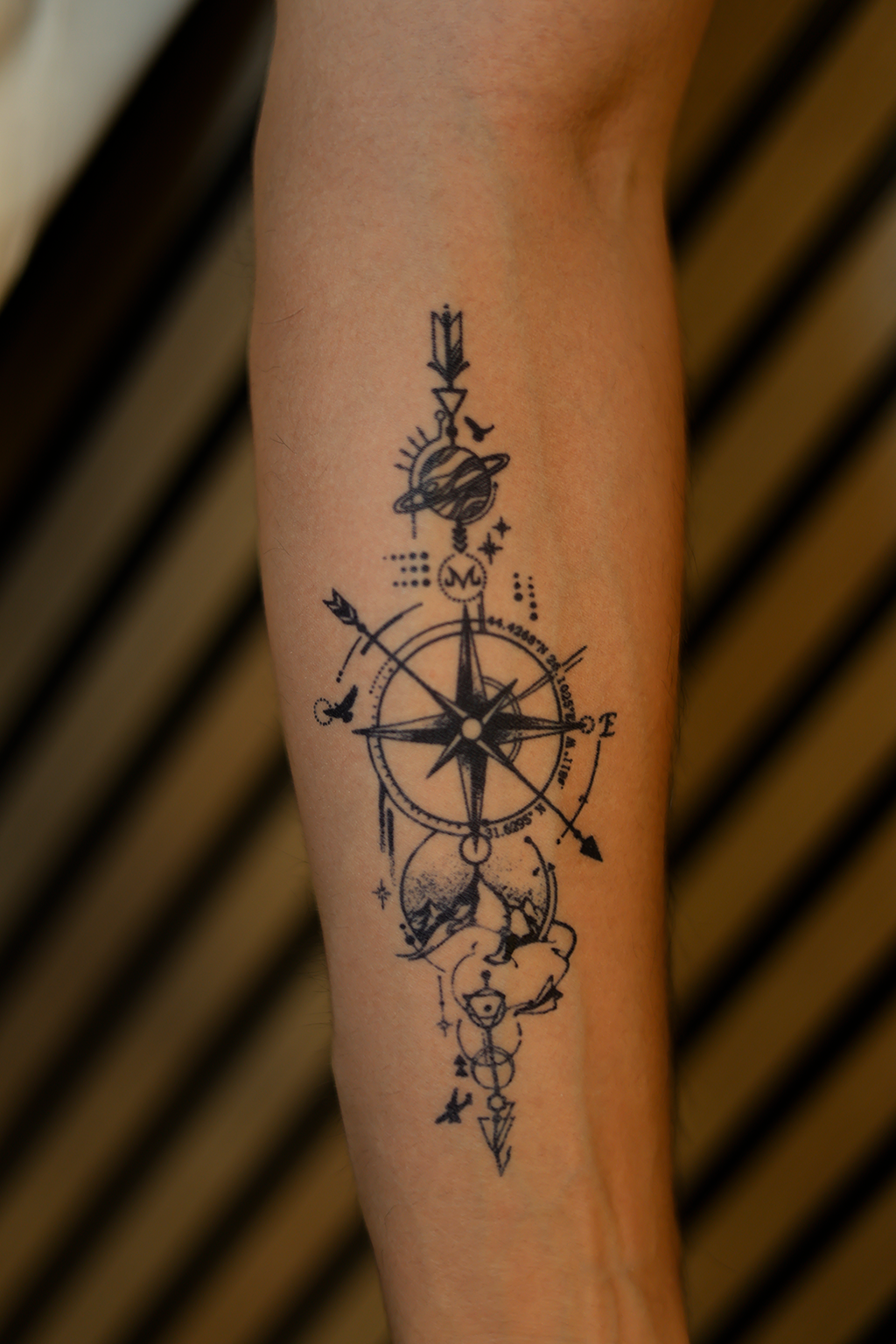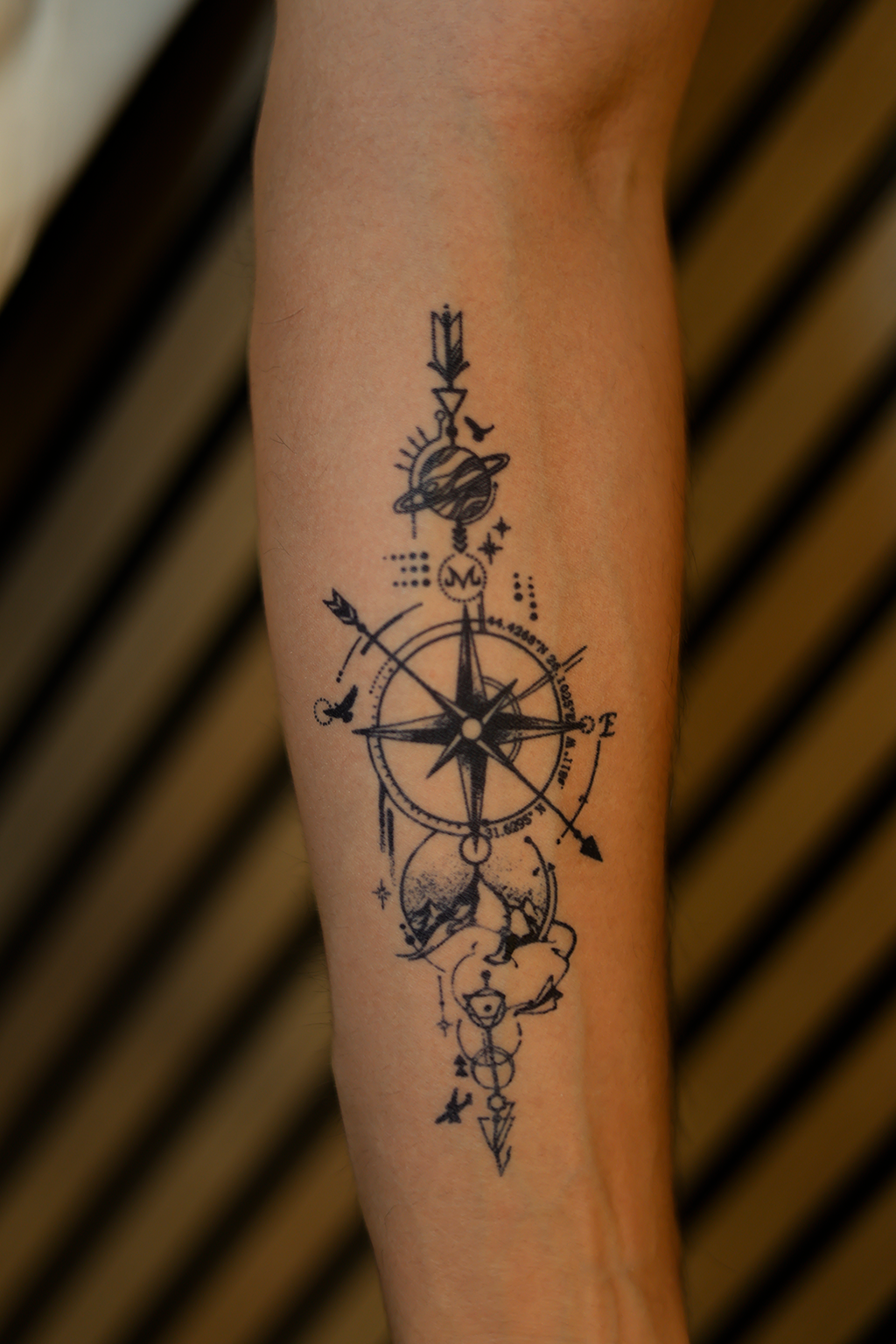


An Icarus tattoo, also called an Icarus tattoo after the Latin form of the name, puts one of the best-known Greek myths on your skin: the story of the young man who flew on wings made of feathers and wax and fell into the sea because he got too close to the sun. Its meaning depends largely on which part of the story you choose to emphasize. Read as a warning, the tattoo speaks to the price of ambition that ignores a clearly explained limit. Read as an affirmation of courage, it speaks to consciously taking a risk and trying to fly even when the outcome is uncertain. Neither reading is absolutely “correct,” because both are supported by the way the story has been told over time, from antiquity to the present day.
- The myth tells the story of Daedalus, the craftsman who builds wings of feathers and wax for himself and his son, Icarus, so they can escape from a place with no other way out.
- Daedalus’s instruction to Icarus—to fly neither too low toward the water nor too high toward the sun—is the thread that gives the whole tattoo its meaning, because every visual element in it—the wings, the sun, the fall—points to part of that instruction.
- The traditional reading sees Icarus’s fall as punishment for uncontrolled ambition; a more recent reading emphasizes the courage to attempt flight, not just the mistake at the end.
- A temporary or semi-permanent tattoo shows you how the design looks on your skin, but it does not predict the pain, healing, or final appearance of a permanent tattoo.
Who Were Daedalus and Icarus?
According to Greek mythology, Daedalus was the craftsman of King Minos of Crete, and he is also credited with building the labyrinth in which the king imprisoned the Minotaur (source: World History Encyclopedia). At one point, Daedalus himself was imprisoned on the island with his son Icarus, and because the two usual escape routes, by sea and by land, were closed to them, the only route left was through the air. For this, Daedalus built wings for both of them from bird feathers fastened with wax, a solution that is part of the same tradition that portrays him as the most skilled craftsman of his time. The story is part of a broader collection of legendary symbols you can wear as tattoos, alongside other figures from Greek mythology.
The Wax Wings and Daedalus’s Warning
Before takeoff, Daedalus gave his son one instruction, repeated in several versions by ancient poets: to fly a middle course, neither too low, because the sea water would weigh down his feathers, nor too high, because the sun would melt the wax (source: Ovid, Metamorphoses, Book VIII). This is, in fact, the oldest known form of the expression “too close to the sun,” and it explains why the sun has remained the myth’s central visual element. Icarus listened at first, but the joy of flying drew him higher and higher, until the wax melted and the feathers came loose one by one. He fell into the sea and drowned, and the water where he died became known in antiquity as the Icarian Sea, a detail that shows just how deeply his story entered Greek geography and memory (source: Ovid, Metamorphoses, Book VIII).
Two Readings of the Same Myth: Warning or Courage?
What makes the myth suited to a tattoo is not just the final fall, but the fact that the story can be read in two almost opposite ways, and each person who wears it usually chooses one of them without having to explain it every time.
When the Warning Reading Fits
The traditional reading treats Icarus’s fall as punishment for hubris, or ambition that ignores a clearly explained limit (source: World History Encyclopedia). If your tattoo follows a period when you learned something about limits, whether at work, in a relationship, or through a personal decision, this reading turns the myth into a visual reminder: the sun marks where caution ends, and the falling feathers show what happens when the limit is ignored.
When the Courage Reading Fits
A more recent reading of the myth emphasizes the flight itself, not just its failure, and connects the risk Icarus took with the idea of discovery: trying something new always means accepting some uncertainty (source: TheCollector). For anyone who chooses this meaning, wings outstretched toward the heights, rather than falling feathers, become the central element of the design, and the sun is more a marker of the ascent than a punishment.
Visual Symbols: Wings, Sun, and Fall
Because the myth can be read in two ways, the visual elements you choose matter just as much as the story behind them, because they are how other people will understand the message without further explanation.
- Wings and feathers remain the myth’s most recognizable element, whether outstretched and symmetrical for the courage reading, or loose and in motion for the more tragic reading.
- The sun, shown simply or as a circle of rays, marks Daedalus’s warning and works well as the composition’s focal point, usually placed above or behind the wings.
- Falling feathers or a stylized silhouette in free fall directly convey the final part of the myth, for anyone who wants an image closer to warning than to hope.
The broader symbolism of wings and feathers, associated with freedom, memory, or protection in contexts other than the myth of Icarus, is explored in detail in a guide to wing tattoos; here, we’re focusing on the specific meaning this story brings. If the solar motif interests you more than the story of Icarus itself, the article about moon, sun, and space tattoos explores other possible meanings of the sun as a symbol.
Where an Icarus Tattoo Works Well
Placement depends first and foremost on the visual element you choose, not on a fixed rule connected to the myth. A design with outstretched wings needs a surface wide enough for the shape to unfold without being compressed, and the shoulder or back offers exactly that space. A composition centered on the sun or on a vertical fall, by contrast, adapts better to a narrow, elongated area such as the forearm or the line of the ribs, where the eye naturally follows the design from top to bottom. For a more general guide to choosing the right design and placement for your first tattoo, this article takes you through the decision step by step.
How to Test the Design Before Making It Permanent
A temporary or semi-permanent design featuring wings, the sun, or falling feathers shows you exactly what size, shape, and position the design would have on your own skin, which is especially useful for a composition with so many possible variations. It cannot, however, show you how a permanent tattoo made with a needle would heal, how much it would hurt, or how it would age over time, because the process and ink used are completely different; it remains a trial run for the design, size, and placement, not a simulation of the final tattoo.

If you want to compare several options before deciding, the Fantasy and Mythology collection includes, alongside the design above, designs such as Lord of the Skies, a dragon set among the clouds, useful for anyone who prefers a celestial theme without a direct mythological connection to Icarus, but with the same idea of flying high.
A Story with Two Endings, Completed by You
The myth of Icarus remains one of the few classical motifs that works just as well as a warning as it does as an encouragement to be courageous, and the choice between the two ultimately depends on your own story, not on a predetermined interpretation. Testing the design beforehand, on your shoulder, forearm, or ribs, helps you see which of the two readings, and which of its visual elements, truly feels like yours before you decide on anything permanent.