

A geometric tattoo builds its design from mathematical shapes—triangles, circles, hexagons, lines and dot grids—rather than from a single figurative subject. This approach creates clean, structured compositions, but it has a direct consequence for choosing the design and its placement: a straight line or a slightly off-center circle is almost immediately noticeable, whereas a more organic design absorbs that kind of deviation without it being noticed. Understanding the shapes that make up this style, how the body's curvature changes the way they read, and how to check a design's alignment before making it permanent helps you choose a design that remains coherent once it's on the skin.
- The style's basic vocabulary consists of a few shapes: triangles, circles, hexagons, lines and dot grids, combined with one another or with dotwork.
- Sacred geometry and tribal tattoos draw on their own symbolic and cultural traditions; modern geometric style is distinct from them, even when they visually overlap.
- Symmetry is more quickly noticeable in this style than in an organic style, making the choice of body area particularly important.
- Checking alignment on the actual body area from several angles helps reveal any discrepancies before making the tattoo permanent.
The shapes that make up a geometric tattoo
Before choosing a design, it's useful to recognize the few shapes that appear in most geometric compositions. The triangle, circle, hexagon and square form the basic vocabulary: the triangle is often read as a symbol of strength or balance, the circle as a symbol of continuity, and the hexagon as a symbol of harmony—a reading that is a common interpretation rather than a fixed rule (source: Certified Tattoo Studios). Straight lines and dot grids connect these shapes: they extend an outline, link two figures or create a gradient without using a solid block of color. For a complete description of the meanings associated with each shape, the article dedicated to geometric tattoos and their meanings explores them one shape at a time; this page focuses instead on symmetry and placement.
Dotwork, a technique for geometric shapes
Dotwork creates gradients and depth through the density of small dots rather than a solid line or continuous shading (source: Inkscape Tattoo). Applied to a geometric shape, this technique gradually brings a hexagon or circle into view, dot by dot, creating a softer look than a crisp line while keeping the geometric structure legible.
Sacred geometry, tribal tattoos and geometric tattoos: three different things
Geometric style is often confused with two very different traditions, and it's worth clarifying the distinction before choosing a design. Sacred geometry draws on a limited number of shapes considered spiritually significant in several traditions, such as the Flower of Life or the Seed of Life (source: Monolith Studio). Geometric style, by contrast, draws more broadly on the vocabulary of mathematical shapes, without every design necessarily carrying this specific symbolic meaning. Tribal tattoos belong to their own cultural and narrative tradition, with their own rules of composition and history; contemporary geometric style sometimes draws visual inspiration from it, for example through the use of repeated patterns, but without adopting its original meaning. When a design involves a sacred symbol or a specific cultural tradition, it deserves to be chosen and explained with that context in mind, rather than treated as interchangeable decoration.
Why symmetry matters more than in other styles
Symmetry matters more in a geometric tattoo than in a style with freer contours, for a simple mechanical reason: a straight line or a circle makes a deviation of a few millimeters almost instantly visible, whereas an organic design absorbs the same deviation without the eye identifying it as an error. Another factor to anticipate from the outset is that neither arm nor either side of the body is perfectly identical to the other, which means a design intended to be strictly symmetrical has to account for this slight natural asymmetry rather than ignore it. Finally, mobile areas such as the ribs, shoulders or inside of the elbow stretch the design slightly with movement—a factor to consider when choosing the design, rather than afterward.
How the body's curvature affects placement
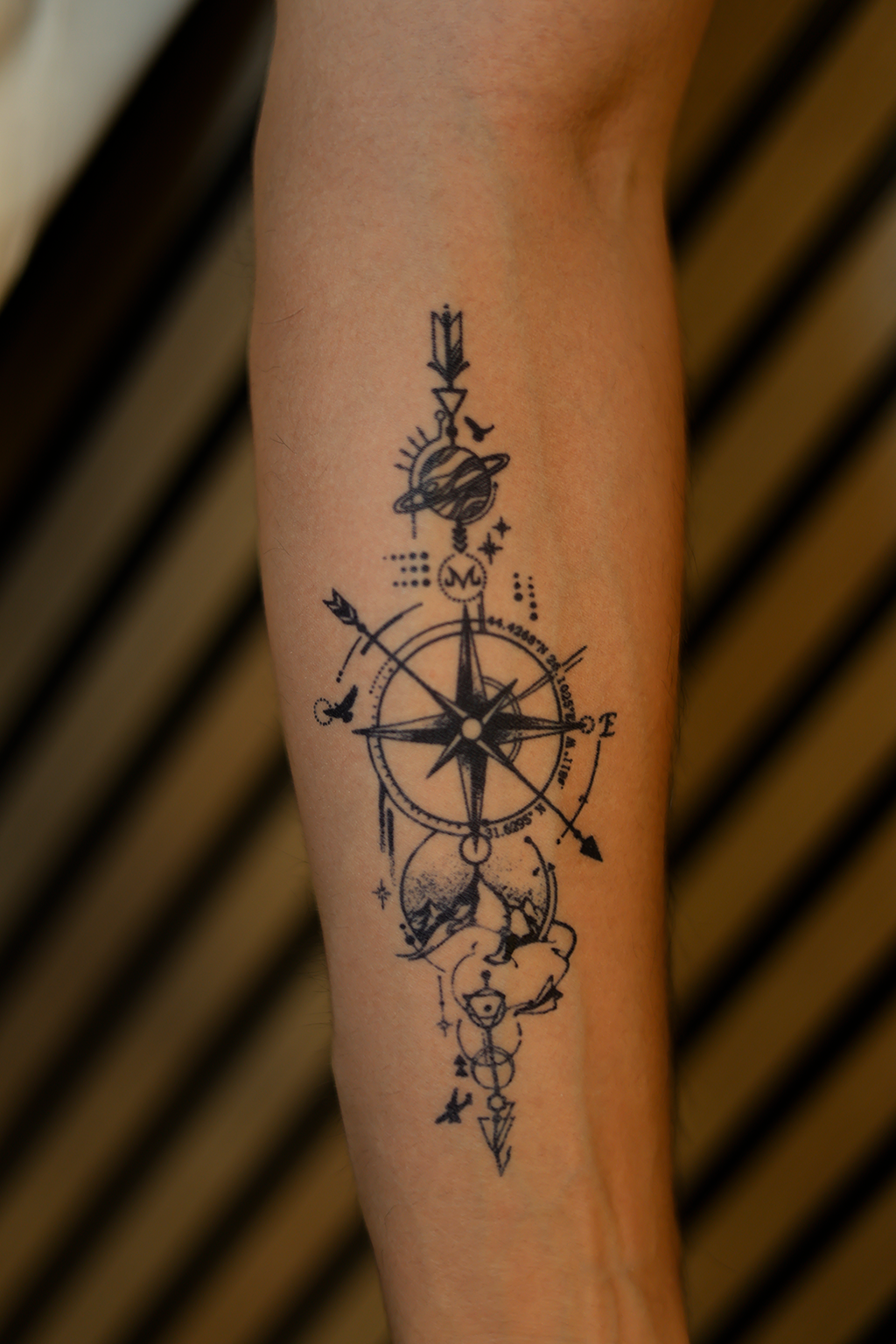
The curvature of the chosen area directly affects how a geometric design reads once it's on the skin, and this is worth considering before settling on the final design. On the forearm, a geometric design can follow several orientations—a vertical composition that follows the arm's axis, a horizontal composition, or a design that wraps around the forearm—with each orientation presenting the same design differently. Choose according to the effect you're after rather than a fixed rule (source: Mantle Tattoo). On the arm and shoulder, the natural roundness of the biceps and shoulder suits circular or wrapping designs better than strictly straight lines, which tend to look broken where the muscles meet (source: Mantle Tattoo). The ribs are a mobile area that can distort a geometric design if the composition doesn't account for breathing and torso movement (source: Sortra). The general principle to keep in mind is to match the shape of the design to the shape of the chosen area, rather than impose a fixed design on a body that is never quite still (source: Sortra).
Pairing a geometric frame with an animal or plant
A figurative design—an animal, a leaf, a branch—often looks sharper when framed or extended with lines and geometric shapes rather than left on its own on the skin. The compass is a good example: coordinate lines and arrows provide a geometric structure around a symbol, turning an otherwise fairly classic design into a more considered composition.

A design of planets connected by lines follows the same logic in a more minimalist style: the geometric structure remains legible even at a small size, making it a suitable choice for a more discreet area such as the forearm.

This idea of a continuous line connecting several elements also relates to the single-line tattoo technique, explored in more detail in the article about linear and single-line tattoos. For figurative designs themselves, whether animals or other subjects, the article about animal tattoos offers ideas and additional meanings to pair with a geometric structure. Radially symmetrical compositions, such as the mandala, follow their own logic; the article dedicated to mandala tattoos explains this particular symmetry in more detail.
The alignment test before choosing a final design
Before making a geometric design permanent, testing it on the actual body area tells you more than looking at a photo of the design laid flat. First, apply the chosen design directly to the intended area—forearm, shoulder or ribs—instead of judging its symmetry from a two-dimensional image that doesn't account for the body's contours. Once the design is in place, check the alignment of the lines and the symmetry of the shapes from several angles and after moving the area naturally, such as bending an arm or breathing with the torso, since this movement is precisely what can reveal a discrepancy that's invisible at rest. If you haven't settled on the final placement, comparing the same design on two or three areas helps you identify where the composition reads best. A temporary or semi-permanent tattoo serves here only as a way to test the design, size and placement: it doesn't allow you to predict pain, healing, a possible allergic reaction or the exact appearance of a permanent tattoo, all of which depend on factors specific to the skin and the tattoo artist's technique.
A successful geometric tattoo depends less on choosing a trendy shape than on the coherence between that shape, the body area that carries it and checking its alignment before making it permanent. Applying a design from the Geometrically collection to the intended forearm, shoulder or ribs makes it possible to assess symmetry and alignment directly on your own skin, in the real conditions in which the design will be worn, before making a final decision.