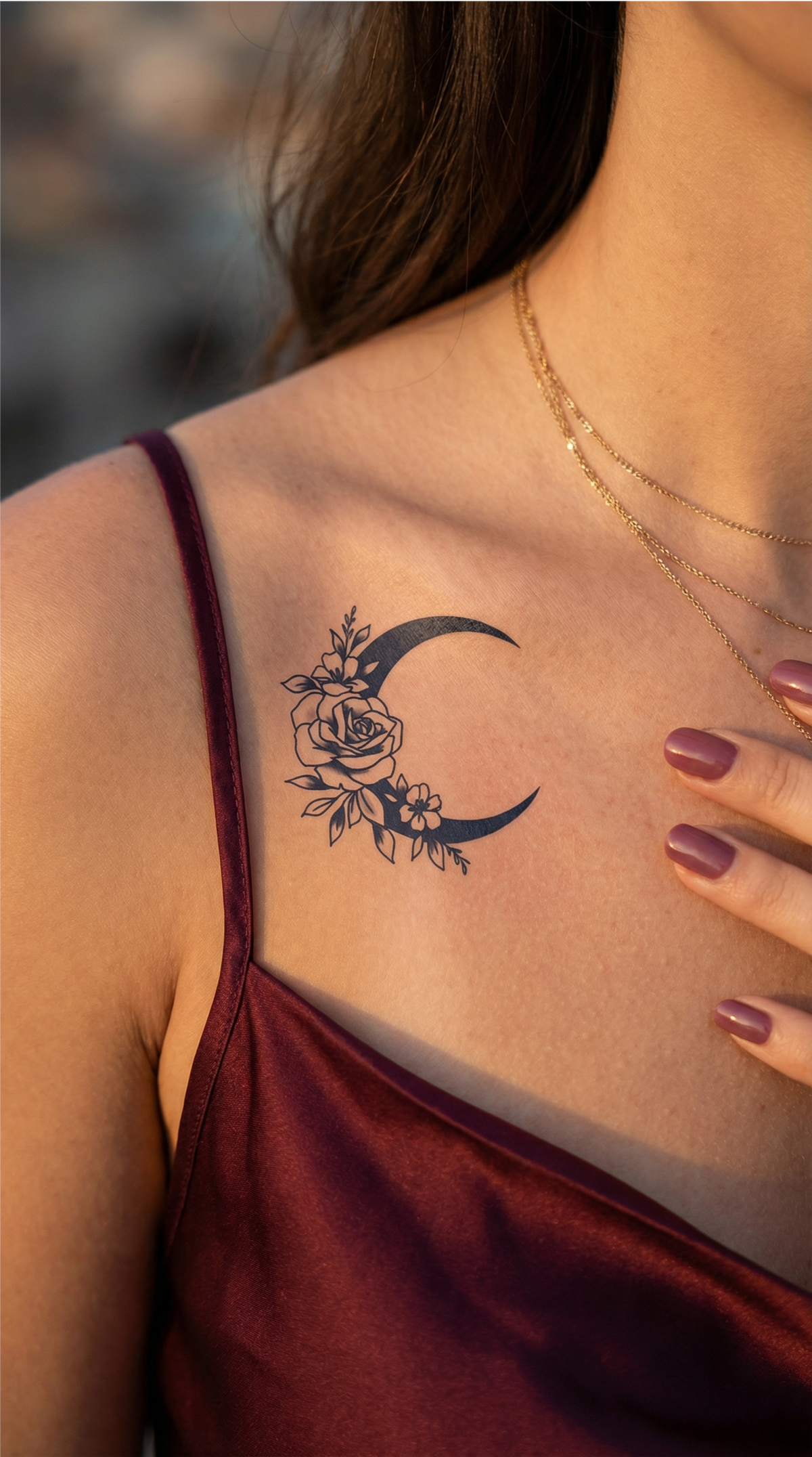


A peony tattoo carries two distinct stories, depending on the culture that shaped it. In China and then Japan, it has traditionally been known as the “king of flowers” and associated with honor, wealth, and love, whereas the 19th-century Western tradition saw it more as a symbol of modesty. Knowing about these two interpretations is mainly useful for choosing a style and placement that fit what the design is meant to convey, rather than searching for one fixed, universal meaning.
- In China, the tree peony is the “king of flowers” and represents honor, wealth, and love, while the herbaceous peony, nicknamed the “minister of flowers,” was traditionally given to someone leaving as a promise of reunion.
- In Japan, the peony holds a status similar to the one it has in China and is one of the recurring floral motifs in traditional irezumi tattooing, alongside cherry blossoms, lotus flowers, and chrysanthemums.
- In the Victorian language of flowers, the peony evoked modesty or shyness, a more intimate interpretation than its Asian symbolism of honor, though today neither interpretation really replaces the other.
- No reliable source links a specific peony color to a distinct meaning: color is chosen mainly for the look you want on the skin.
- The chosen style (traditional Japanese, minimalist, or watercolor) and the size of the design together help determine the most suitable placement on the body.
The peony in China: honor, wealth, and love
The tree peony, Paeonia suffruticosa, is commonly known as the “king of flowers” in China, where it symbolizes honor, wealth, aristocracy, as well as love, affection, and feminine beauty (source: Paeonia suffruticosa, Wikipedia). This dual interpretation, both formal and emotional, explains why the design is worn as much to mark personal success as to represent a strong emotional bond.
Alongside this tree variety, the herbaceous peony, Paeonia lactiflora, has a slightly different place: nicknamed the “minister of flowers,” it was traditionally given to someone leaving as a promise of reunion, a decorative custom attested in China since the 7th century (source: Paeonia lactiflora, Wikipedia). For a tattoo, this offers a useful nuance: a peony design can celebrate ambition or achievement just as easily as it can represent an attachment to a person or a memory, depending on the intention behind it.
In Japan: the sovereign flower of traditional tattooing
Japan follows a floral hierarchy very similar to China’s: the tree peony is also called the “king of flowers” there, while the herbaceous peony bears the title of “prime minister of flowers” (source: Peony, Wikipedia). This honorary status is more than a botanical curiosity: it goes a long way toward explaining why the flower has had such a long-standing presence in the world of Japanese tattooing.
A floral motif among many in irezumi
In traditional Japanese tattooing, or irezumi, the peony is one of the most common recurring floral motifs, alongside cherry blossoms, lotus flowers, and chrysanthemums (source: Irezumi, Wikipedia). It is generally rendered with bold outlines and blocks of color, a graphic treatment quite different from sakura, whose symbolism and more delicate linework are described in the article on the cherry blossom tattoo. Comparing the two flowers is especially helpful when choosing a consistent visual style if you are deciding between several Asian motifs.
In the West: a more intimate interpretation
The Western interpretation of the peony comes from elsewhere. In the highly codified Victorian language of flowers of the 19th century, the peony was associated with modesty or shame, a symbolism rooted in a popular belief that mischievous nymphs hid among its petals (source: Peony, Wikipedia). This folkloric origin is not in direct opposition to the Asian interpretation: it helps explain why the Western peony is now seen mainly as a romantic, understated flower rather than a symbol of openly displayed ambition. The two traditions coexist, and you do not have to choose just one to give your tattoo meaning.
Which peony color should you choose?
Peonies naturally bloom in a broad range of colors: pink, purple, red, white, and yellow (source: Peonies, The Old Farmer's Almanac). Unlike the flower’s general symbolism, no reliable source links a specific color to a particular message once it is tattooed. So color is chosen mainly for the visual effect you want: pink and red create contrast on most skin tones and work well for a design that is meant to stand out; white and pastel shades suit a more subtle look in linework or light watercolor; and purple works well with a more saturated watercolor treatment. If you are looking to connect a floral design to a specific birth month instead, the article on the birth flower tattoo explores that question in detail, though no such connection is attested for the peony itself.
Styles that suit the peony: Japanese, minimalist, watercolor
The peony’s symbolism has a practical influence on the choice of style, and the three most common approaches each suggest a different intention.
Traditional Japanese style
Traditional Japanese style, with its bold outlines and layered blocks of color, works well for a design that explicitly embraces its connection to irezumi and the flower’s honorary status mentioned above. It generally needs a fairly generous area so the layered petals remain clear.
A minimalist peony tattoo
At the other end of the spectrum, a minimalist peony tattoo reduces the design to a simple outline or a single continuous line, without trying to depict every petal. This treatment works well for a discreet first try or a small design. The Rose design illustrates this single-line approach to a flower, offering a useful way to picture how a peony treated in the same way would look.

Watercolor and illustrative styles
Unlike minimalism, a watercolor or illustrative treatment uses color gradients and layered petals, a look that highlights the peony’s natural fullness. The Blooming design, an illustratively rendered floral bouquet, gives an idea of how this type of look appears on the skin in terms of volume and color gradients.

To compare a wider range of floral designs, the floral tattoo gallery brings together other designs beyond the peony alone, which can help if you have not settled on a motif.
Where to place a peony tattoo based on the design’s size
The size of the design and the level of detail you choose largely determine the most suitable placement. A detailed design with several layered petals, in a Japanese or watercolor style, needs a fairly large area to remain clear: the shoulder or thigh provides enough room to keep the details from looking cramped. A medium-sized design works well on the forearm or ribs, two areas where the peony can be shown or concealed depending on what you are wearing. A simplified peony bud in a minimalist style, on the other hand, works very well as a small design on the wrist or ankle, making it a good starting point for a first try. For a more complete method of choosing a design and placement, the article First tattoo: how to choose a design and placement explains this approach beyond the specific case of the peony.
A flower with a different symbolism, such as the fleur-de-lis, follows a similar approach to placement but draws on a very different heritage; the article on the fleur-de-lis tattoo explores this other interpretation for anyone considering several floral designs at once.
Try your peony before making it permanent
Once you have chosen the style and area, a temporary or semi-permanent design lets you judge the size, placement, and balance of the petals directly on your own skin before making a final decision. This test is primarily visual: it shows how the design fits each person’s body shape and skin tone, but it does not let you predict the pain felt during a permanent tattoo session, how the healing process will go, or exactly how permanent ink will look over the long term—factors that depend on the technique, the tattoo artist, and each person’s skin. To explore the temporary floral tattoo collection, simply compare the available designs with the style and size you chose above. For the actual lifespan of a semi-permanent tattoo, the dedicated article How long does a semi-permanent tattoo last? provides that detail, so there is no need to repeat it here.