

A birth flower is the flower that Western tradition associates with your birth month, a little like a zodiac sign, but based on floral folklore rather than astronomy. In a tattoo, it serves as a simple starting point for choosing a design with personal meaning: a single flower for you, or several flowers brought together to represent members of the same family. This guide lists the twelve birth flowers and the meanings most commonly associated with them, explains how to put together a bouquet with several names without making it hard to read, helps you choose between a single flower and a personalized flower with a name or date, suggests discreet placements suited to this kind of design, and then shows what trying a temporary tattoo can really help you check before considering a permanent version.
- The flower associated with each month comes from a popular tradition passed on by florists, not a scientific rule: sources differ for some months, notably February and December.
- A family birth-flower bouquet works best with one flower per person, arranged in a loose cluster rather than in a row, so it remains legible when miniaturized on the skin.
- A single flower stays discreet and timeless; adding a name or date personalizes the design but requires more space and finer lines.
- The wrist, forearm, ankle, and area behind the ear work well for this kind of design, provided you adapt the size of the composition to the chosen area.
- A temporary or semi-permanent tattoo lets you assess the design, size, and placement on your own skin, but not the pain, healing, or exact appearance of a permanent tattoo.
Birth flowers, month by month, and their meanings
Where did the idea of a flower for each birth month come from?
The association of a flower with each month dates back to the language of flowers popularized in the 19th century, when each plant carried a meaning that could be tucked into a bouquet rather than a letter. Florists later adopted and simplified this tradition into an easy-to-remember list: one month, one flower, one meaning. Today, this list appears on most florist websites (source: Birth flower – Wikipedia). Since this is commercial folklore rather than an official standard, two florists may suggest different secondary flowers for the same month: the table below gives the version most widely cited for each month.
| Month | Associated flower | Meaning commonly associated with it |
|---|---|---|
| January | Carnation | Fascination, love, and remembrance |
| February | Violet (or iris, depending on the source) | Loyalty and modesty; message and wisdom for the iris |
| March | Daffodil | Renewal and new beginnings |
| April | Daisy | Innocence and purity |
| May | Lily of the valley | Renewed happiness and gentleness |
| June | Rose | Love and romance |
| July | Larkspur | Lightness and open-mindedness |
| August | Gladiolus | Strength of character and sincerity |
| September | Aster | Wisdom and loyalty |
| October | Marigold | Energy and warmth |
| November | Chrysanthemum | Loyalty, joy, and longevity |
| December | Holly (or narcissus, depending on the region) | Protection and festive spirit |
In France, a florist such as Interflora confirms the broad outline of this table for the rose in June, lily of the valley in May, carnation in January, iris in February, and holly in December (source: Birth flowers – Interflora), while an English-language florist details the meanings of the carnation as fascination, love, and remembrance (source: Birth Month Flowers and Their Meanings – ProFlowers). If the month you have in mind brings a cherry blossom or peony to mind instead, each of these designs has its own dedicated article to explore its meaning beyond the monthly chart: the cherry blossom tattoo and its symbolism and the peony tattoo, its colors, and placement ideas. For other floral design styles that do not follow this birth-month logic, the article on flower tattoos offers a broader overview.
Putting together a family birth-flower bouquet tattoo
A family birth-flower bouquet starts with a simple principle: one flower for each person you want to represent, while keeping in mind that a miniaturized tattoo loses detail. A flower with many fine petals, such as gladiolus or aster, remains recognizable at a medium size but becomes indistinct if reduced too much; a flower with simpler shapes, such as daisy or lily of the valley, holds up better at a small size. Before settling on the composition, make sure that each flower you choose keeps its outline legible at the size you plan to wear it.
For the arrangement, a loose, asymmetrical cluster generally works better than a straight line, because it gives each flower room to breathe and avoids the row effect that squashes the details. Also leave enough space between each flower in the bouquet: if they are too close together, they visually run into one another on the skin; if they are too far apart, the composition loses its unity as a bouquet.

Adding several names or dates to one bouquet
If you want each flower in the bouquet to be identifiable, a small name or date in numerals can accompany each stem rather than being added as a block beneath the whole design. This arrangement keeps the link between each flower and the person it represents, but it requires more room than the bouquet alone: in a small area, it is better to reduce the number of flowers or choose very fine lettering rather than squeeze everything together. A tattoo artist experienced in fine-line work can tell you, once you have settled on the number of flowers and names, the smallest size that will remain legible in your chosen style.
Single flower, flower with a name or date: which option to choose
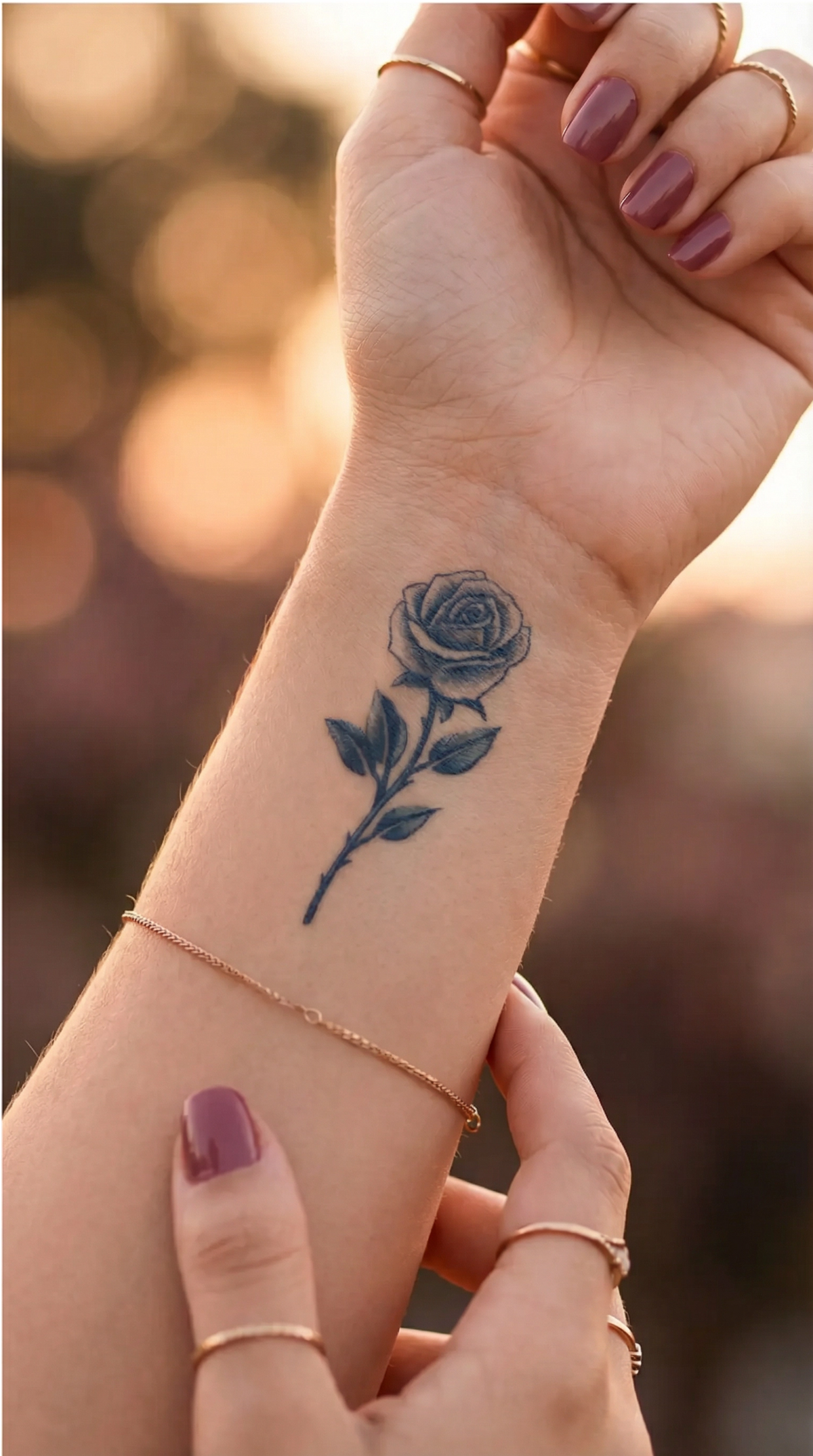
A single flower works when you want a discreet symbol that keeps its meaning for you without needing to explain it to anyone who sees it. It is also the easiest version to adapt later, since it is not tied to any specific date. A design such as this stylized Rose, the birth flower for June, is a good example of this option: a recognizable outline, with no text to date the tattoo or associate it with a particular event.
Adding a name or date makes the design more personal and easier to place in time, but it requires more space to keep the two elements balanced, and finer lines if you want to keep the design compact. The style of the design also plays a role in this choice: a fine-line drawing lends itself well to adding discreet text along the stem, while a more illustrative style, with shading and volume, generally remains more legible without accompanying text. If you are unsure between the two options, it may help to first revisit the temporary tattoo size guide, which helps you estimate how much space you will really need, depending on what you want to include.
Where to place a birth flower tattoo for a discreet look
The wrist and forearm work well for either a single flower or a small bouquet of two or three flowers, because the surface is wide enough to preserve the details without the design necessarily drawing attention at first glance. The ankle and the area behind the ear are better suited to a very small design, such as a single flower or a tiny bouquet, because there is less space available and the skin moves more in these areas.
In every case, the rule is the same: adapt the size of your composition to the chosen area rather than the other way around. A bouquet of four or five flowers designed for the forearm will lose its details if simply reduced to fit on an ankle; in that case, it is better to rework the composition itself by reducing the number of flowers or simplifying their lines, rather than shrinking it as is.
Try your composition as a temporary tattoo before making it permanent
A temporary or semi-permanent tattoo lets you see your chosen composition directly on your skin: the number of flowers, their arrangement, the size of the design, and its placement, in conditions close to what a permanent tattoo would look like when applied. It is a practical way to adjust a family bouquet before committing to it, for example by repositioning a flower that seemed well placed on paper but sits differently once it is on your wrist.
This trial gives you an idea of the design, size, and placement, but not the pain, healing, risk of an allergic reaction, or exact appearance of the same design as a permanent tattoo, since the techniques and pigments used are different. For these questions, the article on the benefits of trying a tattoo before it becomes permanent explains what a temporary trial can and cannot tell you, and the guide to choosing your first tattoo adds to this discussion if a birth flower is your first idea for a lasting design.
Once you have chosen the flower or flowers for each person in the bouquet, creating a temporary version of the design lets you adjust the size, spacing, and placement before making any final decision. You can find more floral designs in the floral temporary tattoo collection to compare styles before settling on your own composition.