

A fleur-de-lis tattoo does not refer to just one symbol: depending on the context in which the design was adopted over the centuries, it can evoke medieval French royalty, contemporary Quebec, the values of worldwide Scouting or Louisiana’s French heritage. Before choosing this design for yourself, it is worth knowing which of these meanings you want to carry, and setting aside a common but mistaken association: the fleur-de-lis is not the historical emblem of Brittany, despite what you may sometimes read.
- The same graphic motif encompasses several distinct legacies: French royalty, Quebec, worldwide Scouting and New Orleans each adopted the fleur-de-lis at different times and for different reasons.
- The coat of arms “azure, three fleurs-de-lis or” represented the kings of France from the Middle Ages until the Revolution of 1789.
- The Fleurdelisé, Quebec’s flag, became official on January 21, 1948, and bears four fleurs-de-lis on an azure field crossed by a silver cross.
- In the World Scout Emblem, the fleur-de-lis serves as a symbolic guide: its three petals refer to the three parts of the Scout Promise.
- The traditional emblem of Brittany remains the ermine, seen on the Gwenn ha Du flag; the fleur-de-lis is not historically associated with it.
What does the fleur-de-lis represent in heraldry?
In heraldry, the fleur-de-lis refers to a stylized figure that does not correspond to any specific botanical flower: with three points connected by a central band, it distills the appearance of a lily or iris as medieval artisans depicted it on coats of arms. This graphic figure, rather than an actual plant, was later adopted by French royalty and then by other institutions that inherited it directly or indirectly.
In medieval Christian iconography, this motif was associated with purity and, more specifically, the Immaculate Conception, which partly explains why the kings of France adopted it as a symbol of religious as well as political legitimacy (Fleur-de-lis, Wikipedia). The exact botanical origin of the design remains debated among historians: some see it as a stylized lily, while others see it as a marsh iris, a plant found abundantly along certain waterways associated with the early Frankish kings. Neither hypothesis has been definitively settled, so it is better to present it as an open question than as an established fact.
The fleur-de-lis, symbol of French royalty
The coat of arms of the kings of France
The meaning most often sought in this motif is its use as an emblem of the French monarchy. The coat of arms “azure, three fleurs-de-lis or” represented the kings of France from the Middle Ages until the Revolution of 1789, before being briefly revived in the 19th century during the monarchist restorations (Fleur-de-lis, Wikipedia). This use dates back several centuries before the monarchy reached its height: Philip Augustus received the fleur-de-lis banner at his coronation in 1179, an episode that shows just how firmly the motif was already rooted in the visual identity of French royalty, long before other institutions adopted it in turn (History of the Quebec flag, Government of Quebec).
Wearing this motif in this specific sense evokes a dated historical legacy—the French monarchy of the Ancien Régime—rather than taking a position on current French politics. Shown without a full coat of arms or flag, it works as a subtle reference to that period rather than as a symbol of allegiance.
The Fleurdelisé: the fleur-de-lis on the Quebec flag
Quebec developed its own use of the motif, rooted in this French heritage but now a national symbol in its own right. Jacques Cartier was already using the fleur-de-lis as an emblem when he arrived in the Americas, placing the motif in the region’s history several centuries before it became an official symbol. The resulting flag, the Fleurdelisé, became Quebec’s official flag on January 21, 1948, replacing the Union Jack atop the central tower of the Parliament Building; its official coat of arms is described as “azure, a silver cross cantoned with four fleurs-de-lis of the same” (History of the Quebec flag, Government of Quebec).
For a reader with a personal attachment to Quebec rather than to French royalty itself, this specific context is worth knowing: there, the motif functions as a symbol of contemporary national identity, built on French heritage but now distinct from it in its present-day meaning.
Why worldwide Scouting uses the fleur-de-lis
Worldwide Scouting adopted this same motif for a use unrelated to royalty or national identity. The emblem dates back to 1907, when Baden-Powell handed out copper fleur-de-lis badges to participants in his experimental camp on Brownsea Island, after a similar brass badge had already been given to scouts in the British Army in India as early as 1897 (World Scout Emblem, Wikipedia). In this emblem, the fleur-de-lis acts as a compass: it points north and, by extension, symbolically guides Scouts toward service.
According to the World Organization of the Scout Movement, the motif’s three petals refer to the three parts of the Scout Promise: duty to God, service to others and respect for the Scout Law (Our emblem – what does it mean?, WOSM). This reference to duty to God is part of the emblem’s official description, without implying that wearing the motif means adopting a religious position: the five-pointed stars alongside it represent truth and knowledge, and the link surrounding the whole symbolizes the unity of the Scout family around the world.
The fleur-de-lis in Louisiana and New Orleans
A third context, often confused with the two previous ones, is Louisiana and, more specifically, New Orleans. The city’s official flag, adopted in January 1918, bears three golden fleurs-de-lis on a white field (Flag of New Orleans, Wikipedia). This choice marks the city’s heritage and historical ties to France, alongside other visual references to its Spanish heritage found elsewhere in its visual identity.
This North American regional meaning remains distinct from the French royal and Scout uses: here, it is a marker of belonging to a particular city and culture, built on the historical French presence in Louisiana rather than on a direct connection to the monarchy or an international organization.
Fleur-de-lis and Brittany: a common confusion to avoid
A common confusion is to associate the fleur-de-lis with Brittany. Historically, however, this link is unfounded. The region’s traditional emblem is the ermine, which appears on the Gwenn ha Du flag as black ermine spots arranged on nine horizontal black and white stripes (Flag of Brittany, Wikipedia). The fleur-de-lis remains associated with the kingdom of France as a whole and the institutions that inherited it, not with any particular region of France.
So if your intention is to wear a symbol specifically associated with Brittany, the fleur-de-lis does not meet that goal: the ermine, or other verified regional motifs, are a better fit for that specific identity.
What meaning, style and placement should you choose for your tattoo?
Once you have made these distinctions, the choice comes down to a practical question: what intention do you want to express, and with what level of detail? A reader who wants to evoke French heritage in general, an attachment to Quebec, Scout values or Louisiana roots does not necessarily need the same graphic treatment. A fine-line version, reduced to the motif’s three essential points, suits a discreet intention and a placement that is not very visible day to day, such as the inner wrist or the nape of the neck. An ornamental version, with more detailed filigree around the fleur-de-lis, is better suited to an intention you want to show, on the forearm or shoulder blade, for example, where the available space highlights the detailed work.
Choose the placement according to this same logic of visibility rather than at random. A discreet motif on the wrist or ankle is easy to cover if needed; a larger motif on the forearm or upper back means being comfortable with its everyday visibility. To explore these considerations further, the guide to choosing a design and placement for your first tattoo explores this decision beyond the fleur-de-lis motif alone, and the Minimalist tattoo collection brings together other fine-line designs if this style appeals to you more.
Try out the design before committing
Once you have chosen the meaning and style, there is one practical check: see how the design actually looks at this size and in this placement before committing further. A temporary or semi-permanent tattoo lets you compare the size, orientation and level of detail of a fleur-de-lis directly on your skin, whether minimalist or ornamental, before choosing a more visible or larger placement. The comparison of temporary and permanent tattoos explores the uses of this intermediate step in greater detail, particularly when deciding on a permanent placement with all the information you need.
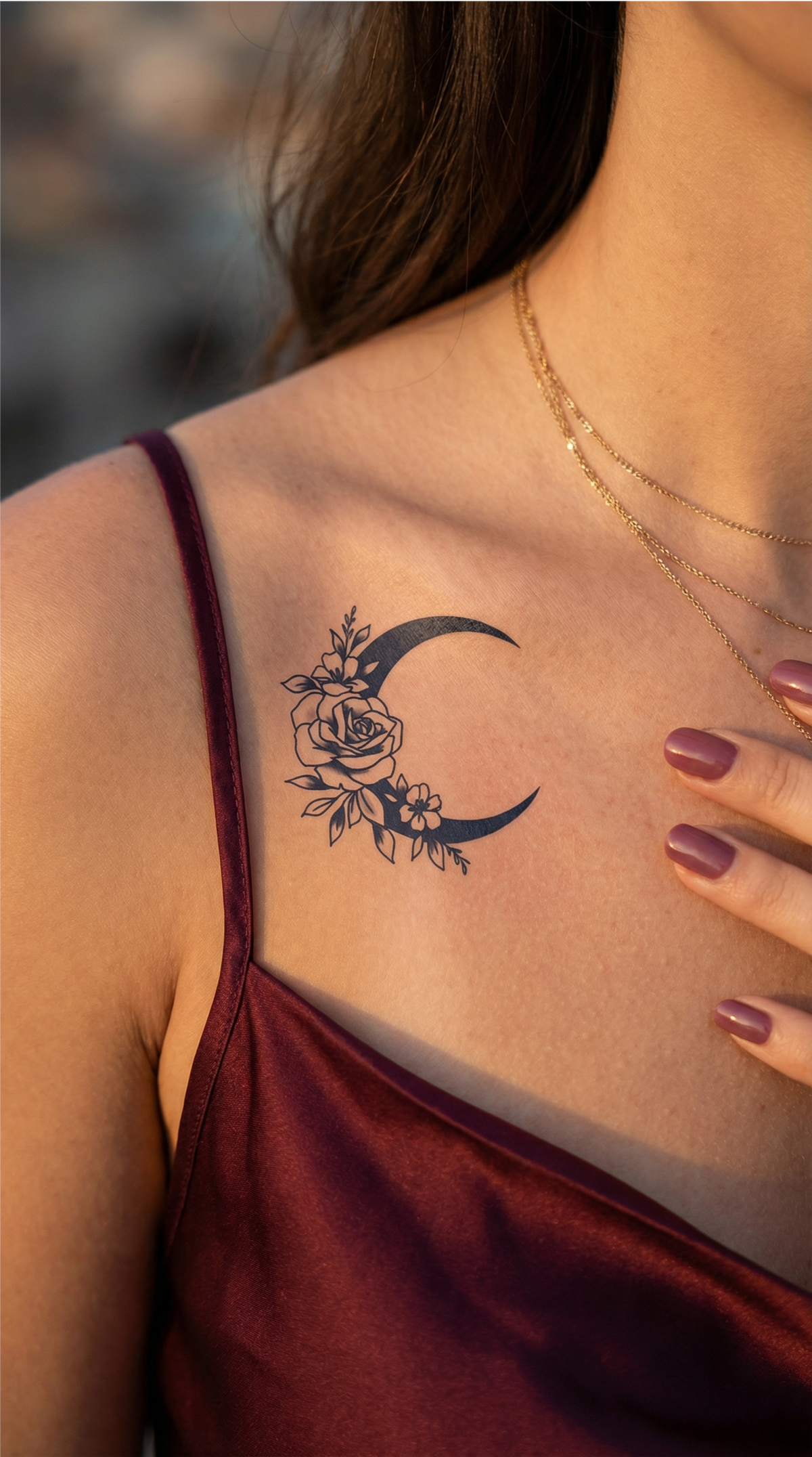
The InkLabs catalog does not offer a heraldic fleur-de-lis design as such, but the illustrative floral bouquet in the range lets you try a floral look on your skin, under the same application and wear conditions, before deciding on the final style of your design.

If you are exploring other floral meanings for your next tattoo, the Flowers collection brings together all the available floral designs, while upcoming guides to peony tattoos and birth flowers explore other specific floral symbolism for an intention that is more personal than heraldic. For decorative floral designs in general, unrelated to any particular historical emblem, the article about flower tattoos covers this broader approach.