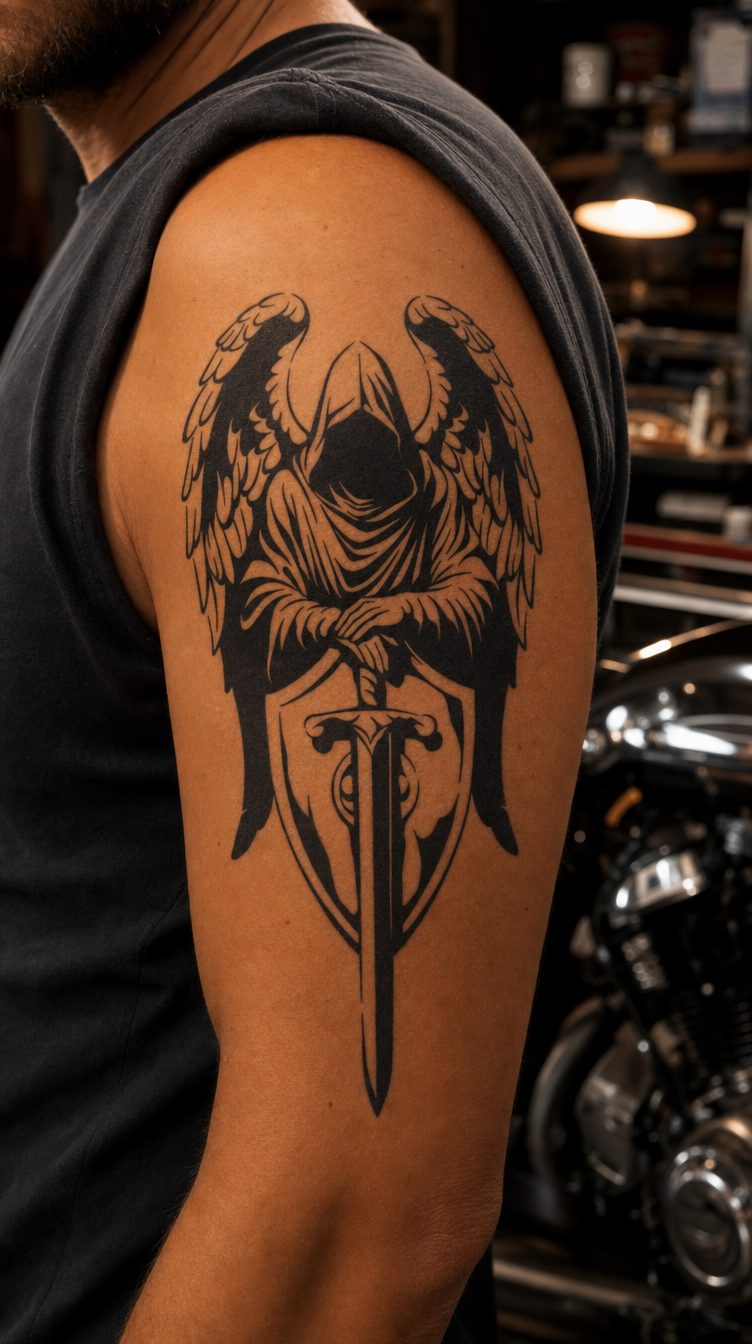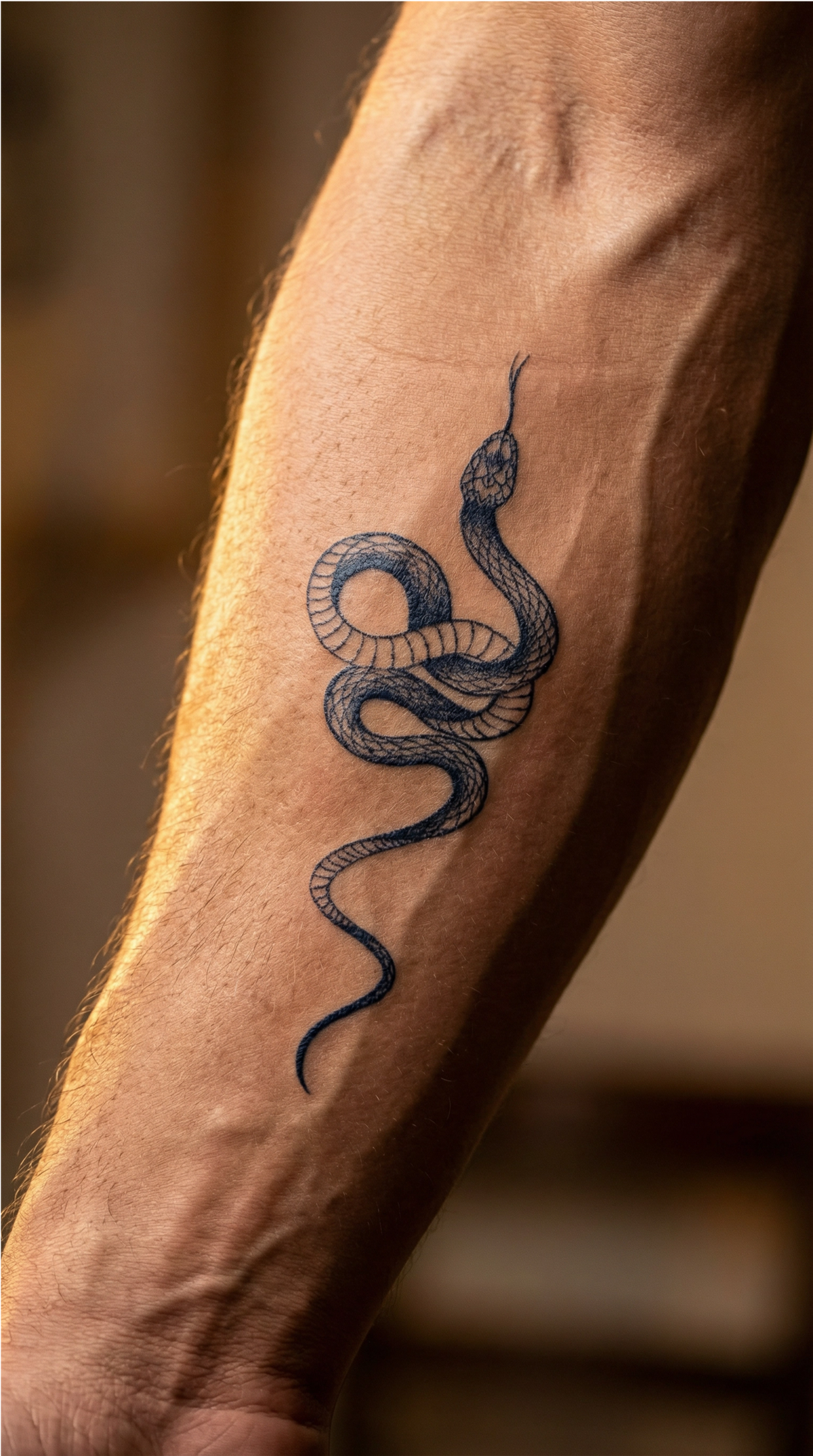


An Archangel Michael tattoo is usually sought by someone who wants a visible symbol of protection and faith, but does not want to choose a religious image at random without understanding what each element in it represents. In the Orthodox tradition, Michael is known as the Commander-in-Chief, or great leader of the heavenly hosts, and a tattoo inspired by his iconography carries an entire structure of symbols—the sword, the wings, the garments, the way he is depicted—each with a meaning worth knowing before you choose a design.
- The sword, wings, and red garments in traditional depictions of Michael each have a distinct meaning; they are not merely decorative details chosen for effect.
- Orthodox and Western iconography emphasize different scenes, which changes what a design recognizable as following the Orthodox tradition conveys.
- Saint George is often sought alongside Michael, but the two have their own iconography, with the dragon as a shared element and a specific meaning in each story.
- A temporary or semi-permanent option shows the actual size and placement on your skin before a permanent decision, without replacing reflection on how you want to wear such a symbol.
Who Is Archangel Michael and Why Is He Chosen as a Symbol of Protection?
The name Michael is often translated as “Who is like God?”, a rhetorical question through which the archangel rejects any attempt to compare himself with the divine. In the Orthodox tradition, he is called the Commander-in-Chief or Great Leader, the leader of the heavenly powers, and is invoked as a protector of the faithful and a defender against evil (OrthodoxWiki, on Archangel Michael). For someone who wants a tattoo as a form of personal protection, this role as leader in the spiritual battle explains why his figure is so prominent in religious art and, for the same reason, in tattoos inspired by it.
The search for such a symbol usually comes from a specific need: someone is going through a difficult time, remembers a moment of faith, or simply wants a personal sign of protection that they can see every day. A tattoo of Michael does not replace that faith, but gives it a visual form that you can wear and recognize immediately.
How Archangel Michael Is Depicted in Orthodox Iconography
For centuries, Orthodox iconography has established a fairly consistent set of elements for Michael. He holds a sword in his right hand—described by many Christian sources as a “sword of fire,” a symbol of divine justice and the fight against injustice, not an ordinary weapon of war (CrestinOrtodox.ro, on Saints Michael and Gabriel the Archangels). A shield, spear, or white banner often appears in his other hand, and his garments are usually red. The classic image also shows him standing with his feet on the devil, depicted as a dragon or a dark figure, to mark his victory over evil (OrthodoxWiki, on Archangel Michael).
What Each Element Means When Choosing a Tattoo Design
The wings signify his heavenly nature and role as a messenger; the sword speaks of justice, not gratuitous violence; and his victorious stance over evil is why many choose this particular moment in the scene rather than a static depiction. If you want a design focused on the stance of a heavenly warrior, with a visible weapon and outspread wings, a thematically similar option is the The Protector design, which depicts a warrior angel with a weapon at the ready, built around the same idea of active, rather than passive, divine protection.

For those who prefer the emphasis to be on outspread wings and the attire of a heavenly warrior, without the sword in the foreground, the “Serafim” design from the same range of illustrative designs offers a complementary option, also built around the motif of the seraphic knight.
Differences from the Catholic Depiction of Archangel Michael
Beyond their shared elements, Byzantine Orthodox and Western art develop different scenes for the same figure. Byzantine Orthodox iconography often shows Michael in imperial court attire, holding a set of scales as a symbol of his role as judge at the Last Judgment; Western art, by contrast, more often develops the dynamic scene of direct combat with the dragon or Satan, in armor similar to medieval armor (Wikipedia, Archangel Michael in Christian art). The difference matters to anyone who wants a design recognizable as Orthodox: the scene with the scales and Byzantine regalia differs from the more cinematic Western version of the armored warrior.
For readers drawn to the dynamic composition of battle, with a long sword and an emphasis on the confrontation between light and darkness, the Sacrifice design depicts exactly this kind of scene—an angel armed with a long sword, built around the theme of spiritual protection and inner struggle, and closer to the Western tradition than to Byzantine regalia.

Saint George: A Related Protector Often Sought Alongside Archangel Michael
Saint George often comes up in the same discussion because the two are regarded as closely related protectors, even though their stories are distinct. His iconography shows him as a beardless young man in military garments and a red cloak—the color of martyrdom—riding a white horse and piercing with his spear a dragon that symbolizes evil. The scene originates in the legend of the rescue of the city of Silena, where George confronts the dragon that was terrorizing the city (CrestinOrtodox.ro, on the iconography of Saint George).
Although the dragon also appears in scenes with Michael, its meaning differs: for Michael, the dragon represents the devil, defeated through a spiritual and heavenly victory, while George’s scene has its roots in a narrative legend connected to the rescue of a specific community. Anyone looking for a broader angelic theme, not just Michael, can find additional context in the article about the Last Supper tattoo, which explores another religious scene frequently requested at InkLabs.
What to Avoid When Wearing a Religious Tattoo Respectfully
Many Christian voices recommend careful reflection before getting any tattoo, including a religious one. Commentaries often cite the prohibition in Leviticus 19:28 on marks made on the body, along with principles about modesty and the body as the “temple of the Holy Spirit” (Semnele Timpului, on tattoos and the Bible). There is no single doctrinal position that can officially be attributed to one denomination, so the most useful approach is to consider these arguments as a point for reflection, not as a universal prohibition, and to decide based on your own relationship with faith.
Beyond the question of whether to get tattooed, respect for the chosen figure is reflected in concrete details. Keep the traditional proportions and elements—the sword, wings, colors—instead of fanciful reinterpretations that turn the figure into a simple decorative character. Avoid combining Michael or George with elements that have no thematic connection or with ironic tones, because that strips the image of the meaning for which it was chosen. And, importantly, present it as a personal symbol of faith or remembrance, not as an object with literal spiritual power—a tattoo, however faithful to the iconography, remains a depiction, not a talisman.
Placement and How to See the Design on Your Own Skin Before Deciding
A design with outstretched wings or a vertical sword works well on the forearm, shoulder blade, or chest, areas with enough surface for the details—the feathers, the sword blade, the folds of the garment—to remain clear. The choice of placement also depends on how visible you want the tattoo to be in everyday life: the forearm remains visible in most situations, while the chest or shoulder blade gives you more control over when you show it.
Testing it on your skin with a temporary or semi-permanent design shows you exactly how the design looks at its actual size on your body, something no catalog image can replace. Important to remember: the test shows size and placement, not the pain, healing, or exact appearance of a permanent tattoo, because the ink, skin, and application process are completely different in the two cases. The guide on how to choose the right design and placement for your first tattoo explains this decision-making process in detail, while the instructions in how to apply a temporary tattoo at home help you test it properly, step by step. If you want the design to remain visible for longer so you can truly evaluate it in everyday life, the semi-permanent option described in the guide to InkLabs semi-permanent tattoos offers a longer trial period than a regular temporary design.
For anyone who wants to explore more options before choosing, the Temporary Angel Tattoos collection brings together designs featuring wings and angelic figures, useful as a point of comparison before deciding on the final design. And for a broader look at Christian symbols as tattoo themes, beyond Michael and George, the article about temporary cross tattoos and religious symbols is the right place to start.
An Archangel Michael tattoo can be both a symbol of faith that is true to tradition and a well-researched aesthetic choice, if you know what each element of the composition represents and carefully choose how to wear it. Testing it on your skin with a temporary or semi-permanent design gives you the time you need to check the size, placement, and how it feels to wear such a symbol every day, before taking the step toward a permanent tattoo.