

The Last Supper tattoo depicts one of the best-known scenes in the New Testament: Jesus’s final meal with the twelve apostles, when he instituted the Eucharist and foretold Judas’s betrayal. Most designs on skin do not recreate the biblical scene from imagination, but follow the composition standardized by Leonardo da Vinci, with all thirteen figures seated on one side of the table. It is precisely this elaborate composition that raises the practical question behind the search: how much space does a scene like this need to remain legible on the back or another area of the body, and what simpler options are there for someone who wants the same symbol in a smaller composition.
- The scene comes from Jesus’s final meal with the apostles, focusing on the institution of the Eucharist and the foretelling of Judas’s betrayal.
- Most designs follow Leonardo da Vinci’s composition, rather than other biblical depictions of the same episode.
- A scene with thirteen figures needs a generous area; more limited versions or a representative symbol require much less space.
- A large temporary design shows concretely how much space the scene takes up, but does not simulate the pain, healing, or exact long-term appearance of a permanent tattoo.
What does a Last Supper tattoo mean?
The Last Supper was Jesus’s final meal with the twelve apostles, during Passover, shortly before the crucifixion (source: Last Supper, Wikipedia). During this meal, Jesus blesses the bread and wine and gives them to his disciples, an act that Christianity continues to repeat through the Eucharist. He also announces that one of those present will betray him, which explains why many depictions of the scene include tension between the apostles, rather than simply showing a calm shared meal.
For someone choosing this tattoo, its meaning usually has two layers: the institution of the Eucharist, as an act of connection and continuity, and the foretelling of betrayal, as a dramatic element that gives the scene visual weight. Some people keep both ideas in a complete composition, while others prefer to focus only on the gesture involving the bread and wine, leaving the tension of the betrayal in the background. Neither option is “more correct” than the other; the choice depends on what each person wants to convey through the image and the personal story they connect with it.
Why most designs are inspired by Leonardo da Vinci’s painting
When someone searches for “Last Supper tattoo,” almost all the visual results follow the same reference: the mural painted by Leonardo da Vinci between 1495 and 1498 for the refectory of the Santa Maria delle Grazie monastery in Milan (source: The Last Supper, Leonardo da Vinci, Wikipedia). Leonardo places all thirteen figures on one side of the table, with Jesus in the center, his arms extended toward the bread and wine, and the apostles arranged in groups of three, each group reacting differently to the news of the betrayal. This symmetry is why the scene is instantly recognizable, regardless of the style in which it is redrawn on skin.
One detail tattoo artists often preserve is the way Judas is visually integrated into the group, rather than isolated in a corner: he is identified by his posture, the shadow on his face, and the gesture of knocking over the salt cellar, not by a position separate from the other apostles. This integration is one reason the scene works as a single unified composition on skin, rather than looking like thirteen portraits placed side by side. Anyone who wants a tattoo faithful to this visual reference should discuss with their tattoo artist exactly which details of posture, grouping, and shadow are essential to keeping the scene recognizable at smaller sizes, and which can be simplified without disrupting the balance of the composition.
Styling options: from the complete scene to a representative symbol
A scene with thirteen figures requires clear lines and enough contrast between the characters; otherwise, the details blur together, especially on smaller areas of the body. That is why tattoo artists generally work with the complete scene, including all the figures, only on larger areas, where each character has room to remain distinct. For someone who wants the same idea on a smaller area, there are more limited options: a few central figures around Jesus, just the hands gathered above the table, or a single symbolic detail, such as the chalice, which sums up the gesture of the Eucharist without recreating the entire scene.
A completely different alternative is to leave out the scene and keep only a symbol of faith, such as a fine-line cross.

For more ideas in this direction, the guide to temporary cross tattoos and other religious symbols presents other symbolic options suited to a small area or to someone just beginning to explore a religious tattoo.
Execution challenges: how much space a scene with several figures needs
A composition with thirteen faces, hands, and garments needs a generous area so that each element remains distinct, especially if you want to recognize each apostle’s expression and gesture, not just the group’s silhouette. On a small area, the tattoo artist has to either reduce the details until they become hard to distinguish or leave out some figures, changing the balance of the original composition and potentially altering the meaning of the scene itself.
With a permanent tattoo, there is also the question of how a crowded scene looks over time: in the long term, pigment gradually migrates deeper into the dermis, and very fine lines lose some of their clarity (source: Tattoo, Wikipedia). In a scene with many figures, this affects the outlines of faces and fingers in particular—the very areas with the most small details. For this reason, broad areas such as the back or thigh are often chosen for complex scenes: they provide not only the space needed at first, but also some extra room for the gradual softening of the lines over the years. If you are hesitating between a complete scene and a smaller version, the guide to choosing the right tattoo size details the real differences between small, medium, and full-body designs.
How to test the size and placement before deciding
Before committing to a permanent scene with thirteen figures, a larger temporary design shows concretely how much space an elaborate composition takes up on an area such as the back.

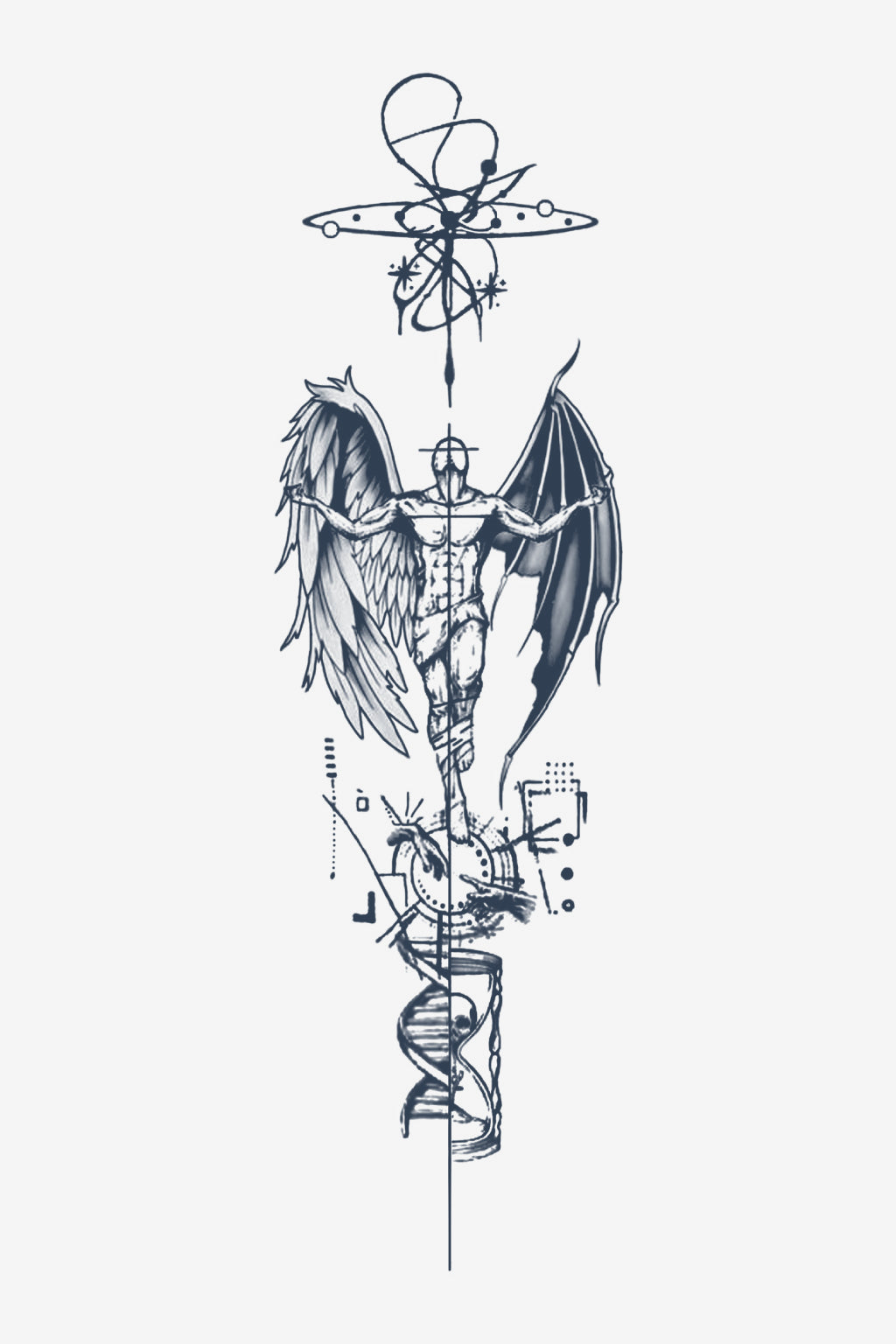
For example, a design such as “Divine Duality,” measuring 11 x 18 cm, lasts up to 15 days depending on activity, placement, and skin hydration, and its color darkens from light blue to blue-black during the first 24 hours after application. By checking these specifications before applying it, you know exactly what to expect while wearing the design, with no surprises about how long it lasts or how its color develops.
You can check the proportions and placement directly on your skin: apply the design exactly where you would want the permanent scene and observe how it looks over a few days from different angles, while moving and under your clothes. The test is especially useful if you are hesitating between the back and a smaller area, such as the forearm, where the scene would need to be significantly simplified to remain legible. If, at the end of the test, you decide you want a composition with elements specially adapted for you, the guide to custom temporary tattoos explains what options are actually available for a design tailored to your own requirements.
One important thing to remember: testing shows only the design, size, and placement. A temporary or semi-permanent tattoo does not simulate the pain, healing, risk of allergy, or exact long-term appearance of a permanent tattoo, and if you have never worn a large design before, the guide your first tattoo: how to choose the right design and placement helps you work through the decision step by step.
Respect for religious symbolism
Beyond its aesthetic value, the Last Supper scene has genuine spiritual significance for many people, and choosing to wear this tattoo deserves the same consideration you would give any symbol of faith that is important to you. The decision to keep or simplify certain details, such as the presence of Judas, is not just about visual composition, but also about what you want to say with the design: some people prefer the complete scene, including the tension of the betrayal, while others choose to keep only the gesture involving the bread and wine, leaving out that particular detail.
If you are interested in other symbols of faith or protection treated with the same care, also look out for the guide to the Archangel Michael tattoo, which discusses another religious motif frequently requested within the same theme.
Whether you choose the complete scene, a more limited version, or just a representative symbol, the useful step before making any permanent decision remains the same: test the size and placement on your own skin. The Temporary Religious Tattoos collection brings together several designs on the same theme, useful if you want to compare an elaborate scene with a smaller symbolic option before deciding what to make permanent.