

The “witch’s knot” seen in tattoo photos is usually a single continuous line interlaced into a loop, with no visible beginning or end, and the name refers to a documented tradition of knot magic and ritual cords, not to a unique pictorial symbol with its own historical record, as the Celtic triquetra and Norse valknut do. The interpretations of protection or an eternal bond that circulate alongside this design today are modern extensions of that broader idea, and it is worth clearly distinguishing its shape from the triquetra (three interlaced arcs) and the valknut (three interlaced triangles), which have their own archaeological record and scholarly debate.
- The documented academic term is “witches’ knots,” studied by folklorist Cyrus L. Day in 1967 as part of a broad tradition of knots with ritual meaning; there is no encyclopedia entry defining a “witch’s knot” as a specific pictorial glyph.
- The triquetra has been documented in Celtic Insular art from the 7th century onward, but its interpretation as a symbol of the Christian Trinity was proposed by George Petrie in 1845, and the scholar J. Romilly Allen expressed doubts about it in 1905.
- The valknut appears on surviving Viking Age and Anglo-Saxon objects, such as the Stora Hammars I stone, the Oseberg ship and the Nene River ring; the name “valknut” itself is a modern label.
- The three shapes are distinct: a continuous loop (witch’s knot), three interlaced arcs (triquetra) and three interlaced triangles (valknut).
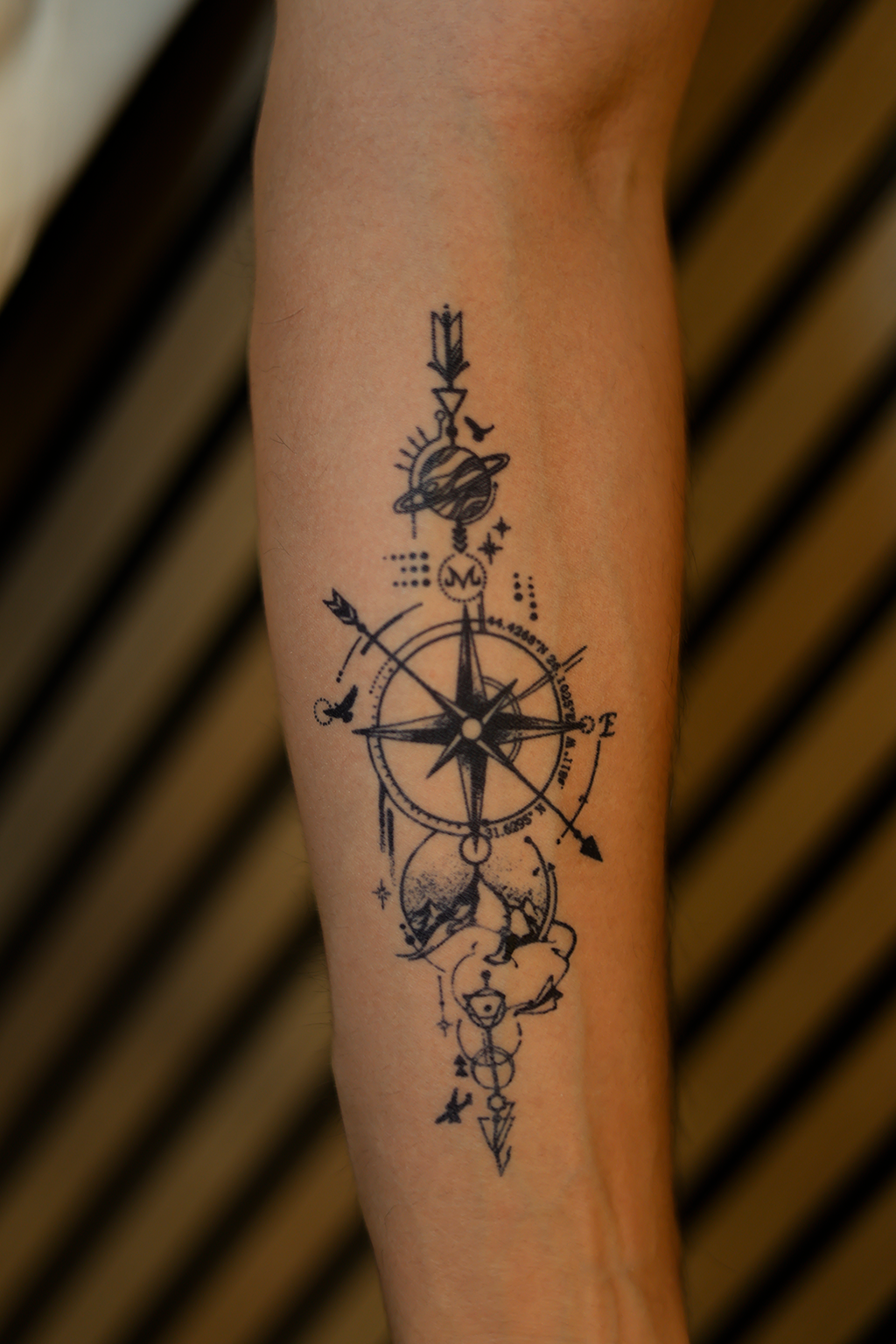
- A temporary or semi-permanent copy lets you test the design, size and placement; it does not predict the pain, healing or final appearance of a permanent tattoo.
What is the “witch’s knot,” and where does the name really come from?
In jewelry and tattoo studios, the “witch’s knot” is almost always drawn as a closed loop made from one continuous line, with no loose ends or marked starting point. That visual continuity explains much of its appeal as a small design: there is no “before” or “after” in the line, so it looks the same from every angle.
What supports the name is not a dated archaeological find, but a body of folkloric study on knots and cords used with magical or ritual intent in different cultures. The reference work is by folklorist Cyrus L. Day, who published Quipus and Witches' Knots in 1967, on how different traditions have tied cords to bind, protect or curse (source: String figure, Wikipedia, which cites Day’s work). It is a study of a practice and a category of objects, not of a specific drawing with a date of origin, and there is no encyclopedia entry devoted to a “witch’s knot” as a pictorial symbol with its own distinct shape, unlike the triquetra or valknut. The closest thing in the field of knot magic is the “witch’s ladder,” which describes cords knotted with ritual intent, not a single geometric pattern (source: “Witch’s knot” search on Wikipedia). In short, the name you see on a product listing is a popular label for an interlaced knot design, supported by a real tradition of knot magic, but not by a specific historical object that bore the design from its creation.
The Celtic Trinity knot (triquetra): what we know and why it is not the same symbol
The triquetra does have a history that can be traced through specific dates and objects. It features prominently in Celtic Insular art from around the 7th century onward, both in illuminated manuscripts such as the Book of Kells and in metalwork, and it also appears on Anglo-Saxon coins from 710–760 and in carved stone (source: Triquetra, Wikipedia).
The best-known interpretation of the triquetra, as a representation of the Christian Trinity, is not as old as the motif itself: antiquarian George Petrie proposed it in 1845, and in 1905 another scholar, J. Romilly Allen, called that interpretation into question. We know for certain what the shape is and the objects on which it appears; the exact intentions of the medieval artists who carved it are unknown. Similar forms made of three interlaced arcs already existed around the 4th century BCE on pottery from Anatolia and Persia and on Lycian coins (source: Triquetra, Wikipedia), so this geometry is ancient and recurs in several cultures: it did not originate with the Celts and does not belong exclusively to them.
How it looks different from the witch’s knot
The structural difference is easy to see: the triquetra is made from three interlaced curved arcs that form three symmetrical points, while the usual witch’s knot is a single continuous loop without that three-point symmetry.
The Viking knot (valknut): another distinct interlaced design, with its own record
The valknut adds a third geometric pattern, just as distinct from the other two. It is carved or depicted on surviving objects from the Viking Age and Anglo-Saxon period: the Stora Hammars I stone in Gotland, the Oseberg ship burial in Norway and the Nene River ring, which is Anglo-Saxon in origin and dates to around the 8th–9th centuries (source: Valknut, Wikipedia).
One detail worth keeping in mind: the name “valknut” itself is a modern label, and there is no certainty about what those who carved the motif called it. Its current interpretation is based on the context in which it appears, alongside figures associated with Odin and in funerary settings, leading scholars such as Hilda Ellis Davidson to connect it with death and Odin’s power to bind and unbind the minds of warriors. This is a reasoned interpretation based on the finds, not a definitive meaning confirmed by a contemporary written source (source: Valknut, Wikipedia). Placed side by side, the three designs are not easy to confuse if you know how they are constructed: the valknut interlaces three triangles, the triquetra interlaces three arcs and the witch’s knot is usually made as a single closed loop. Anyone looking for the vegvisir, another Norse symbol that is sometimes mistakenly mixed up with the valknut in search results, can find the broader picture of legendary symbols in our article on fantasy and mythology tattoos, and the full history of that specific design in the article dedicated to the vegvisir.
What lies behind the interpretations of protection and an eternal bond attributed to it today
The idea that a knot represents a lasting bond did not begin with the “witch’s knot”: the term “true lover’s knot” has been documented since the late 14th century and does not refer to a single design, but to several families of knots used over the centuries to represent devotion and a union that endures over time (source: True lover's knot, Wikipedia). This shows that “a knot means enduring love” is a cultural idea much broader than any specific symbol.
Something similar applies to protection. The Solomon’s knot, another real interlaced design made of two closed loops that cross twice, appears in Roman mosaics, Yoruba beads and textiles, and Islamic architecture, including mosques in Cairo and the Yattir mosaic in Jordan. Its name is associated with King Solomon’s reputation for wisdom—and, in some legends, power: an example of how a name laden with meaning becomes associated with a geometric pattern that already existed in cultures distinct from one another (source: Solomon's knot, Wikipedia). Interpreting the witch’s knot as protection or an eternal bond fits that same custom of imbuing interlaced knots with meaning, rather than a verified chain of historical transmission from a particular culture to the design you buy today; that does not make the meaning any less valid for someone who chooses it, it simply places it as a modern, shared symbolic interpretation, not a verified historical fact about an ancient glyph.
How an interlaced knot looks in a small area: finger or wrist
Whatever interpretation you prefer, there is a design question worth resolving before deciding on the final size. A fine, continuous-line interlacing, without gaps that will end up closing as the ink settles, stays legible in small areas better than an interlacing with many fine crossings and sharp points, which loses definition when reduced too much. For a finger or wrist, it is worth prioritizing designs where the line remains fully readable and the crossings do not bunch together; the design Infinite, with its fine-line interlaced loop, illustrates this principle well: a single continuous line that retains its recognizable shape even at a reduced size.

If the interpretation that interests you is the lasting bond rather than the geometric shape itself, the design Eternity 2 explores that same idea of permanence with a different fine-line composition, without implying that it is “the” historically verified witch’s knot.

Before deciding on the final size, it is worth testing the exact proportions on the intended area, whether that is the ring finger or wrist; our guides to finger tattoos and wrist tattoos go into detail about how small designs work on each of those areas. A temporary or semi-permanent copy is exactly for that: testing the design, size and placement with the actual line on your skin. It does not predict the pain or healing, nor the final appearance of the permanent version, which we discuss in more detail in our first tattoo guide.
Conclusion
The “witch’s knot” in a tattoo catalog is a design whose name is supported by a real tradition of knot magic, not an ancient glyph with its own historical record; the triquetra and valknut do have that documented history, but they are different shapes and have different stories that should not be mixed together. If you are interested in interlaced geometry beyond this design, you can read our article on geometric tattoos or explore the Geometrically designs collection to compare fine-line interlacings before trying one at actual size.