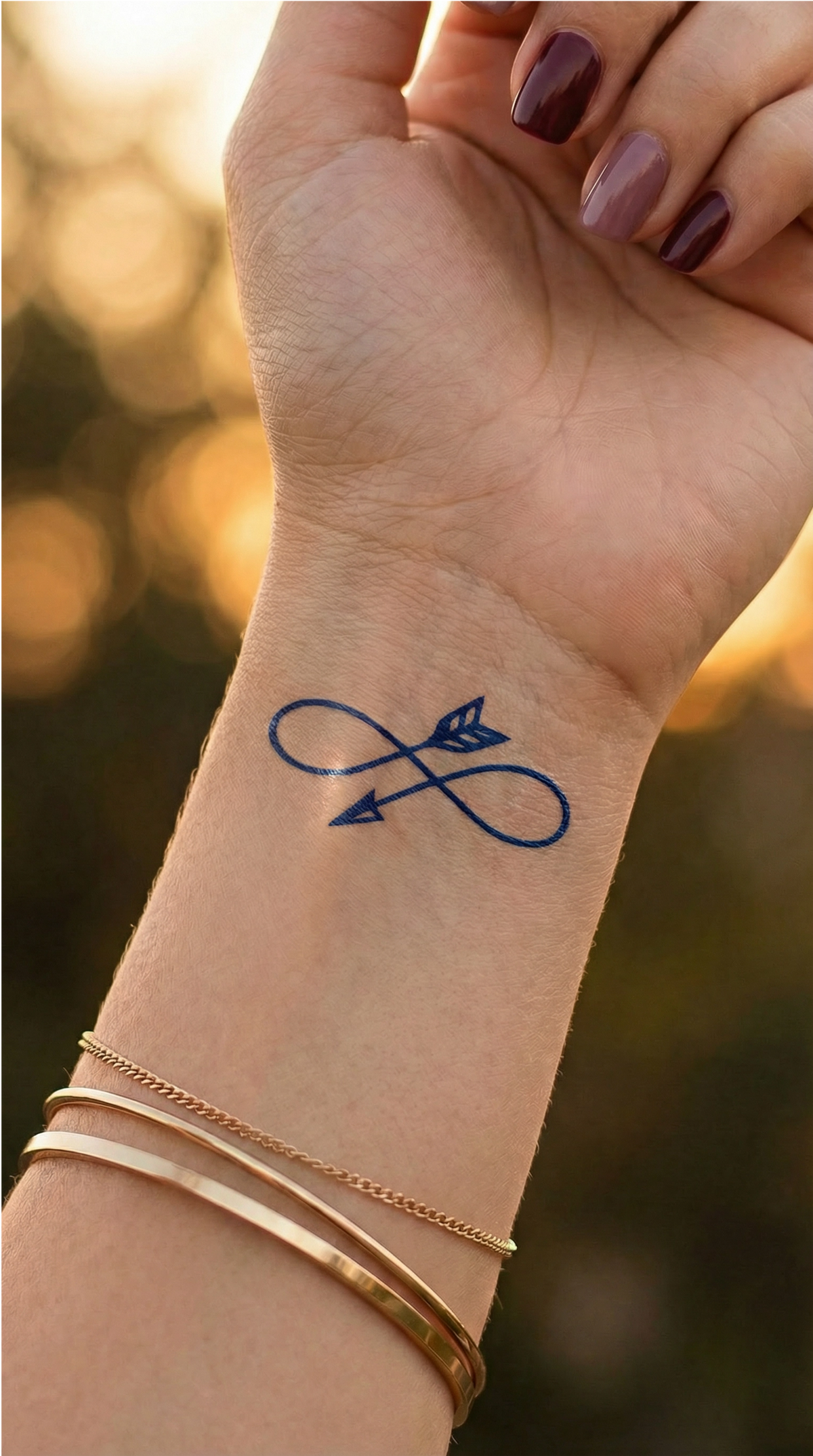


If you’ve been told that a group of tattoos “has” to be odd-numbered, what you heard is an old folk belief about lucky numbers, not a tattooing rule. No industry study or documented tattooing tradition requires an odd number: the idea circulates mostly among friends and on social media, and has become associated with tattoos simply because it’s now common to get more than one at a time. There is, however, a real reason—different from superstition—why a small odd-numbered group of designs often looks more balanced: it’s a principle of visual composition, not a rule a tattoo artist has to follow.
- The belief that odd numbers are “lucky” is a cultural superstition, not a rule in the world of tattooing.
- Its documented origins go back to rituals and ideas far older than modern tattoos.
- In other cultures, such as Chinese culture, even numbers are considered auspicious: the belief isn’t universal.
- The real reason three or five small designs often “work” better visually is a principle of composition, not luck.
- A set of two, three, or five fine-line designs is planned by starting with the theme, then the body area, and finally the layout.
Why people say tattoos should be odd-numbered
The phrase almost always comes up as informal advice, not as guidance from a tattoo studio or a recognized tattooing tradition. It often happens when someone is thinking about getting two or three small designs together and wants reassurance before deciding, and finds this unwritten rule repeated everywhere without a clear source. The reason it sounds so familiar is that odd numbers being lucky is an idea far older than modern tattoos: it belongs to a strand of Western beliefs about numbers that existed before tattooing became a common practice, and has simply been applied in recent times to an aesthetic choice such as a small set of designs.
Where the idea of lucky odd numbers really comes from
Its roots can be traced to ancient texts, not to a convention that began in the world of tattooing. In Virgil’s Eighth Eclogue, during a love spell recited by the shepherd Alphesiboeus, the phrase “God delights in odd numbers” appears in the available translation (source: The Eclogues of Virgil): one of the oldest Western references to the idea of odd numbers as pleasing or lucky, linked to a magical ritual rather than an object or decorative art.
A second thread leads to the Pythagorean tradition, where, according to Aristotle, there was a table of ten pairs of opposites that linked odd and even with other symbolic pairs such as male-female and limited-unlimited (source: Pythagoreanism, Wikipedia). This was an ancient way of assigning symbolic meaning to numbers, not proof that one number brings luck and another doesn’t: the distinction matters because it explains why the idea has survived more as a cultural notion than as a verifiable fact. If you want to follow the broader history of tattooing beyond this one belief about numbers, read our guide to the origins and history of tattoos.
It isn’t a universal rule: elsewhere, the opposite is true
If odd numbers really were a law of nature connected to luck, we would find the same belief everywhere, but we don’t. In Chinese culture, the opposite preference is widespread: even numbers are seen as auspicious. The idea that “good things come in pairs” is a common expression, and even numbers are generally preferred over odd numbers on many occasions (source: Chinese numerology, Wikipedia). This is enough to show that lucky odd numbers are one of many possible Western cultural conventions, not a principle a tattoo artist or client has to follow. You can choose two, three, or five designs based on what you want to express or the visual result you prefer, without the number itself bringing or taking away luck.
The real reason an odd-numbered group often looks more balanced
There is, however, a concrete reason why, all else being equal, a small odd-numbered group often looks more pleasing than an even-numbered one, and it has nothing to do with luck. In visual composition, as used in photography and the visual arts, an odd number of subjects in an image tends to look more natural than an even number, because it avoids the overly rigid symmetry that an even number creates almost automatically (source: Rule of odds, Wikipedia). With three elements, the eye almost always finds a center around which the other two balance; with four, the mind tends to divide them into two equal pairs, and the group can seem less cohesive as a whole. This remains a principle of composition, not an automatic guarantee: a well-arranged even-numbered group, with carefully considered sizes and spacing, can work just as well. The layout matters more than the number itself.
How to plan a set of 2, 3, or 5 small designs
Once you set the superstition aside, the practical question becomes how to make a small group of designs work, whether odd- or even-numbered. The first step is to choose a unifying thread before you even count the pieces: a consistent style, such as fine line, similar sizes, and a theme that connects them (similar subject matter, the same technique, or a shared inspiration) matter more than the exact number. If you like the fine-line style, you can get a clearer idea by reading the article about fine-line tattoos, the style best suited to small designs intended to go together.
The second step is to decide on the body area before working out the layout, because the same composition looks substantially different on a narrow wrist compared with a long forearm or the rib area. Our guide to tattoo sizes, from small to full body helps you understand how much space you really need before deciding how many designs to include in the set. The third step is to consider the space between the designs: with fine-line motifs, leaving room between them keeps thin lines from blurring together at close range, while designs placed too close together tend to read as one confusing block rather than as distinct elements.
Three designs: a triangular layout
With three motifs, the easiest layout to work with is a loose triangle: one design slightly higher or more central, and the other two to the sides, not perfectly aligned along the same horizontal line. This naturally follows the visual principle explained above, giving the eye a central reference point without the need for precise measurements.
Five designs: a semicircle or cascading layout
With five motifs, a gentle curve—forming a semicircle along the wrist or forearm—or a cascade following the arm’s natural line downward tends to work better than a straight, rigid row. In either case, it’s best to start with the largest or most meaningful design, place it first, and build the others around it rather than lining them all up at the same height.
Try the layout before making a permanent decision

Whatever number you choose, the most reliable way to know whether a composition really works is to see it on your skin, in the body area you have in mind, before making any permanent decision. A design on paper or on a screen doesn’t show how the curve of your wrist, the length of your forearm, or the skin’s natural movement changes how the layout looks; a temporary or semi-permanent tattoo applied exactly where you’re thinking of placing it shows you straight away, and you can move it, try it again, or compare two different layouts without any permanent commitment. The same applies if you first want to understand how to choose the right design and where to place it: our guide on how to choose the right design and placement for your first tattoo covers this part of the decision in more depth.
To find other small, fine-line designs to combine in your set, you can browse the Small Temporary Tattoos collection, where you’ll find different styles and subjects to pair based on the theme you’ve chosen. The goal is always the same, whatever the number: to see how the designs really look together on your body, not to follow a superstition about numbers.