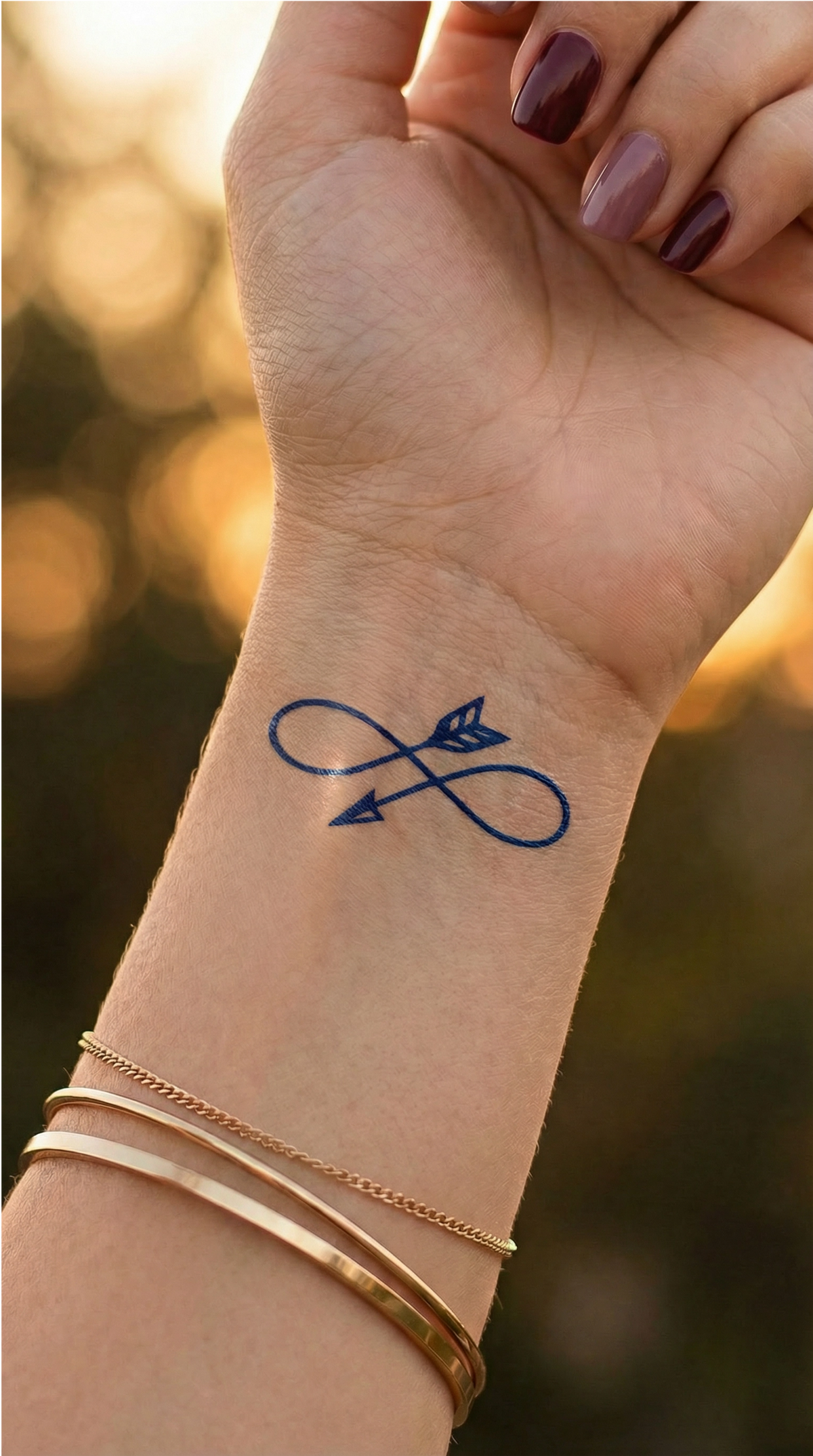


The earliest known tattoos date back more than 5,000 years: the glacier mummy Ötzi already had a total of 61 tattoos around 3230 BC, and Egyptian mummies from Gebelein show skin markings that, according to current research, may even be somewhat older. Both finds come from different parts of the world, with no apparent contact between them, suggesting that people developed tattooing independently in several early cultures rather than spreading it from a single point of origin. Following the timeline from the oldest finds to designs you can try out today with no commitment gives you a clearer picture of how long people have communicated through images on their skin, both permanently and temporarily.
In brief:
- The oldest clearly dated tattoo comes from the glacier mummy Ötzi, around 3230 BC; however, the Egyptian Gebelein mummies may bear even older figurative designs dating to around 3400 BC.
- The word “tattoo” comes from the Polynesian “tatau” and only entered European languages in the 18th century, through Captain Cook’s voyages across the Pacific.
- Among the Māori, Tā Moko remains closely connected to ancestry and social status and follows its own techniques and symbolism, which differ significantly from other tattooing traditions.
- Temporary body art such as henna is demonstrably just as old as permanent tattoos and has accompanied celebrations and life events for thousands of years.
The oldest known tattoo: Ötzi, the ice mummy from Hauslabjoch
When the approximately 5,300-year-old glacier mummy Ötzi was discovered in the Ötztal Alps in 1991, an unusually extensive pattern was revealed on his skin: a total of 61 tattoos, dated to around 3230 BC (source: Ötzi – Wikipedia). Contrary to what you might expect of body art, the markings are not in highly visible places, but are mostly on the legs, on either side of the lower spine, as well as in the form of a cross-shaped mark behind the right knee and on the right ankle.
They were probably made by puncturing the skin with a bone point or copper awl, allowing soot-based pigment from the hearth to enter the skin. The location of the marks is particularly revealing: many coincide with parts of Ötzi’s body where he had age-related or stress-related joint wear. This gave rise to the theory that the tattoos may have served to relieve pain, like an early form of acupuncture or acupressure, rather than being purely decorative. This is a scientific interpretation based on the location of the finds, not an established fact; there is still no definitive answer as to why these exact spots were chosen.
Even older? The Gebelein mummies and the earliest figurative tattoos
Although Ötzi is the best-studied early find, he is not necessarily the oldest. Two pre-dynastic Egyptian mummies from Gebelein, listed in the British Museum under the numbers EA 32751 and EA 32752, bear tattoos dated to around 3400 BC (source: Gebelein predynastic mummies – Wikipedia), possibly several centuries before Ötzi’s markings. The designs only became visible after infrared images, published in the Journal of Archaeological Science in 2018, revealed figurative patterns on the skin, which had darkened over time. According to current research, they are among the earliest known figurative—rather than purely linear—tattoos preserved on human skin; if older finds are described in the future, this classification would change.
Together, Ötzi and the Gebelein finds illustrate something that applies to the entire history of tattooing: traces of tattoos have been found on mummified remains from many parts of the world, from Egypt and parts of Asia to Indigenous American cultures (source: Tattoo – Wikipedia). This suggests that the practice arose independently in multiple places, rather than spreading around the world from a single point of origin.
Where the word “tattoo” comes from: from “tatau” to Captain Cook
As ancient as the practice is, the word we use for it today is comparatively recent. “Tattoo” traces back to the Samoan or Polynesian “tatau,” meaning something like “to strike” or “to tap in,” which originally described the traditional technique used to work pigment into the skin (source: Tattoo – Wikipedia). The term only entered Western languages from 1768 onward, through Captain James Cook’s voyages across the Pacific: crew members, including the botanist Joseph Banks, returned to England with both the word and tattoos of their own.
This means that the term used around the world today is a comparatively recent borrowing from the 18th century, while the practice itself, as the previous sections show, is thousands of years older. If you have wondered why tattoos remained a marginal phenomenon in Europe for a long time, this time gap between the practice and the word offers at least part of the explanation.
More than decoration: Tā Moko and the meaning of tattoos among the Māori
Tā Moko, the traditional tattoo art of the Māori in Aotearoa New Zealand, shows just how much the meaning of tattoos can vary from one culture to another. Tā Moko is closely connected to mana, meaning prestige and spiritual status, as well as to a person’s genealogy; receiving moko traditionally marked the transition from childhood to adulthood and was accompanied by its own rituals (source: Tā moko – Wikipedia). Technically, Tā Moko differs significantly from the other tattooing traditions described in this article: the skin was not punctured, but actually carved with uhi, chisels made from materials including albatross bone, giving it a grooved rather than smooth surface.
Traditionally, placement also followed clear rules based on gender: men usually wore moko on their faces, buttocks and thighs, while women wore it mainly on their lips and chins. Tā Moko is an example of how tattoos in some cultures make identity, ancestry and social status visible rather than serving as mere decoration—a context that deserves respect and should not be reduced to an interchangeable pattern. If you are also interested in the religious side of tattoos, for example in Islam, you can find a separate discussion in our article on how Islamic scholars view tattoos.
Always temporary, too: henna and other forms of temporary body art
Tattoos are not the only way people have been putting images on their skin for thousands of years. Henna has been used since antiquity in Egypt, the Middle East and the Indian subcontinent to temporarily color skin, hair and nails; wall paintings from around 1680 BC already show hands colored in this way (source: Henna – Wikipedia). To this day, henna traditionally accompanies major life events such as weddings, as well as holidays such as Eid and Diwali.
Unlike a tattoo, henna fades away on its own: the color normally fades within one to three weeks as the skin naturally renews itself. This points to something important about the history of body art as a whole: people have always chosen between permanent and temporary body art depending on the occasion—not an either-or choice that only emerged with modern products. If you would like to compare henna and modern temporary tattoos directly, our comparison of temporary tattoos and henna explains the differences in detail.
From ritual to trying it out: temporary tattoos and semi-permanent designs today
The long history of body painting, henna and permanent tattoos shows one thing above all: historically, there has always been a middle ground between “nothing” and “forever.” Today’s temporary tattoos and semi-permanent designs occupy exactly that middle ground, but with a clearly defined purpose: they let you see how a design, size or placement looks on your own skin before you even have to make a decision. We explain in detail what technically distinguishes semi-permanent tattoos from classic temporary tattoos in our guide to semi-permanent tattoos.
It is important to recognize the limit that history itself makes clear: a temporary or semi-permanent design only shows the motif, size and placement. It does not tell you how a permanent tattoo feels, how it heals or exactly what it will look like years later; that would require a real, permanent tattoo. If, like people thousands of years ago, you are interested in a symbol with personal meaning, the current collection includes, for example, a protective and faith motif or a compass as examples of how you can try out meaningful imagery today with no commitment.


For anyone thinking about getting their first permanent tattoo after this journey through history, it is worth taking a look beforehand at our guide to your first tattoo, which can help you choose a design and placement. And if you find yourself wondering, while putting together a whole set, why some people swear by an odd number of designs, you can find out more in our article on the superstition around odd tattoo numbers.
Conclusion: a line from Ötzi to the temporary tattoo
From Ötzi’s 61 markings and the figurative designs on the Gebelein mummies to the Polynesian origins of the word, Tā Moko and henna, one continuous thread runs through it all: for more than 5,000 years, people have used their skin to make meaning, belonging or an important moment in life visible, both permanently and temporarily. The option today to try out a design with no commitment in the Temporary Tattoos collection is therefore not a break with this history, but its latest chapter.