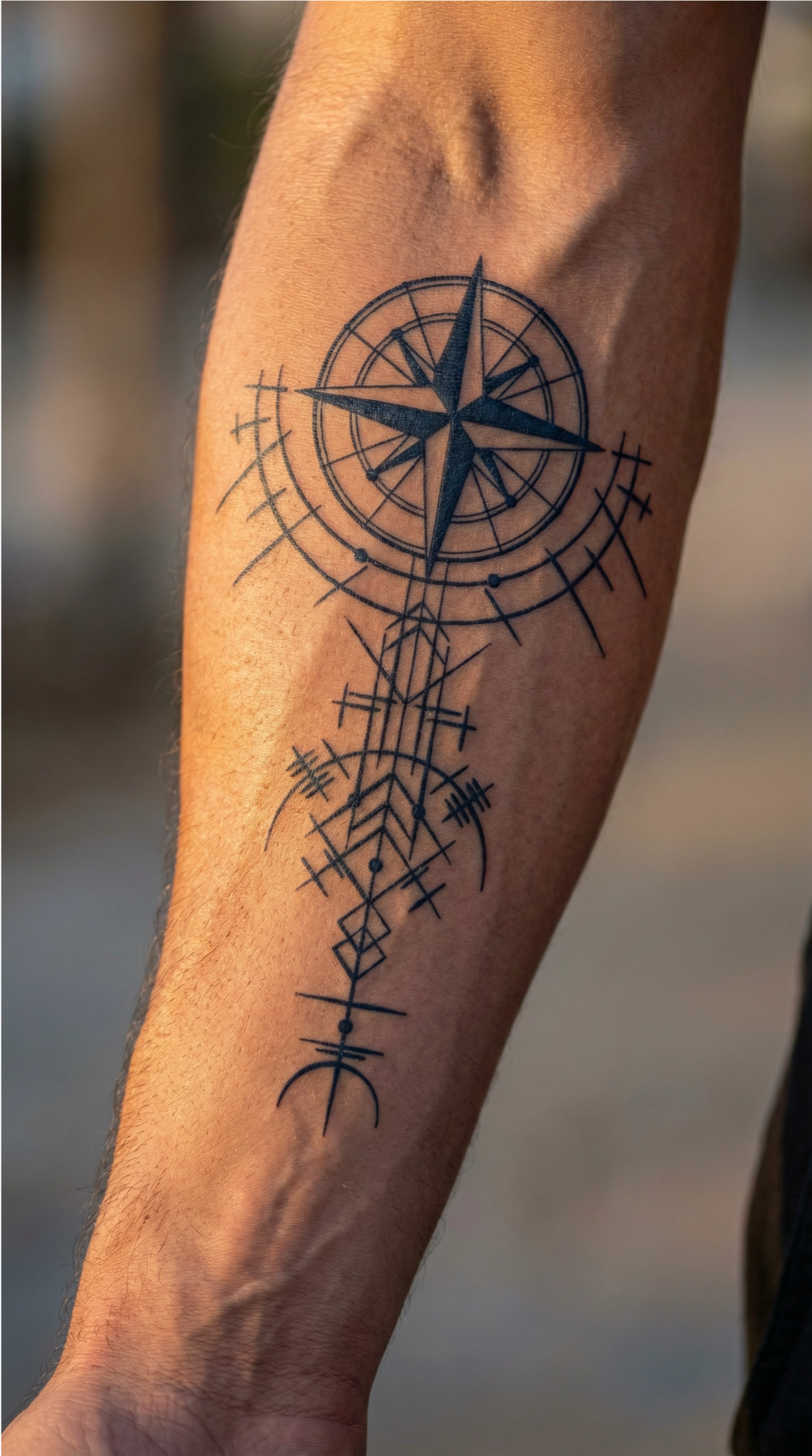


Anyone searching “what does the Bible say about tattoos” almost always comes across Leviticus 19:28, quoted as a clear prohibition. The verse does exist, and it does refer to marks on the skin, but its context—a purity code written for the ancient Jewish people, directed against certain funerary customs of the pagan peoples of that time—and the different ways Christians have interpreted it over the centuries make the answer less clear-cut than it might first appear. A Romanian Orthodox priest has publicly written against tattoos, citing this very verse, while Coptic Christian pilgrims in Jerusalem have worn a cross tattooed on their wrist for centuries as an openly embraced sign of their faith. There is no single Christian point of view on this subject, and the text below brings together the verse, a contemporary pastoral voice, and a real historical tradition, so you can weigh the question for yourself or take it further with your own priest.
- Leviticus 19:28 forbids “cuttings...for the dead” and “print any marks,” but the Hebrew uses two different terms—one for mourning incisions, the other for a tattoo—and the verse is part of a ceremonial purity code, not a moral command clearly reiterated in the New Testament.
- Fr. Marcel Stavara, of the Icoanei Church in Bucharest, published an article of his own on basilica.ro discouraging tattoos, citing Leviticus and 1 Corinthians 6:19-20; his position is a personal pastoral one, not a synodal ruling of the Romanian Orthodox Church.
- The Coptic Razzouk family has tattooed Christian pilgrims in Jerusalem for generations, giving them a simple cross on the right wrist—a practice documented as far back as the 17th century, evidence that tattoos have not always been rejected within Christianity.
What Leviticus 19:28 actually says
In the King James Version, the verse reads: “Ye shall not make any cuttings in your flesh for the dead, nor print any marks upon you: I am the LORD.” The NIV renders the second part more directly as “nor put tattoo marks on yourselves,” which explains why the verse comes up in almost every discussion of tattoos and the Bible (source: Leviticus 19:28, parallel translations - BibleHub).
The original Hebrew text uses two distinct terms where an ordinary translation puts a single generic word: seret, an incision or cut in the skin, and qa'aqa', a mark or impression—essentially a tattoo. The two words describe two different mourning customs, addressed together in the same sentence, not a single prohibition stated twice (source: Notes on the Hebrew terms, BibleHub).
The verse is part of Leviticus 19, a chapter devoted to a holiness code for the ancient Jewish people that prohibits a range of funerary and religious customs adopted from neighboring peoples, from certain ritual haircuts to cuts made for the dead. The immediate context, then, is separation from specific pagan practices of that era, not a standalone ethical command explicitly reiterated as such in the New Testament. Christians interpret the relationship between Old Testament purity codes and the life of faith today differently: some consider them superseded with the coming of Christ, while others retain them as moral guidance with continuing value. This article does not choose between these interpretations—its purpose is to bring together the verse, a contemporary pastoral voice, and a real historical tradition, so you can think clearly about the question, rather than be handed a ready-made verdict.
The pastoral perspective of a Romanian Orthodox priest
Fr. Marcel Stavara, a priest at the Icoanei Church in Bucharest, published an article on July 9, 2025, on basilica.ro—the Romanian Patriarchate’s news agency—discouraging tattoos. He bases his position on Leviticus 19:28 and 1 Corinthians 6:19-20, where the body is called “a temple of the Holy Spirit,” and adds an argument about the pagan origins of tattooing in antiquity (source: “The Tattoo Epidemic,” Basilica.ro).
His practical recommendation is that those thinking about getting a new tattoo abandon the idea, while those who already have one should discuss it in confession. An important clarification: this is one priest’s article, published as his own pastoral opinion on a church news site, not a synodal ruling or canon of the Romanian Orthodox Church with general validity. His article also contains medical or psychological claims about tattoos, which we present here only as his personal point of view—not as independently verified medical facts, because they do not have that status simply because they appear in a text published on a church website.
A Christian tattoo tradition older than the debate: the cross of Jerusalem’s pilgrims
The Coptic Razzouk family has tattooed Christian pilgrims who have come to Jerusalem for several generations, and their craft can be traced back to 14th-century Egypt; a Coptic priest, Jersuis Razzouk, settled in Jerusalem around 1750 and continued the family tradition there. The classic design is a simple cross tattooed on the right wrist (source: Razzouk Tattoo - Wikipedia).
The practice is not recent. European travelers in the 17th century, such as Johann Lund and William Lithgow, were already recording Christian pilgrims receiving commemorative tattoos at the end of their journey to the Holy Places—a sign that the custom long predates today’s debate about tattoos and faith (source: Razzouk Tattoo - Wikipedia).
It is worth remembering that this is a tradition specific to Coptic Christianity, not a practice or endorsement of the Romanian Orthodox Church. It does not settle the question raised at the beginning of the article, but it clearly shows that tattoos have not always been rejected within Christianity: there is a historical branch of Christian tradition that uses them precisely as a sign of faith worn with pride and passed down through families for centuries.
Why arguments about “the body that matters” are older than the debate about tattoos
After Emperor Constantine converted to Christianity, Roman law specifically prohibited branding the faces of condemned people, while preserving the possibility of marking them in this way on other parts of the body. The stated reason was that the human face reflects the image of God (source: Constantine the Great and Christianity - Wikipedia).
The example is not directly related to tattoos today—we are talking about a punishment imposed on condemned people by law, not someone’s personal choice—but it shows that the idea that the body, and especially the face, has a particular spiritual significance has deep roots in early Christian thought. It is a line of thought that you also find, transformed, in today’s arguments for and against tattoos, even though neither argument follows directly from Constantine’s law.
So what can we take away from this?
Three real points of reference, not one ready-made answer: the verse from Leviticus, read in its original context as part of a purity code; a Romanian Orthodox priest who publicly cites it against tattoos alongside 1 Corinthians 6:19-20; and a centuries-old Coptic Christian tradition that tattoos the very symbol others consider forbidden. Taken as a whole, Christian tradition has no single clear answer to this question, and this article cannot invent one on its behalf.
If the question is troubling you personally, the most appropriate next step is still to discuss it with your own priest or faith community, because this is a pastoral and personal decision that only you, together with them, can make.
If you simply want to see what a symbol of faith looks like on your own skin before making any decision about a permanent tattoo, trying a temporary design before going permanent lets you see its size, shape, and placement on your skin. It remains strictly a visual test: it does not answer the religious question discussed above and does not replace a real conversation with your priest.
For anyone who identifies with biblical symbolism, a few faith-themed designs are also available as temporary tattoos:


You can see more options in the Temporary Faith Tattoos collection or, if you would rather start with the symbol of the cross, in the gallery of designs featuring a cross and other religious symbols. For the general steps involved in choosing a first tattoo—design, size, and placement on the body—the guide to your first tattoo covers the subject separately, outside the religious aspect discussed here. What a temporary tattoo can and cannot show you about the permanent version is, in turn, a topic explained in detail in a dedicated article, and if your question is more about social perceptions in Romania than the religious aspect, tattoo acceptance and generational change are discussed separately.