

A triangle tattoo does not have a single fixed meaning: it brings together several different interpretations that depend on the context in which the shape appears. The direction its point faces, the number of triangles you use, and the type of triangle you choose (equilateral, isosceles, or scalene) change both the design and how it can be interpreted. Before settling on a particular shape, it is worth separating two things: meanings that come from a documented tradition—alchemy, religious symbolism, mathematics, and structural geometry—and popular associations surrounding triangle tattoos, which tend to be more recent and do not have the same historical backing.
- This design has no single meaning: it depends on the orientation, the number of shapes you combine, and the tradition you connect it to.
- In Western alchemical symbols, an upward- or downward-pointing triangle refers to the four classical elements.
- The type of triangle (equilateral, isosceles, or scalene) determines whether the design looks symmetrical, directional, or more dynamic.
- Before deciding on a permanent design, a temporary or semi-permanent piece lets you compare the size, orientation, and type of triangle directly on your skin.
What a triangle tattoo means
This shape appears in very different traditions, and each gives it a different role: in alchemy, it represents an element depending on which way it points; in mathematics, it represents change through the letter delta; and in some religious traditions, it has been used as a diagram to explain a unity made up of three parts. None of these interpretations cancels out the others, because they do not describe “the” meaning of the triangle, but rather documented uses in different fields. It is worth distinguishing these from popular associations surrounding triangle tattoos, such as “family” or “protection”: these are recent conventions within the tattoo world itself, not a verified historical or religious meaning, and if you choose to include them in your own interpretation of the design, it is worth presenting them for what they are.
What does demonstrably change is the visual interpretation depending on the orientation and number of triangles you combine, as you can see in more detail in the general guide to geometric tattoos, which covers other shapes besides the triangle.
Upward- and downward-pointing triangles: the four elements in alchemy
The most concrete documented explanation for why a triangle’s orientation changes its interpretation comes from Western alchemical symbols. In that system, a triangle with its point facing up represents fire, and the same triangle with a horizontal line added represents air. A triangle with its point facing down represents water, and that same inverted shape with a horizontal line represents earth (source: Alchemical symbol, Wikipedia).
This means that if you want the orientation of your triangle to communicate something specific and verifiable rather than a vague impression, the fire/water pair (point up or down) and the air/earth pair (with a horizontal line) are the strongest references available, beyond scattered interpretations with no clear source.
Geometric variations: equilateral, isosceles, and scalene
The “geometric design” aspect of a triangle tattoo depends not only on its orientation, but also on the type of triangle. Classified by sides, a triangle is equilateral when all three sides and all three angles are equal, at 60° each, producing a symmetrical and balanced design. It is isosceles when it has two equal sides and two equal angles, a useful shape when you want the design to have a clear direction, for example with a more elongated point. And it is scalene when no side or angle matches another, creating a more asymmetrical line with greater visual movement. You can also classify it by its angles—as acute, right, or obtuse—if you are looking for a more angular or softer design (source: Triangles, Math is Fun).
Single, double, or interlocking triangles
The number of triangles in the design also changes the result. A single triangle works as a minimalist, discreet piece. Two triangles placed as mirror images, point to point, or overlapping add visual complexity without losing the geometric foundation. Combinations with several interlocking triangles move closer to the territory of other, more elaborate geometric motifs, which you can explore in the same general guide to geometric tattoos mentioned earlier if you are interested in going beyond a single shape.
The triangle as a symbol of unity in three parts
Outside alchemy, the triangle has also been used as a visual diagram of a unity made up of three parts. The best-known documented example is the Christian “Shield of the Trinity,” a traditional diagram in which three outer nodes—the Father, the Son, and the Holy Spirit—are connected to a central node by “is” links, and to one another by “is not” links, expressing that they are three distinct persons and, at the same time, one God (source: Shield of the Trinity, Wikipedia).
Outside that specific religious context, the triangle is popularly associated with other triads, such as body-mind-spirit or past-present-future. This is a philosophical and personal interpretation, not a historical dogma documented in the same way as the Christian symbol, and it is worth presenting it with that nuance if you choose this interpretation for your design: one comes from a specific religious tradition, while the other is a more recent and open-ended association.
The triangle in mathematics: the letter delta and the symbol of change
There is a little-mentioned fact in articles about triangle tattoos: the uppercase Greek letter delta (Δ), which is shaped like a triangle, is used in mathematics and science to represent a change or difference between two values, as in the expression Δy/Δx (source: Delta (letter), Wikipedia).
This makes the triangle a common choice for anyone who wants a tattoo that speaks to a period of change or a specific transition in their life, without needing text or explanatory phrases: the shape itself already has this documented use in the language of mathematics.
Why the triangle reads as a stable design
In addition to its symbolic interpretations, the triangle has a real geometric property that explains why it is perceived as a stable shape. In structural geometry, the triangle is the simplest shape that does not change form when the lengths of its sides are fixed, unlike a square or rectangle, which can deform even when their sides are the same length. That is why it is used as a basic unit in trusses and building structures: it is the most rigid shape among simple polygons (source: Truss, Wikipedia).
This real, verifiable property in engineering is the most concrete basis for associating the triangle visually with stability or balance, and is much stronger than a purely decorative interpretation of the shape.
How to choose the size and placement, and try the design before deciding
The size and placement change how the orientation of a triangle is perceived. The same upward-pointing tip looks different on the wrist, where the design is usually small and seen up close, than on the shoulder blade, where there is more space and the triangle can be part of a broader composition. If you are still deciding between a discreet format and a larger one, the temporary tattoo size guide explains what to consider for each area of the body.
A temporary or semi-permanent piece lets you compare an equilateral triangle with a scalene one, or one orientation with another, directly on your skin before considering anything permanent. It is important to be clear about what this test is for: it lets you see the design, size, and placement, but it should not be taken as a way to anticipate pain, healing, allergy risk, or the exact appearance of a permanent tattoo, which depend on factors that a temporary piece does not reproduce. If this is the first time you have considered taking this step, the guide to your first tattoo covers how to choose a design and placement without rushing.
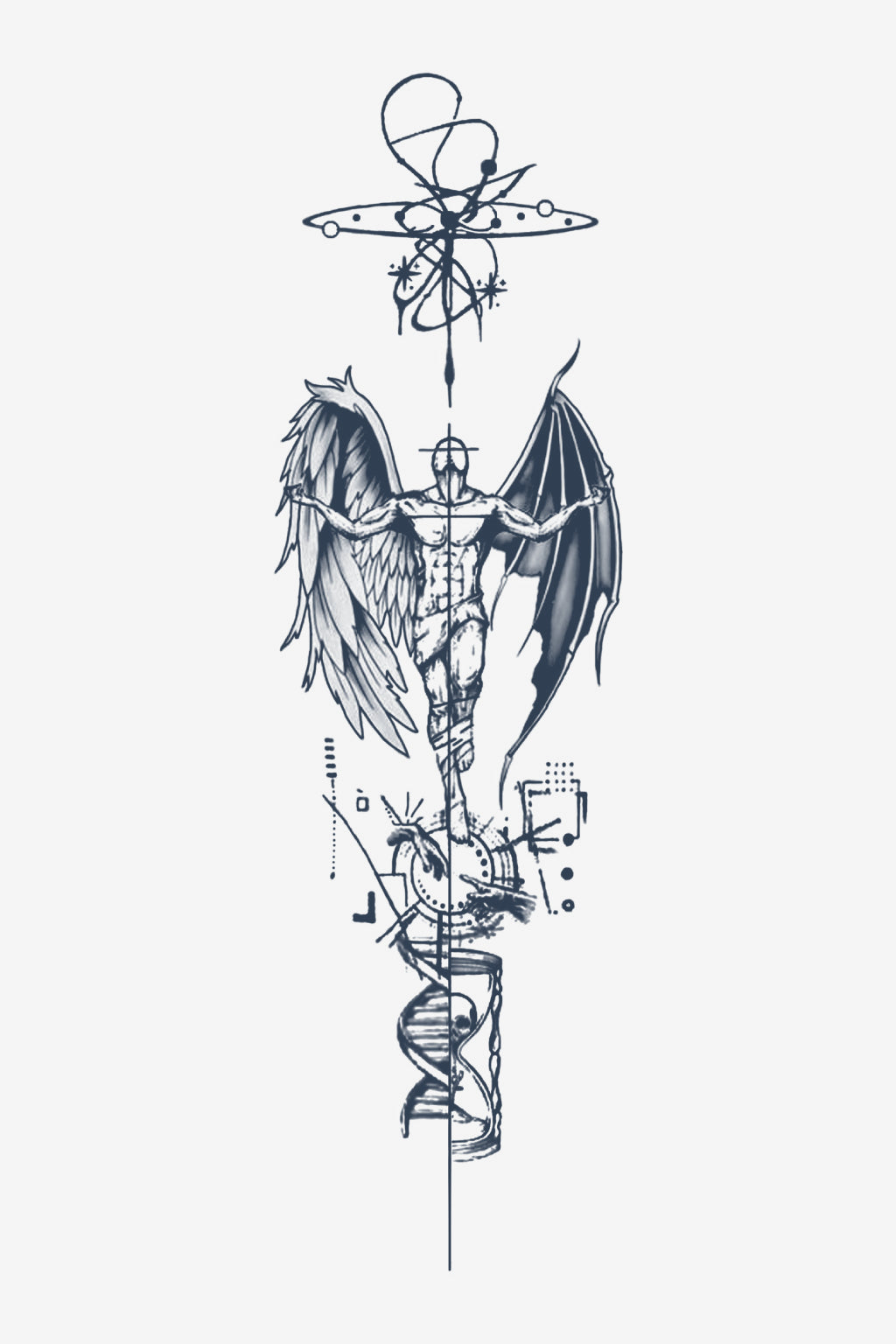
In the Geometrically collection, you will find fine-line designs that show how this style looks on skin, useful as a reference even though they are not triangles. Solar, with its interconnected planets in a minimalist line style, is an example of how a small geometric composition remains legible up close:

Compass 2 offers another variation in the same style, with planets, mountains, and arrows coordinated in a single composition:

If what attracts you to a geometric design is the idea of a shape with direction, like a triangle pointing toward a point, another option in the same visual family is the compass, which we cover in the guide to compass rose and compass tattoos. Comparing both ideas before deciding helps you see which one communicates what you are looking for more clearly, whether with a temporary or semi-permanent piece before moving on to a final design.