

A compass rose and a compass are not the same thing, although people almost always ask for them as if they were when choosing a tattoo. A compass rose is a diagram that marks the cardinal directions on a map or nautical chart, while a compass is the instrument with a needle that points north. As a tattoo, the design is usually read as a reminder of finding your bearings and following your own course, which resonates especially with people who travel, have lived abroad, or have fond memories of an Erasmus exchange. Before deciding on the style, size, and placement, it helps to understand where the symbol comes from and what really distinguishes one design from another.
- Compass rose: a decorative orientation diagram with 4, 8, 16, or 32 points, depending on the level of detail you want.
- Compass: depicts the instrument itself, with a needle and dial, and usually has more contrast and shading.
- Common meaning: orientation, travel, and the idea that you can find your way home, with no fixed religious or national interpretation.
- Placement and size: the wrist and collarbone suit fine-line designs; the forearm allows room to add a map, a fleur-de-lis, or a quote.
What is a compass rose, and how is it different from a compass?
A compass rose is, first and foremost, a diagram: a graphical representation showing the cardinal directions (north, south, east, west) and the intermediate points between them (Compass rose, Wikipedia). It is drawn on maps, nautical charts, and monuments, but it does not function as an object: it does not point anything out by itself; it only represents directions. A compass, on the other hand, is the physical instrument that does this, with a magnetized needle mounted on a pivot that aligns with Earth’s magnetic field and points to magnetic north (Compass, Wikipedia). A tattoo can depict either one, and that choice makes quite a difference to the visual result: a compass rose relies on geometric lines and points, while a compass adds the dial, the needle, and sometimes the circular frame of the instrument itself.
This distinction explains why so many people search for “compass rose tattoo” and “compass tattoo” almost as if they were synonyms: both designs share the same visual language of orientation and often appear together in the same piece, but they do not represent the same thing and do not have the same origins. Knowing which element interests you more—the diagram or the instrument—helps you decide which style of design to start looking at.
Where the compass rose design comes from
The design has its roots in the wind systems used by Mediterranean navigators in the Middle Ages to describe the direction from which each wind was blowing, and from there it evolved into the decorative diagram we know today. The earliest surviving ornamented compass rose appears in the Catalan Atlas of 1375, created by cartographer Cresques Abraham (Compass rose, Wikipedia). Centuries later, in the Portuguese nautical tradition associated with Prince Henry the Navigator and his school in Sagres, the diagram took on the form we recognize almost immediately today: 32 diamonds arranged in a circle, with a fleur-de-lis marking north (Compass rose, Wikipedia). In this context, the fleur-de-lis is a cartographic element, not a religious symbol or a symbol of any particular country, which is worth bearing in mind if you choose a design that includes one.
How many points can it have (4, 8, 16, or 32)?
Compass roses are drawn in standard configurations of 4, 8, 16, or 32 points, and each level simply divides the circle into smaller angles: 90° between cardinal points, 45° when the intercardinal points are added, and so on, down to 11.25° for the 32-point version (Points of the compass, Wikipedia). For a tattoo, that number is also a practical consideration: a 4- or 8-point compass rose reads clearly even at a small size, while the 32-point version needs more skin area so each diamond remains legible at a glance.
What this tattoo symbolizes: orientation, travel, and finding your way home
The symbol originated in navigation, from the very practical need to know which direction you were traveling when there were no visible landmarks around. Over time, that idea of finding your bearings took on a more personal meaning: having your own course and not losing it even when the path changes. For someone who travels often, lives far from their hometown, or has a special memory of a period in their life such as an Erasmus exchange, the tattoo often serves as a reminder that there is always a way back, even if your current course points somewhere else.
It is important not to impose an interpretation the symbol does not have: the compass rose and the compass do not belong to any particular religious tradition or represent a specific country, so their meaning almost always depends on the personal context of the person wearing them. That is why they work well as standalone tattoos and also as designs combined with a date, coordinates, or a short quote that gives the story behind them more specificity.
Common styles: compass rose, compass, and combinations
There are variations of this same motif with very different results, and it is worth looking at them all before deciding which one suits what you are looking for.
A fine-line compass rose pares the diagram back to its essential strokes: defined points, little or no fill, and a clean outline that works well on smaller areas where a busier design would lose clarity. A compass design, by contrast, comes closer to the real instrument, with a needle, a graduated dial, and greater contrast between light and shadow. This gives it more visual weight but also means it needs a little more space so the details do not become crowded. There are also common combinations of the two: a fleur-de-lis marking north, a sketch of a map in the background suggesting a specific place, or a short quote that adds another layer of meaning to the piece. The “Orientare” design in the catalog, for example, combines the precision of a nautical chart with modern-looking fine lines and clearly defined cardinal points, offering one way to see how that balance between diagram and instrument translates into a real design.

Choosing between these variations mainly depends on two things: how much detail you want to be visible from a distance and how much skin you are willing to dedicate to it. A fine-line design with a few points suits almost any area; a full compass with a needle and dial needs a more generous surface to keep the result clean.
Where to place it: wrist, collarbone, and forearm
The three most common areas for this motif each have their own logic, and comparing the same design across them helps show why.
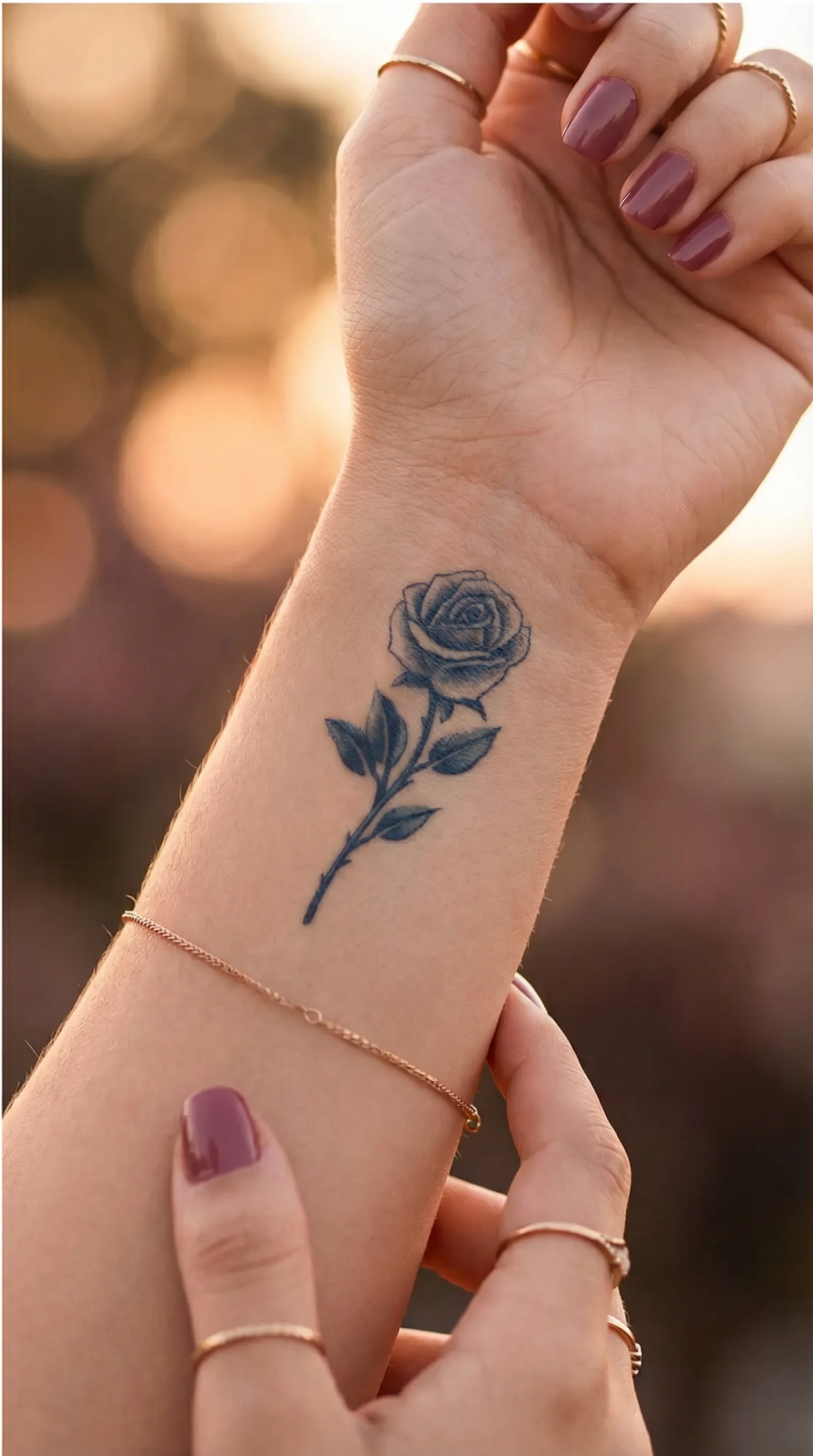
On the wrist, a small fine-line design keeps the cardinal points legible without losing detail. It is also easy to show when you want to, or cover with a bracelet when you do not. The collarbone’s elongated shape naturally suits the horizontal outline of a compass rose or the vertical axis of a compass needle. It is an area you can show with a low neckline or easily cover with work clothes. The forearm offers the most room: there is plenty of space to add a sketched map, a prominent fleur-de-lis, or a short quote without having to shrink the compass rose to fit everything in.
What size to choose for each placement
The rule of thumb is simple: the more points or added elements you want, the more space you need to keep the design defined. An 8-point fine-line compass rose remains legible even in the smaller format that works on the wrist, while a 16- or 32-point version, or any combination with a map and fleur-de-lis, calls for the larger area the forearm offers so each line can be distinguished without crowding. The collarbone falls somewhere in between, suiting medium-sized, elongated designs that do not need as much width as a full compass rose.
How to try the design before deciding
A temporary tattoo lets you see the compass rose or compass on your skin—in place on your wrist, collarbone, or forearm—before committing to a placement for a permanent tattoo. It is a practical way to compare how the same design looks in different places, without having to imagine it or rely on a reference photo of someone else’s skin. Bear in mind that this kind of test lets you assess the design, size, and placement, but it does not predict how a permanent tattoo would feel, heal, or look over time; that follows a completely different process.
If you wear the design for a few days and move it to different areas, it is easier to notice where the size still feels right even after seeing it every day. That is exactly the kind of decision it is worth taking your time over before getting a permanent tattoo. You can see the full design and other compass variations in the Temporary Compass Tattoos collection, or go straight to the Orientare compass design used as an example in this article.
To help you move forward with your decision, this guide to choosing the design and placement for your first tattoo covers general criteria that also apply to this motif, while this other guide on choosing the size of a temporary tattoo explores the relationship between available surface area and level of detail in more depth. If the wrist is your favorite placement, this article on wrist tattoos goes into more detail about that specific location. And once you have settled on a design, this step-by-step guide explains how to apply a temporary tattoo at home so your test looks just as clean as the original design.