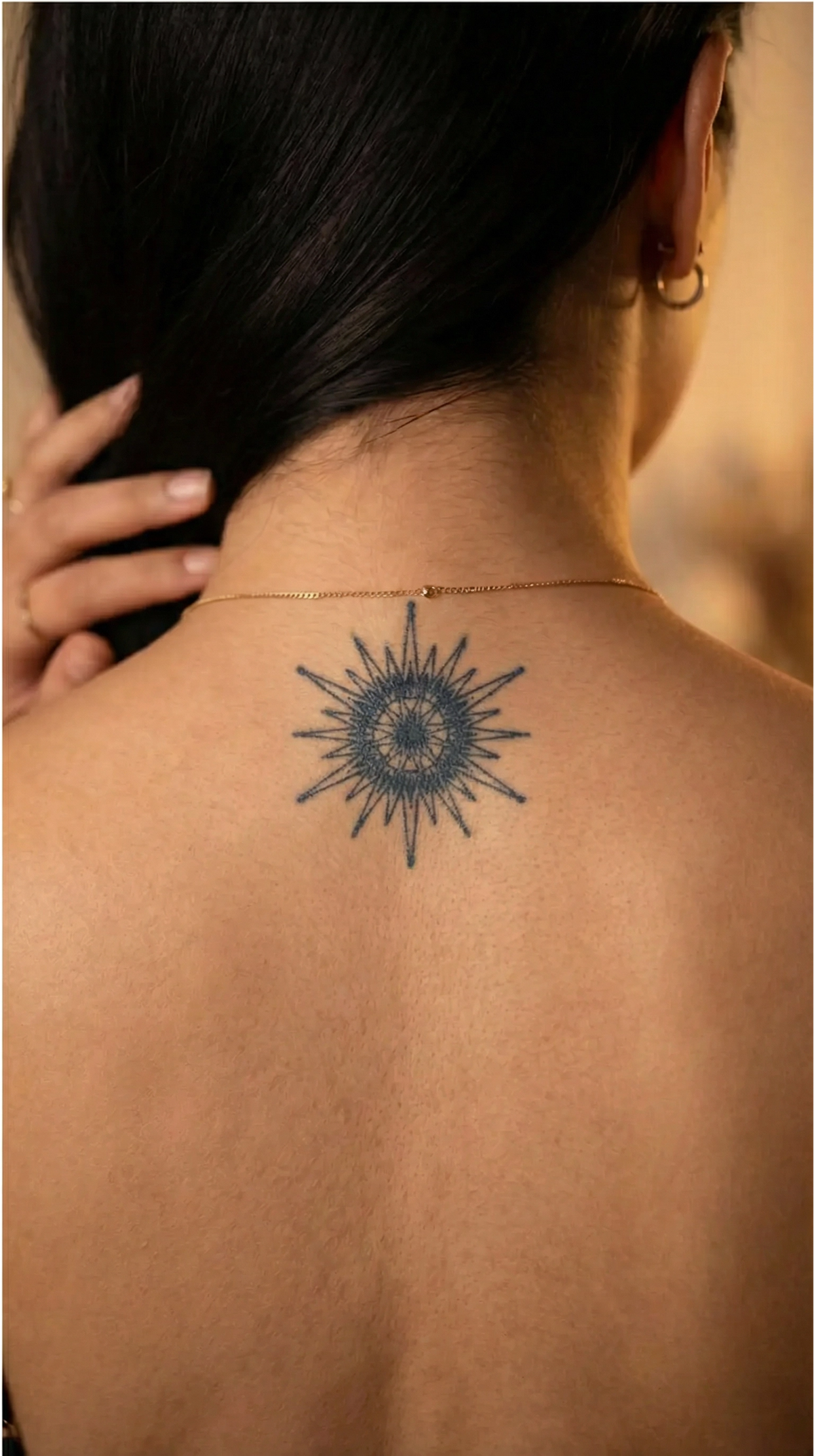


A sun tattoo carries a specific symbolism before it is simply a positive image: in several ancient civilizations, the solar disk or chariot represented life, power, and daily renewal. Choosing this motif then involves three concrete, interconnected decisions: the number and shape of the rays, which change how the design is read; the linework style (minimalist, fine-line, or geometric), which determines how it looks on the skin; and the placement, which depends directly on the size of the chosen design.
- The sun is a solar symbol shared by several ancient cultures (Egypt, Greece, Mesopotamia, the Aztec world, the Inca world, the Vedic tradition, and Germanic mythology), associated with themes of power, justice, and renewal.
- The number and thickness of the rays are not a minor detail: a few thick rays create a bold, graphic look, while many fine rays create a delicate, ornamental look.
- Three drawing styles make it possible to describe precisely what you want to a tattoo artist: minimalist, fine-line, and geometric.
- The design's size guides its placement: small minimalist or fine-line designs work well on the wrist or ankle, while larger geometric designs suit the shoulder or back.
- A temporary or semi-permanent tattoo lets you test the design, size, and placement, but never the pain, healing, an allergic reaction, or the final look of a permanent tattoo.
What does a sun tattoo symbolize?
The sun is one of the oldest motifs in human iconography, and its meaning goes beyond a general sense of good cheer. In ancient Egypt, the solar disk associated with the god Ra symbolized his life-giving power, and each sunrise marked a renewal after his nightly passage through the underworld (source: World History Encyclopedia). In Greece, Helios drove a chariot that carried the sun from east to west each day, an image that embodied not so much a one-off feat as a cycle that began again without interruption (source: World History Encyclopedia).
The same pattern appears, under different names, in many traditions: Shamash in Mesopotamia, Tonatiuh among the Aztecs, Inti among the Incas, Surya in the Vedic tradition, and Sól in Germanic mythology. The stories change, but one thread connects these solar figures: power, justice, and renewal recur from one culture to another as values associated with the sun (source: Wikipedia). This continuity, rather than one fixed, universal meaning, explains why the motif has endured across styles and eras without going out of fashion.
Sunrise as a symbol of personal renewal
Sunrise encapsulates the essence of this symbolism, which explains its particular popularity as a tattoo. It draws on the idea of the cycle embodied by Helios or Ra, but on the scale of a single day: after the night, the light returns, always at the same point on the horizon. For this reason, a rising sun is often chosen to mark a personal fresh start, a milestone reached, or a chapter being closed, without the need to invent an additional meaning: the image already carries the idea in itself.
The number and shape of the rays change how the design is read
Once the symbolism is established, the practical question becomes: what kind of sun, exactly? The number and shape of the rays are not a secondary aesthetic choice; they directly influence how the design is read. A sun with a few long, thick rays creates a bold, graphic design that stands out even at a small size. By contrast, a sun covered in many fine, evenly spaced rays feels more delicate and ornamental, closer to solar lace than to a solid symbol.
A third option is to break the symmetry: rays of uneven lengths, arranged like a burst rather than a perfect circle, suggest movement, like a sun caught in an explosion of light rather than a still disk. These three approaches are not mutually exclusive: they can be combined with the chosen linework style, which naturally leads to the next question.
Three ways to draw a sun: minimalist, fine-line, and geometric
The symbolism and choice of rays remain abstract until they are translated into a recognizable drawing style—the kind you can actually ask a tattoo artist for by name.
The minimalist sun
The minimalist style favors clean lines and negative space over shading or intricate detail, which is why it reads well on small, flat areas such as the wrist or ankle (source: Monolith Studio). Applied to a sun, this often results in a simple circle surrounded by a few short lines, sometimes paired with another small motif in the same composition.
The fine-line sun
Created with a single needle or a small needle grouping, fine-line tattooing produces thin, precise lines with little or no shading (source: Monolith Studio). On a sun, this technique allows for numerous, evenly spaced rays without making the design look heavy, creating a result closer to an engraving than a solid block of ink. For anyone who wants to go beyond this summary, the article on fine-line style explores other motifs and their distinctive features.
The geometric sun
Built from precise, symmetrical shapes, often inspired by sacred geometry, the geometric style works well for larger placements such as the shoulder or back (source: Monolith Studio). The sun is often built around a polygon or regular star at its center, with the rays treated as straight segments rather than freehand lines. The article on geometric tattoos explores this construction approach in more depth for motifs other than the sun.

Where to place a sun tattoo based on its size
Once the style has been chosen, the design's size is largely determined, and that size in turn determines which areas of the body will keep it clear and well-proportioned. A minimalist or fine-line sun designed in a small format works especially well on the wrist or ankle: these are small, flat areas where an overly busy design would lose clarity.
By contrast, a larger geometric sun naturally fits on the shoulder or shoulder blade, two areas with enough surface to preserve the design's symmetry without compressing it. The forearm is somewhere in between: it can accommodate a sun with medium-length rays, prominent enough to remain visible without becoming overwhelming, making it a common compromise for anyone deciding between subtlety and impact.
A sun paired with other motifs: a face, a palm tree, or the moon
This motif is rarely limited to a simple disk with rays: it is often combined with other elements, each with its own logic.
The “sun face,” with stylized eyes and a mouth inside the disk, remains a decorative variation rooted in illustration rather than a realistic portrait: its features are deliberately simplified in keeping with the chosen style (minimalist or fine-line), rather than designed to reproduce a specific expression.
Pairing the sun with a palm tree works on a different principle: it creates a small scene rather than an isolated symbol. The Serenity design is one concrete example, described by the brand as a composition evoking escape and serenity found in nature rather than simply a vacation memory; this is a product description and should be taken as such, rather than as an established fact.

The sun is also often paired with the moon, a combination whose symbolism of duality deserves a full treatment of its own: it is the subject of a dedicated article on sun and moon tattoos, which explores the pair on its own rather than as an addition to the sun alone. For an overview of the celestial hub, including space, the article on moon, sun, and space tattoos is the best place to start.
Try the design before making it permanent
Once the style, rays, and placement have been chosen on paper, the next question is practical: how can you tell whether this design, at this size and in this exact spot, matches what you had in mind? A temporary or semi-permanent sun tattoo answers exactly this question, and only this one. It lets you see the design on your own skin, judge whether the chosen size is right once it is placed beside a real wrist or shoulder, and check that the placement works day to day, under clothing or in the open air.
What this test can never predict, however, is the pain you will feel, how your skin will heal, a possible allergic reaction, or exactly how the same design will look once done in permanent ink: these things depend on the permanent tattooing technique itself, not on the design you tried beforehand. To understand why this test is still useful despite this limitation, the article on why to test a tattoo before making it permanent explains the process step by step. For anyone specifically considering the semi-permanent option, the article on the safety of InkLabs semi-permanent tattoo ink answers the most common questions on this topic.
Between the sun's symbolism, the logic of the rays, the three drawing styles, and the question of placement, the choice ultimately comes down to a series of concrete decisions rather than a vague intuition. Once those decisions have been made, the Temporary Sun Tattoos collection makes it possible to compare designs already finalized at their actual size, such as Sun for a fine-line and geometric look, or Serenity for a minimalist composition paired with a palm tree.