

A tattoo that brings the sun and moon together in one design draws on an idea that is easy to understand but rich in meaning: two forces that are not really opposed, but take turns. Day gives way to night, then night gives way to day, and it is this passing of the baton, more than simply combining two fashionable symbols, that many people want to wear on their skin. Before choosing between a single disc and two separate pieces, it is worth understanding where this interpretation comes from and what it can really express.
- The sun-and-moon duo symbolizes balance between two complementary forces, an idea that several mythologies developed independently of one another.
- The choice between a combined disc and two separate symbols changes both the meaning and the way the tattoo is worn, especially for a matching design shared by two people.
- A temporary or semi-permanent tattoo lets you test the design's size and placement, but not anticipate the pain, healing, a possible skin reaction, or the final appearance of a permanent tattoo.
What the sun-and-moon duo symbolizes
Bringing the sun and moon together in one tattoo draws on an intuition that several cultures arrived at independently, without consulting one another: day and night are not rival camps, but two moments in the same cycle. In Greek mythology, Helios (the sun) and Selene (the moon) are brother and sister, both children of the Titans Hyperion and Theia, and each travels across the sky in turn (source: World History Encyclopedia, article on Selene). A very similar structure appears in Japanese mythology, where the sun goddess Amaterasu and the moon god Tsukuyomi are also brother and sister, traditionally depicted sitting back to back (source: World History Encyclopedia, article on Amaterasu). These two traditions, with no direct historical connection to each other, arrive at the same image: the sun and moon as a pair, not as two interchangeable elements.
The yin-yang symbol expresses a related but distinct idea, and it is worth mentioning for what it is rather than confusing it with the sun-and-moon duo: two opposing and complementary forces, interdependent, each containing a part of the other (source: New World Encyclopedia, entry on Yin and Yang). If you choose a design that visually draws on yin-yang to represent the sun and moon, you are consciously borrowing from a Chinese tradition in its own right, not simply choosing a decorative variation of the same symbol. Keeping this distinction in mind helps you choose a design that respects the origins of each reference rather than unknowingly blending them together.
Common interpretations: balance, parent and child, couples, your two sides
Beyond its cultural symbolism, most people who choose this duo give it a personal interpretation. None of these interpretations is more “true” than another: they coexist, and that is precisely what makes the design adaptable to very different situations.
An interpretation for couples or family
The duo lends itself well to a parent-and-child interpretation, where one of the two symbols represents a steady presence and the other a presence that changes form over time: the moon passes through its phases, while the sun stays the same from one day to the next. Others choose this pair to represent a couple or close friendship, not as two identical people, but as two complementary roles that work together without becoming one and the same.
A personal interpretation, without a partner
You do not need to associate the design with another person. Many people wear it on their own to represent two sides of their own character, such as an active, social side alongside a calmer, more introspective one, or to symbolically mark two phases of their life that they want to hold together rather than set against each other.
One combined disc or two separate symbols
Once you have chosen the meaning, there is one very practical decision left: should the sun and moon be drawn as one fused disc or as two separate pieces? Both options carry the same message, but they are not worn in the same way.

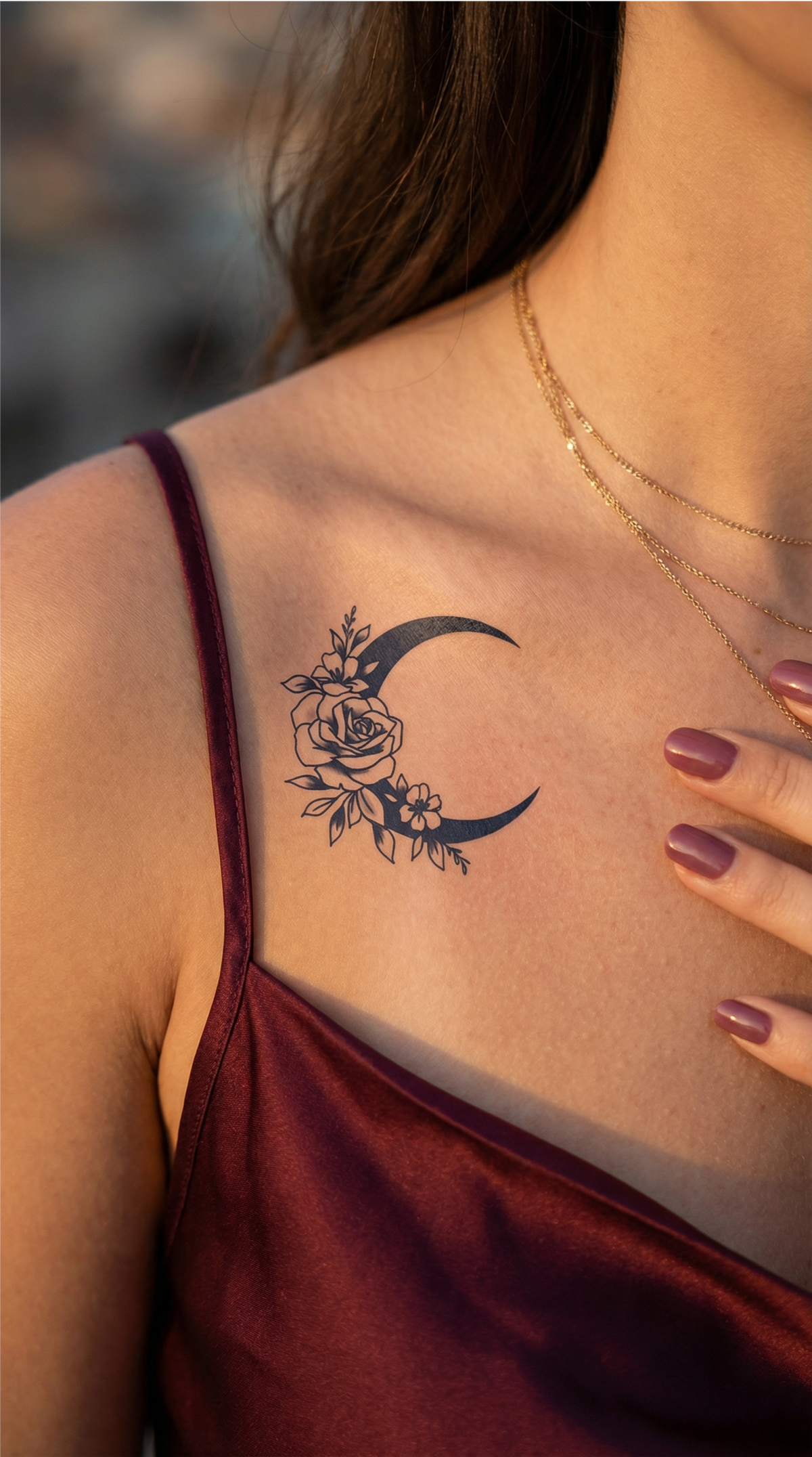
A combined disc, where the crescent moon and the sun's rays blend into one circular shape, reads as a single idea: balance is already achieved within the design itself. It is an option that works in one spot, for example on the inside of the forearm, and does not depend on another person to have meaning. Two separate symbols, by contrast, leave the pair “unfinished” until it is completed, making this the natural format for a matching design worn by two people, or by the same person in two different places on the body.


The style of the design also changes how it reads. A figurative version, with faces drawn on the sun and moon, tells a more explicit, almost narrative story. An abstract or geometric version, reduced to shapes and lines, keeps the symbol more discreet and makes it feel more like a graphic piece of jewelry than an illustrated scene. Neither is more “correct”: the choice depends on whether you want the design to stand out straight away or be noticed only up close.
Placement ideas for a matching tattoo
For a design shared by two people, mirrored placements work particularly well: two wrists, two ankles, or a small, discreet design behind each ear. This type of placement highlights the idea that each person wears one half, most visible when the two people are close to each other.
If you would rather wear both symbols yourself than share them, placing them in two different spots on your own body recreates the same sense of a pair without depending on anyone else: for example, a small sun on one wrist and a moon on the other, or one design on each ankle. Visibility is worth considering before you decide: a wrist design stays visible every day, while a larger tattoo on the forearm or shoulder allows for a more detailed design but is also more exposed, which matters if you need to cover it easily for certain occasions.
Why test the design before getting a permanent tattoo
A temporary or semi-permanent tattoo lets you see exactly how the combined disc or separate pair looks on your skin, at the right size and in the right spot, before committing to a permanent tattoo. It is a test of the design and placement, nothing more: it tells you nothing about the pain caused by a tattoo artist's needle, how your skin would heal, the risk of an allergic reaction to permanent tattoo ink, or exactly how the design would look after several years. These are questions to ask a professional tattoo artist directly when the time comes.
If you are considering a matching design, the article on couples’ tattoos explores in greater depth the ways two people can share the same theme. And to understand what a temporary trial can and cannot tell you before going permanent, the guide to your first tattoo walks you through the process step by step.
If you would rather keep the two symbols completely separate instead of combining them, the meaning of a sun tattoo on its own and the meaning of a moon tattoo on its own explore each symbol independently. For a broader look at the celestial world this duo belongs to, the moon, sun, and space tattoo gallery features other designs on the same theme. Finally, to compare actual designs side by side before making up your mind, the Sun, Moon and Space design collection brings together the combined discs and separate pairs featured in this article, along with other variations to compare side by side.