

If you’re organizing a St Andrew’s Eve party and looking for something beyond the classic wax-pouring ritual, the simplest answer is to add three games to the traditional fortune-telling activities, with a temporary tattoo as the prize and keepsake from each round. St Andrew’s Eve is celebrated on the night of November 29–30, the eve of Saint Andrew’s Day, as the last big night of fun before Advent (source: St Andrew’s Eve – history, tradition, and customs). Below, you’ll find three new games built around symbols and zodiac signs, a brief reminder of the classic fortune-telling traditions, and what to prepare before your friends sit down at the table.
- St Andrew’s Eve always falls on the night of November 29–30, regardless of the day of the week.
- The three new games described below are based on drawing a symbol, matching a zodiac sign, and guessing the meaning of a motif—each ends with applying a tattoo as a keepsake from the round.
- Classic fortune-telling traditions—wax pouring, the shoe race, and peeling an apple—work best when the group knows their history, not just what to do.
- All the games, old and new, are treated here as a social activity, not as a way to learn about the future.
Where St Andrew’s Eve fortune-telling traditions came from
The first written mention of the St Andrew’s Eve custom dates back to 1557, in a morality play published in Kraków by the satirist Marcin Bielski (source: St Andrew’s Eve – history, tradition, and customs). The custom itself is probably older and dates back to the pre-Christian ritual calendar, although its exact age remains unknown (source: St Andrew’s Eve: Polish Fortune-Telling Ritual). Fortune-telling takes place on the night of November 29–30 because it is the eve of Saint Andrew’s Day and also the last opportunity for a big celebration before the Advent fast.
Historically, fortune-telling was reserved for unmarried women of marriageable age and was meant to reveal when and whom they would marry (source: St Andrew’s Eve: Polish Fortune-Telling Ritual). Today, people play these games for fun, in mixed groups of friends, without expecting the results to prove anything. This distinction matters for the new games described below, too: the tattoo that appears after each round is a reward for taking part and a keepsake from the evening, not a sign of the future.
What to prepare for a fortune-telling evening
Before your friends sit down at the table, it’s worth laying out what you’ll need for both the classic fortune-telling traditions and the new games, so the evening isn’t interrupted by a search for supplies while you’re playing.
- A candle, a metal spoon, a key with a large bow, and a bowl of cold water—the essentials for wax pouring.
- Pieces of paper, pens, and a container for drawing from—the basics for the destiny-symbol game.
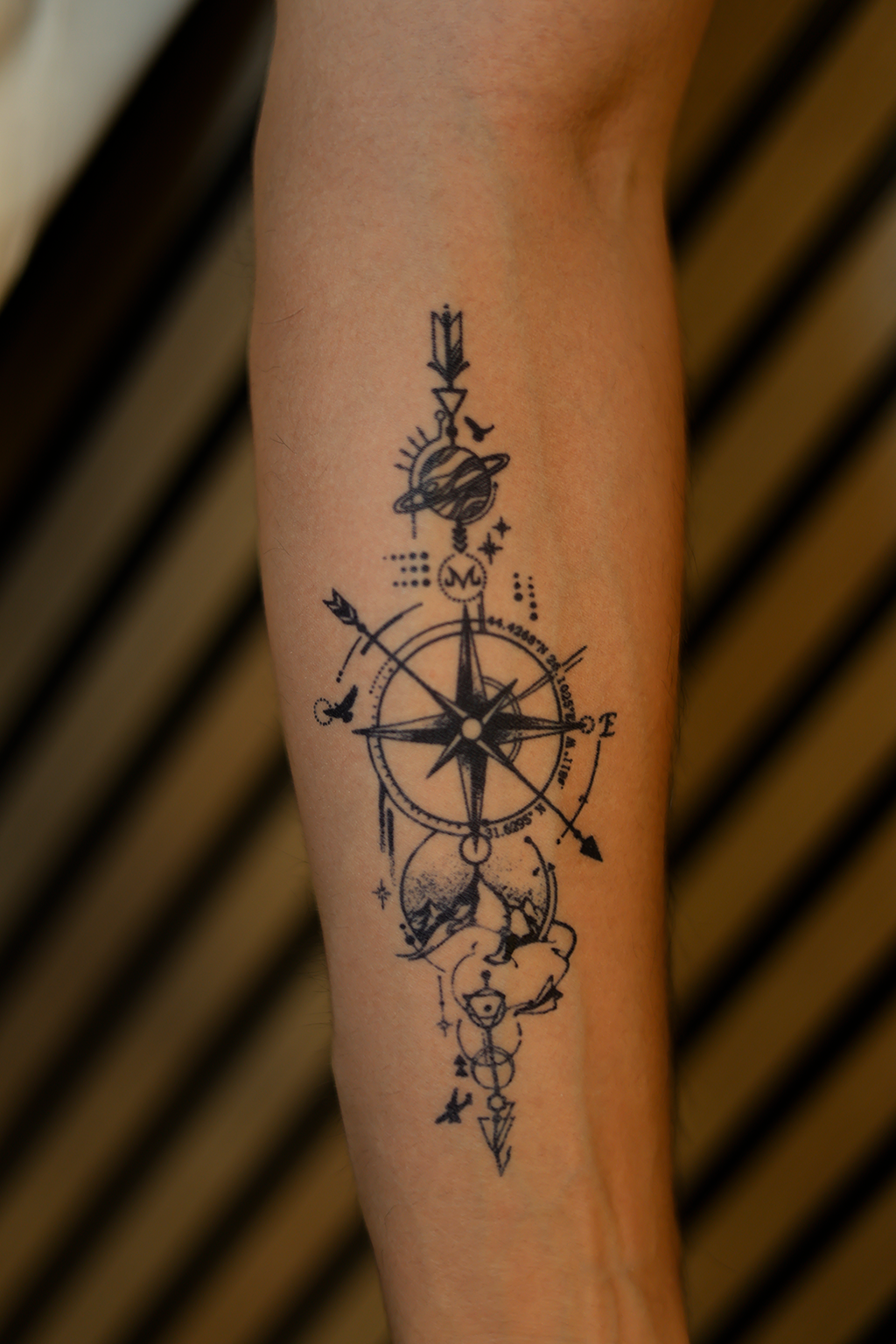
- A spot at the table and a little time after each turn to apply a tattoo, so the keepsake is already visible in photos from the evening. If someone in the group is doing this for the first time, a quick look at the step-by-step guide to applying a temporary tattoo before the party will save confusion during the game.
- If St Andrew’s Eve is just one of many occasions throughout the year when you wear temporary tattoos, the article about tattoos for parties and events covers other situations where the same idea works well.
Game 1: Draw a symbol of destiny
The first game is the simplest and works well as a warm-up: each participant draws a piece of paper with the name of a symbol, and the draw determines which temporary tattoo they put on their skin. Three sample symbols are a guiding star, a flower, and a heart, each with a different, lighthearted interpretation for the evening.

How to lead the round, step by step
- Write the names of three symbols on separate pieces of paper: guiding star, flower, and heart. Repeat each name as many times as there are players.
- Each person draws one piece of paper without showing it to the rest of the group right away.
- The host briefly explains what the symbol drawn means in the spirit of the evening: a guiding star stands for direction and decisions for the coming year, while you can come up with your own equally lighthearted associations for flower motifs and heart motifs.
- The participant applies the corresponding tattoo right after drawing, before the game moves on to the next person.
Game 2: Match the zodiac sign
The second game turns zodiac signs into a guessing game. The host shows zodiac motifs one by one, and the group tries to guess who each sign belongs to before the birth date is revealed. The game works best when there are several different signs to guess in the group, so it’s worth asking your friends for their birth dates in advance to choose a selection of motifs.
- Taurus – a motif representing stability and inner strength, a good place to start the first round.
- Gemini – a design evoking curiosity and energy, usually easy to guess in a louder group.
- Leo – a motif described as a sign of royalty and passion, for someone who likes being the center of attention.
- Aries – a design for those who take action and lead the group.
- Cancer – a motif associated with loyalty and family bonds.
- Scorpio – an intense scorpion design in an attack position, associated with the survival instinct.
- Pisces – choose between a full zodiac-sign illustration, a motif with two Koi fish circling geometric elements, or a version with two betta fish and the Pisces symbol incorporated into the design, useful when there’s more than one person born under this sign in the group.
How to share out the signs in the group
Instead of preparing a motif for every specific guest, choose a few signs representing different groups of people on the guest list, and let everyone guess, including those whose own sign isn’t included. Once the sign has been guessed—or after an unsuccessful attempt—the person associated with that sign applies the corresponding tattoo as a keepsake from the round. If someone wants to wear their sign for longer than one evening, the full range of zodiac motifs is available in the temporary zodiac tattoo collection.
Game 3: Guess the meaning of the symbol
The third game uses more decorative astral motifs and involves guessing their meaning rather than matching them to a specific person. The host shows the group a flower motif outlined with stars and lines resembling constellations, and the participants suggest aloud what message it might carry in the spirit of a St Andrew’s Eve party: a new beginning, a meeting, or a calm decision. Only after a few suggestions does the host reveal how the motif is described on the product page, and the tattoo goes to the person who suggested an interpretation closest to the description—or simply made the rest of the group laugh the most. You can repeat the round with another motif if there’s still some time before moving on to the classic fortune-telling traditions.
Classic St Andrew’s Eve fortune-telling traditions to pair with the games
Alongside the new games with tattoos, an evening for St Andrew’s Eve still works well with four classic fortune-telling traditions, which you can alternate with the rounds described above.
For wax pouring, wax melted over a flame is poured through a keyhole into a bowl of cold water, and the solidified shape is held up to the light to look for familiar outlines in its shadow (source: Wax pouring on St Andrew’s Eve – fortune-telling). Since this game involves an open flame and hot wax, it’s best to leave this part of the evening to an adult who will take care around the candle. Among the popular interpretations of the shadow, a heart is most often said to foretell love, a ring an engagement, and a key a new home, although the authors of these interpretations themselves emphasize that this is symbolic fun, not a literal prediction (source: Wax pouring on St Andrew’s Eve – fortune-telling).
The shoe race involves unmarried women lining up their shoes one behind another, pointing toward the door; the shoe that crosses the threshold first indicates who will marry first (source: St Andrew’s Eve: Polish Fortune-Telling Ritual). For apple peeling, a long, unbroken peel tossed over the left shoulder is supposed to land in the shape of a letter corresponding to the first initial of a future partner’s name (source: St Andrew’s Eve – history, tradition, and customs). Both traditions require little preparation and fill the gap between tattoo rounds nicely while the group waits for someone to finish applying their motif.
How to keep a memento of the evening
A tattoo applied during the game is first and foremost a keepsake from a particular evening and a chance to see a given design on your own skin, not a prediction of what will happen to you in the future. For some people, it’s also their first chance to try out the look and size of a motif before possibly deciding on something more permanent; if that’s you, the article about testing a design before getting a permanent tattoo explores this topic separately. If you want your St Andrew’s Eve keepsake to last longer than one night, the temporary tattoo care guide explains what to pay attention to over the following days.
When the evening is over and the wax, shoes, and apples are back where they belong, the zodiac motifs from the second game will still be waiting in the temporary zodiac tattoo collection, in case anyone in the group wants to wear their sign for a few more days. And if you’re planning another themed evening with friends, not necessarily for St Andrew’s Eve, bachelorette party ideas with friends show a similar kind of activity adapted for a different occasion.