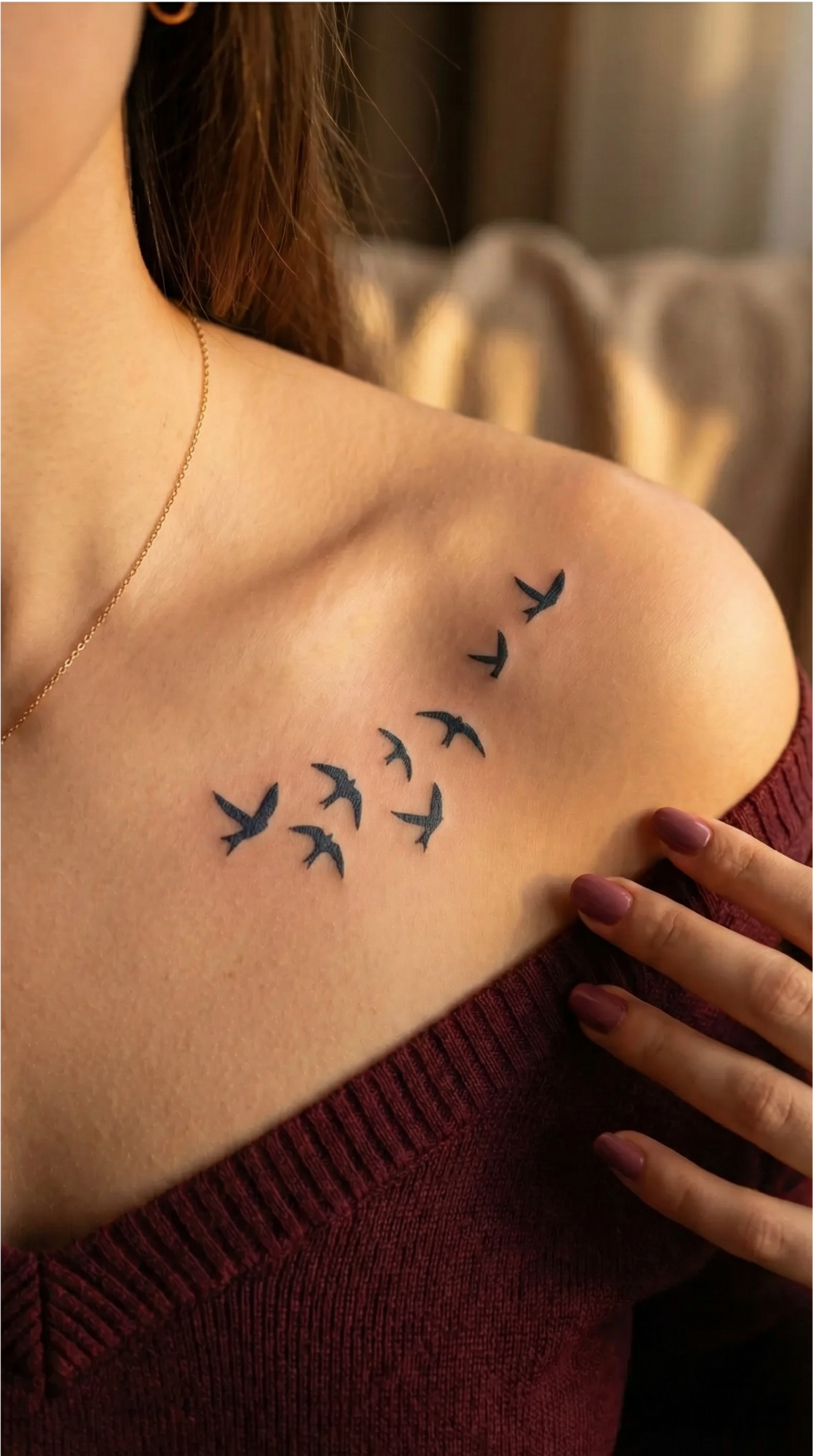


Old school, also known as American traditional, is the oldest easily recognizable tattoo style family in the Western tradition: bold black outlines, a limited palette of saturated colors, and clear motifs such as the swallow, anchor, dagger, or pin-up. It emerged in the early 20th century in tattoos worn by sailors and people in the circus world, and its bold lines and simple colors are not just an aesthetic choice, but a technical solution that helps the design remain legible on the skin many years later.
- It emerged in the early 20th century among sailors and circus performers, and tattoo artists such as Norman “Sailor Jerry” Collins gave it the form we recognize today.
- Bold black outlines and a palette of red, yellow, green, and black keep the design clear over the long term, not just during the first month after application.
- Each classic motif, from the swallow to the anchor and nautical star, originally had a story or a precise meaning for the sailor who wore it.
- A temporary version of an old school motif lets you see the design, its size, and its placement on your own skin, as a step before making any decision about a permanent tattoo.
What is old school style, and where did it come from?
Old school style has its roots in tattoos worn by sailors and people in the circus world in the early 20th century. Tattoo studios at the time displayed their designs on sheets called “flash,” from which clients chose the design they wanted, in a way that’s similar to how you browse a catalog of temporary designs today before settling on one in particular.
Norman “Sailor Jerry” Collins (1911–1973) is recognized as one of the people who laid the foundations of American traditional style, combining compositions from the 1920s and 1930s with influences from Japanese tattooing, and working mainly out of his studio in Honolulu (source: Sailor Jerry – Wikipedia). Many of the motifs we associate with old school today, from the swallow to the anchor, dagger, and pin-up, pass through his lens of simple composition that’s easy to read from a distance.
The tradition goes back even further than Sailor Jerry’s studio: tattoos were already common among American sailors during the American Revolution, and were used, among other things, as a means of identification in sailors’ protection papers (source: Tattoo – Wikipedia). The first professional tattoo studio in the US was opened in the early 1870s by Martin Hildebrandt, a Civil War veteran, and from the major ports, the tradition gradually spread to the tattoo artists who, a few decades later, would go on to shape the old school style you recognize today (source: Tattoo – Wikipedia).
Why line thickness matters for how the design holds up visually over time
Bold black outlines and a limited palette of red, yellow, and green, with black shading, are more than just a visual signature. As time passes, ink diffuses slightly under the skin, and a thin line or very light color loses clarity faster than a bold outline. Old school was designed from the start as a style that remains recognizable over the long term, not just during the first month after you get tattooed (source: Old school (tattoo) – Wikipedia).
Classic motifs and what they symbolized for sailors
Each old school motif originally carried a precise message for the person who chose it. The motifs weren’t interchangeable: a sailor knew exactly what the design they put on their skin said about them, and that’s part of the style’s appeal to this day.
The swallow and the anchor: the stories behind the two most popular motifs
The swallow, sometimes also called the bluebird, marked the distance traveled at sea in maritime tradition: one bird for about 5,000 nautical miles, and a second for 10,000. The numbers were passed from sailor to sailor more as a convention shared through stories than as a rule written down somewhere, so the exact versions differ between sources (source: Sailor tattoos – Wikipedia). The anchor had a more direct meaning: it signaled that the wearer had crossed the Atlantic Ocean, essentially serving as proof of a journey worn on the skin (source: Sailor tattoos – Wikipedia).
The nautical star was considered a symbolic guide for the way back to port, and Sailor Jerry popularized its red-and-black version, the same combination you recognize today in most old school designs (source: Sailor tattoos – Wikipedia). Daggers and pin-ups entered this repertoire later, especially through tattoos popular among US military personnel during World War II, alongside eagles and flags—a generation of patriotic motifs that joined the older sailor and circus imagery (source: Old school (tattoo) – Wikipedia).
How to tell if old school style suits you
Beyond the history, the practical choice comes down to legibility, the area you have in mind, and what you want to put in the spotlight.
- Bold lines and solid fills show up well on both a small design on the wrist and a larger piece on the arm or calf, while very fine designs can get lost from a distance or at smaller sizes.
- Placement matters just as much as the motif you choose: an anchor or swallow reads clearly on the forearm, calf, or collarbone—relatively flat areas where the outline doesn’t distort with movement.
- If you’re torn between a simple outline and a full old school design, the answer depends on what you want to put in the spotlight: for the shape of the design, outline style, rendered using linework only, is a better fit, while old school is the natural choice for the complete image, with its classic palette.
If you want to see how old school fits among other visual styles before deciding, this overview of tattoo styles briefly covers the most popular ones.
From a classic sketch to your own design
The motifs described above haven’t remained just a part of history: they also appear in today’s catalogs, rendered with the same bold-line and solid-color approach.

Marine Anchor is exactly the motif discussed above: a traditional anchor rendered as a temporary design, with rope dynamically coiling around the shank. According to the product description, the ink starts out light bluish and darkens to blue-black in about 24 hours, the design lasts up to approximately 15 days, and application takes 1-2 minutes.
If the motif that caught your eye is the dagger, you’ll find it among temporary designs dedicated specifically to this symbol. And if it’s your first tattoo and you’re still deciding on the design and the right placement, this guide to your first tattoo will help you put all the pieces together.
A temporary version shows you exactly how bold lines and old school colors look on your own skin: the size, the placement, and how the design reads from a distance. It remains a visual test, not a prediction of healing, pain, or the appearance of a permanent tattoo. For the full context, this general guide to tattoos covers the basics of safety and the difference between temporary and permanent tattoos, while why it’s worth testing a design before making it permanent explores this step in detail.