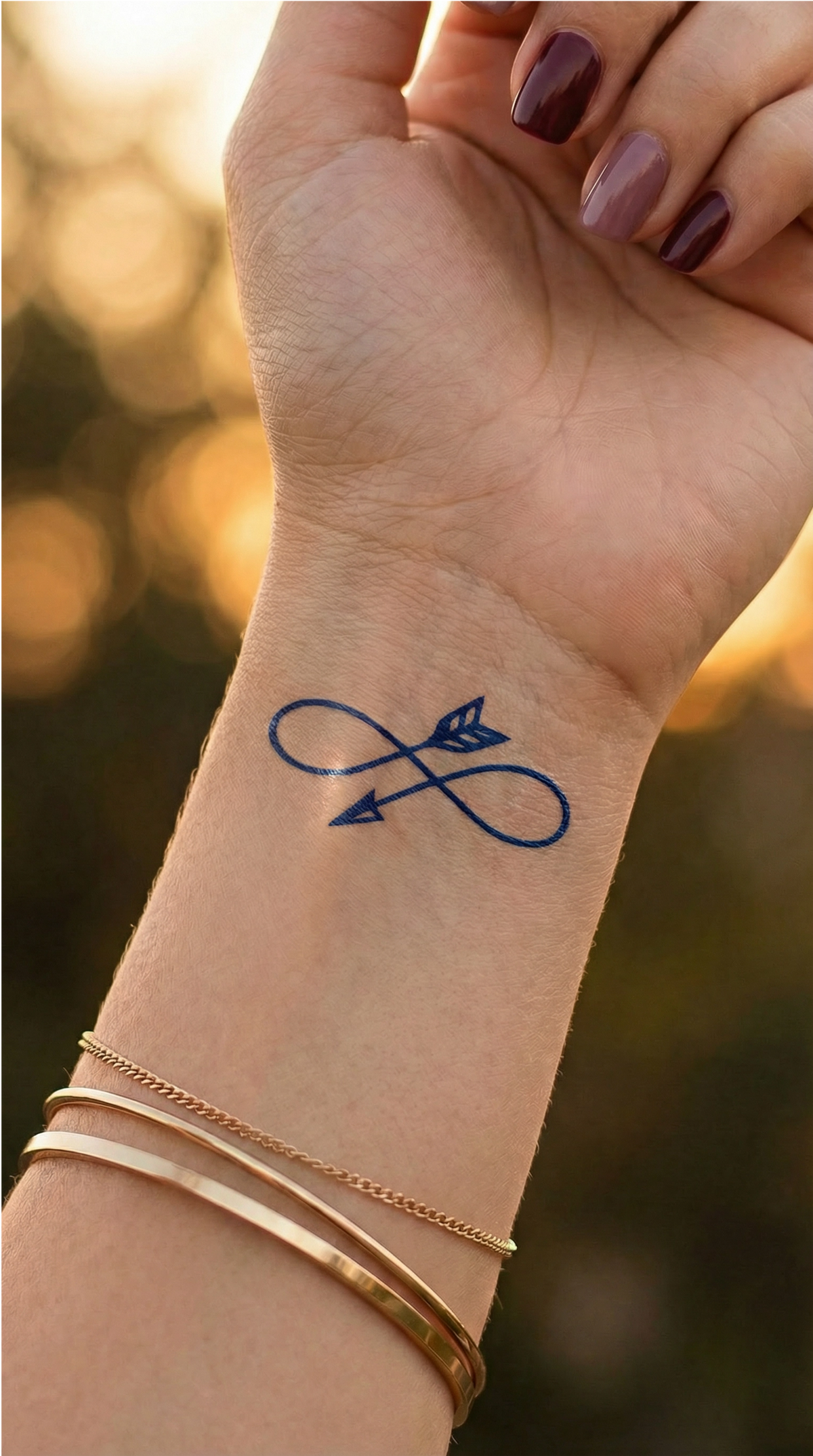


You’re considering getting a tattoo on the inside of your wrist, but you’ve read warnings that it’s dangerous because the veins there are visible. In short: A professionally applied tattoo stays in the dermis, the middle layer of skin, and does not reach the deeper veins or the tendons of the wrist. What is actually different about this spot are other factors: thinner skin, greater sensitivity while being tattooed, and more friction during healing—not any particular danger compared with other body areas.
- The ink is deposited in the dermis, not deep enough to reach veins or tendons.
- Visible veins on the wrist are an effect of thin skin and the way light scatters through it, not a sign that a needle will reach them.
- For most people, the inside of the wrist is more sensitive because there is little fatty tissue to cushion the needle.
- The actual risks of getting a tattoo—infection and an allergic reaction—depend on the studio’s hygiene, not on the wrist as a body area.
Where does the concern that an inner wrist tattoo is dangerous come from?
The concern usually comes from forum posts and press articles that interpret the clearly visible veins on the inside of the wrist as a warning sign. However, tattoo ink is deliberately deposited in the dermis, the layer of skin beneath the epidermis where the pigment-absorbing fibroblasts are located (source: Tattoo – Wikipedia). This depth is chosen deliberately: if the needle goes in too shallowly, the skin pushes the ink out and it fades quickly; if it goes in too deeply, bleeding occurs and the ink washes back out (source: Tätowierung – Wikipedia). Veins and tendons lie well below this target zone.
The reason the veins on the wrist are so easy to see is the thin skin in this area and the way light scatters through it: superficial veins therefore appear bluish, regardless of the actual color of the blood in them (source: Vein – Wikipedia). Their visibility is therefore an optical effect of skin thickness, not evidence that a needle could reach these blood vessels.
A studio that works at an appropriate, correct depth does not go anywhere near a vein or tendon. The myth arises because visibility is mistaken for danger—but the visibility of a vein says nothing about the risk of a professionally applied tattoo. If you’re more interested in designs that suit the wrist than in the safety question, you’ll find ideas in our article about wrist tattoos.
What is actually different about the inside of the wrist
Other factors, not the veins, are what really matter in this area. The skin on the inside of the wrist is thinner than on fleshier parts of the body, and several nerve endings lie close to the surface there. For most people, this causes more noticeable irritation during tattooing than, for example, on the upper arm or thigh.
Why it tends to sting more there
How much a tattoo hurts depends greatly on the body area chosen—it can range from uncomfortable to very painful, depending on where on the body you get tattooed (source: Tattoo – Wikipedia). For most people, the inside of the wrist is one of the more sensitive areas because there is little fatty tissue to cushion the needle and the nerves lie close to the skin’s surface.
The wrist is also constantly moving, and the tendons that make this movement possible run on the palm side beneath the flexor retinaculum and through the carpal tunnel in their own tendon sheaths—that is, well below the skin’s surface (source: Wrist – Wikipedia). This position affects how tattooing feels and how the area moves afterward, but it is not a safety risk of the tattoo itself.
Healing and longevity: what matters on the wrist
During healing, the wrist gets more incidental friction than many other parts of the body: sleeves, watches, bracelets, and frequent handwashing all come into contact with the freshly tattooed area. The usual aftercare instructions—keep it clean, don’t scratch it, and avoid friction—therefore matter more here than on less active areas, not less.
Over decades, tattoo ink moves somewhat deeper into the dermis, which helps explain why older tattoos lose their sharpness (source: Tattoo – Wikipedia). On a joint that is constantly moving, fine lines may therefore blur over time more than they would on a less active part of the body. This doesn’t make the wrist unsafe—it just means you can choose the design and line weight with this movement in mind. If you want to know which body areas tend to age especially well, you’ll find a comparison in our article about placements that age well.
The risks that apply to every tattoo—not just wrist tattoos
The documented risks of getting a tattoo are infection and allergic reactions, and both depend on the studio’s hygiene and aftercare—not on which body area you choose (source: Tattoo – Wikipedia). Unsanitary practices are the actual cause of serious infection risks; choosing a licensed studio that uses sterile, single-use needles is what affects safety, just as much on the wrist as anywhere else.
A fresh tattoo wound is also sensitive to contact with water: unsanitary tattooing can transmit HIV, hepatitis, and other infections, and swimming with a fresh wound carries a risk of Vibrio vulnificus infection, which can be life-threatening for people with weakened immune systems (source: Tätowierung – Wikipedia). This risk applies equally to every fresh tattoo and is not specific to the wrist. According to the US Centers for Disease Control and Prevention (CDC), there have also been no known cases of HIV transmission through tattoos to date (source: Tattoo – Wikipedia)—an indication that hygiene standards work in practice when followed.
A tattoo is also intended to be permanent, and even later laser removal usually requires several sessions spaced a few weeks apart, with no guarantee of a completely clean result—depending on the color, the depth of the tattoo, and individual factors (source: Tattoo removal – Wikipedia). This is a reason to feel confident about your design and placement, regardless of the wrist-specific factors above.
Try out the size and placement on your wrist first
Because the inside of the wrist is small, clearly visible, and constantly moving, seeing the actual size and placement on your own arm answers questions that a photo or digital mock-up leaves open.
A temporary or semi-permanent design shows you how a particular motif fits across the width of the inside of your wrist and how it looks as your hand moves. It is a test of placement and size—not a preview of how a permanent tattoo in this area would feel, heal, affect your skin, or fade over the years. Read our guide to temporary hand tattoos to find out how long a temporary design lasts on your hand and how to apply it, and see this article to learn why it is generally worth trying a design before making a permanent decision.
Fine lines and minimalist designs are a natural place to start with this test, because they are already the style most people consider for such a small, visible area.

A design like Lotus works for the same reason: it is narrow enough for the width of the wrist and easy to recognize despite the small area.
If you want to think more broadly about choosing your first tattoo, our guide to your first tattoo can help; you can also find designs suited to the hand directly in the Temporary Hand Tattoos collection.
So, the inside of the wrist is no more dangerous than other body areas. It is more sensitive to touch, needs a little more attention during healing, and makes even a small design especially noticeable. Knowing these three things lets you take your time deciding instead of being afraid because of a myth.