

“Henna design” is an umbrella term for the ornate patterns painted on the skin with henna paste, and if you’ve come across the term on social media, at a wedding or at a festival, you’ve probably already seen several different styles without knowing exactly what to call them. The recurring pattern families are flowers and vines, paisley, mandala and dense lace-like fills, and they differ both in how their lines are built and where they originally come from. This guide covers each family, explains the differences between Indian, Arabic and African mehndi styles, and then shows how a fine-line temporary tattoo can capture the same ornamental feel without claiming to be henna.
- Henna is a plant-based dye with its own timeline for color and longevity, not a generic term for ornamental patterns.
- The four most common pattern families—flowers/vines, paisley, mandala and lace-like fill—are recognized by how their lines are constructed, not just by how dense they are.
- Indian, Arabic and African mehndi styles differ above all in line density and how much bare skin is left visible between motifs.
- A fine-line temporary tattoo can recreate the ornamental linework, but it follows a different process from actual henna dye.
What henna (mehndi) actually is—and where the patterns originated
Henna is a dye extracted from the dried and ground leaves of the Lawsonia inermis plant, and it has been used for body art since antiquity in North Africa, the Middle East, ancient Egypt and Mesopotamia, and later on the Indian subcontinent too (source: Henna). In many of these regions, mehndi is still a central part of wedding traditions, and patterns are also painted for holidays such as Eid and Diwali.
What makes henna more than just a pattern on the skin is the dyeing process itself. Immediately after the paste is removed, the stain is orange, but it darkens to a deep reddish-brown over about three days through oxidation, then fades away completely within one to three weeks as the skin naturally sheds (source: Henna). It’s this timeline—not just the motif itself—that distinguishes real henna from other ways of wearing a similar pattern, something the comparison you may already be considering, temporary tattoos compared with henna, covers in more detail.
The pattern families you’ll recognize
“Henna design” doesn’t refer to a single aesthetic, but to several distinct pattern families that are often mixed together in the same design. Being able to name them makes it easier to describe exactly the look you’re after, whether you’re looking for henna in its original form or a fine-line alternative.
Flowers and vines
The most recognizable family is built from repeated leaf and petal shapes woven together into vines across the hand, wrist or forearm. The density varies considerably: some designs keep the vines sparse and airy, while others fill almost the entire area with repeated floral shapes.
Paisley (boteh)
The paisley motif—the curved teardrop shape often called boteh—originated in Persia and has been documented for more than two thousand years. It was woven into valuable termeh fabric for Persian nobility, spread to Kashmir around the 15th century, and from there entered Indian and Middle Eastern decorative traditions through Kashmiri shawls (source: Paisley (design)). However, what the shape actually represents has not been established: researchers have suggested everything from a stylized cypress tree to a palm or pine, while older theories point to the sun or a phoenix. The best way to describe its symbolism, therefore, is as debated rather than as having one fixed meaning (source: Paisley (design)).
Mandala and radial symmetry
Mandala—the Sanskrit word simply means “circle”—is a form built with radial symmetry around a central point. In Hindu and Buddhist traditions, the mandala is used as a map of cosmic realms and as an aid to meditation, and is understood as a symbol of balance and wholeness rather than pure decoration (source: Mandala). In Hinduism, the basic structure is often a square with four gateways enclosing a circle around a central point, and psychologist Carl Jung later popularized the mandala in Western thought as a symbol of psychological wholeness, alongside its religious origins (source: Mandala). If the mandala motif is what draws you in most, you can find a more in-depth guide in mandala pattern tattoos.
Lace-like fill
The fourth family is built from fine dotted or linear patterns that cover larger areas of the hand or forearm with texture rather than distinct individual motifs, a little like lace laid over the skin. If you want to explore this type of pattern in more depth, there’s a dedicated guide on the way: lace pattern tattoos.
Indian, Arabic and African mehndi styles compared
The terms “Indian style” and “Arabic style” often appear in searches, and they do point to real, consistent differences. South Asian (Indian) mehndi is characterized by fine, dense linework that often covers the entire hand and forearm, with very little visible skin between motifs. Arabic and Middle Eastern styles instead use bolder floral shapes, leaving more visible skin around each element, which creates an airier overall effect. African style tends toward simpler, bolder geometric shapes with fewer details per area (source: Mehndi). None of the styles is “better” than the others—they serve different purposes: coverage, visibility from a distance, or how long the pattern takes to apply.
If you’d rather compare this aesthetic with tattoo styles more broadly, beyond henna inspiration specifically, we have a wider guide on the way: tattoo styles explained.
Try the look today with a fine-line temporary tattoo
A temporary or semi-permanent design is a different medium from henna: it’s applied to the skin rather than dyeing it, which means it neither oxidizes nor fades through the same process as real henna paste. What it does is recreate the ornamental linework—not henna’s dyeing process. That’s an important distinction to keep clear, especially if you want to describe exactly what you have on your skin to someone else.
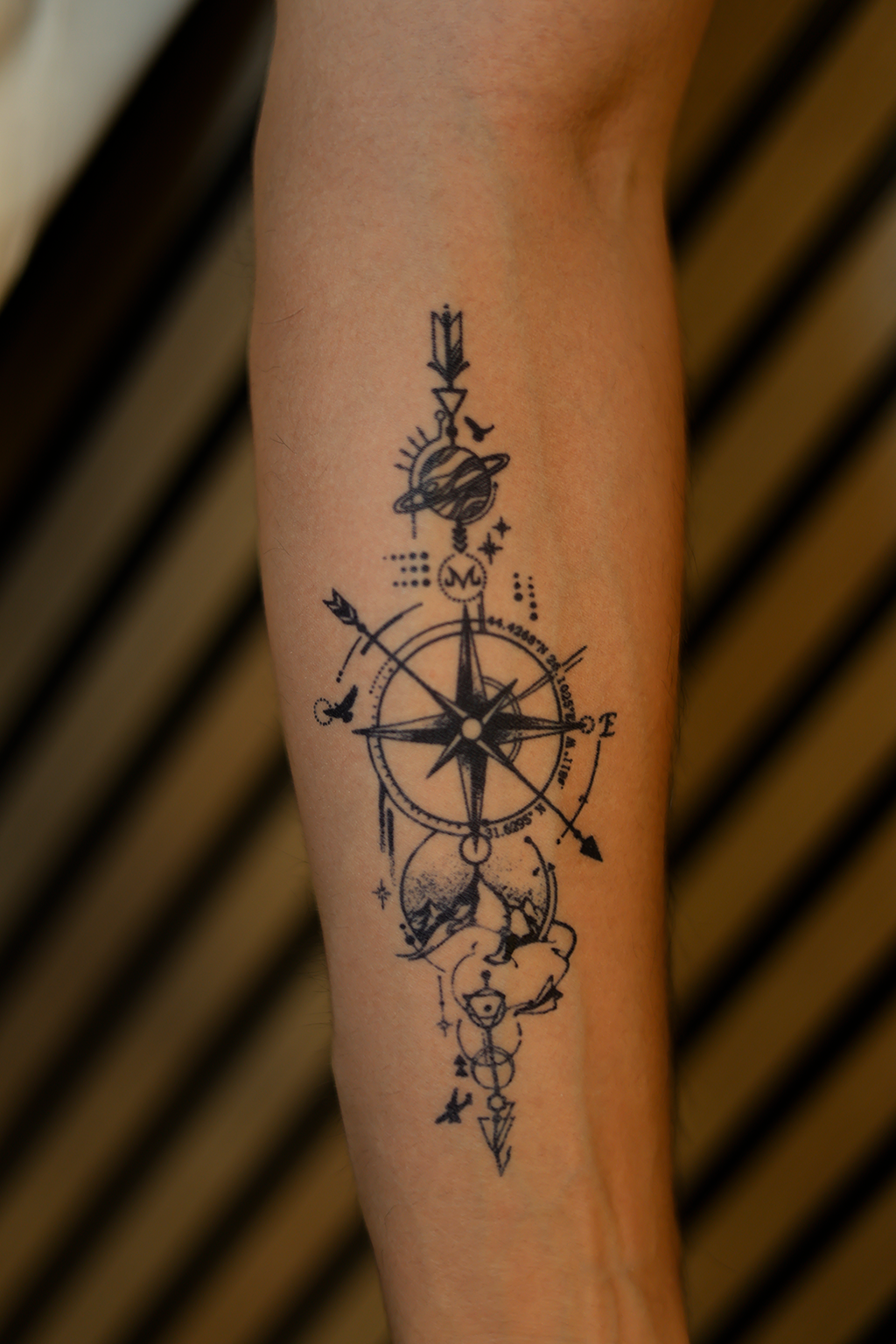
Radial, symmetrical motifs—compass patterns, star-based shapes—echo the same centered structure as the mandala family in henna, while fine, engraved-looking linework echoes the density of lace-like fill. That connection is what makes some geometric tattoo motifs feel familiar from the world of henna, even without containing a single traditional henna motif.


For exactly how long a semi-permanent design lasts, for example, it’s better to read how long does a semi-permanent tattoo last than to guess a number here, because longevity depends on several factors that vary from person to person. And if you want to see the full comparison between real henna and temporary tattoos—process, longevity and safety all in one place—it’s collected in temporary tattoos compared with henna.
Once you’ve decided which line density and symmetry appeal to you, browse the Geometrically collection for more fine-line, radially built designs to try right away.
Using a henna-inspired motif to test a future permanent tattoo
Many people browsing henna-inspired patterns do so as a first step toward a permanent tattoo in the same style, and a temporary design can actually be useful here: it shows how the size, placement and pattern density look on your particular skin tone and body shape before anything becomes permanent.
What it can’t do is predict how it will feel to get a permanent tattoo in the same style, how it will heal, whether it will fade over time or exactly how it will look in a few years—those are separate questions for another discussion, and a temporary test layer on the skin doesn’t answer them. So if you want to try a compass motif or another ornamental pattern, you’re evaluating the size and placement, not what the permanent result will look like.