

If you’ve seen an open hand repeated, sometimes with an eye in the center of the palm, and want to know what it means before wearing it on your skin, you’re looking at the hamsa, also known as the Hand of Fatima, Hand of Miriam, or Hand of Mary, depending on who names it. It is a protective symbol documented in Jewish, Islamic, and Christian traditions across the Mediterranean and Middle East, with origins predating those three religions as they are practiced today (source: Hamsa — Wikipedia). It is not the same as the Turkish evil eye: when the two appear together in the same design, each element retains its own origin, and this article focuses on the hand.
- The term hamsa comes from the Arabic khamsa, “five,” referring to the five fingers of the open hand.
- The name “Hand of Fatima” recalls the daughter of the Prophet Muhammad, but the symbol predates Islam and is also shared by Judaism and Christianity.
- The idea that it protects against the evil eye is a centuries-old cultural belief, not a proven property of the symbol or the tattoo.
- Before settling on a final design, you can see its actual size and placement with a temporary tattoo.
What is a Hand of Fatima (hamsa) tattoo, and how is it different from the Turkish evil eye?
The hamsa is an open hand, with the fingers together or apart, that different cultures adopted as a protective amulet. Its name varies by tradition and region: in the Arab and Islamic world, it is often called the Hand of Fatima; in Sephardic Judaism, it is commonly called the Hand of Miriam; and in Christian contexts, it appears as the Hand of Mary. The three names refer to the same symbol from different religious perspectives, and that shared usage is precisely what makes it interesting: it does not belong exclusively to one faith.
Many designs include an eye drawn in the center of the palm, which leads to confusion with the Turkish evil eye, or nazar. These are two distinct symbols with their own histories: the eye on its own belongs to a different protective tradition that we do not explore here. If you’re interested in comparing the hamsa with another religious symbol commonly used in temporary tattoos, you can read about how the cross and other religious symbols are used in temporary design, where they are discussed separately.
Origins: a symbol shared by Islam, Judaism, and Christianity
Protective hands have been documented in the ancient Near East since before Islam and Judaism existed in their current forms, making the hamsa a pre-Islamic symbol that different religions adopted over time (source: Hamsa — Wikipedia). The name “Hand of Fatima” itself seems to have a more recent origin than is often assumed: according to the same source, the name was a label from the French colonial period rather than an original indigenous Arab use of the symbol. This does not invalidate its connection with Fatima in Islamic tradition, but it does place the name in its actual historical context.
Islamic tradition: Fatima and the Shia Panjtan
Fatima was the daughter of the Prophet Muhammad and his first wife, Khadija, and, together with Muhammad, her husband Ali, and her sons Hasan and Husayn, she is part of the group known as the Ahl al-Bayt, which is central to Shia theology (source: Fatima — Wikipedia). In that same tradition, the hand’s five fingers are read symbolically as the Panjtan, that is, those five figures (source: Hamsa — Wikipedia). This interpretation explains why, within Shia Islam, the symbol carries a specific devotional significance and is not merely decorative.
Jewish tradition: the Hand of Miriam and the letter Shin
In Judaism, the same symbol is known as the Hand of Miriam, and in Kabbalah it is sometimes associated with the Hebrew letter Shin, the first letter of “Shaddai,” one of the names of God (source: Hamsa — Wikipedia). The Sephardic Jewish community adopted it widely, and it is commonly used on mezuzahs, bracelets, earrings, keychains, and other everyday objects (source: The Hamsa — My Jewish Learning). The same tradition also brought the symbol into more significant religious objects, such as the decoration of marriage contracts (ketubot) and accessories used for dressing the Torah, including pointers and the Passover Haggadah (source: Hamsa — Wikipedia). Its presence both on everyday objects and on religious objects confirms that it is not a modern addition, but an established part of Jewish material culture.
Christian adoption and the symbol’s pre-Islamic roots
In Christian communities across the Mediterranean and Middle East, the same design circulates as the Hand of Mary, alongside its Jewish and Muslim interpretations. This triple adoption only makes sense when you understand the starting point: a protective hand symbol that already existed in the region’s cultures before the three monotheistic religions incorporated it, each with its own name and religious explanation. That is why it should not be presented as if it belonged exclusively to one tradition: its history is precisely that of a shared symbol.
What it really represents: protection against the evil eye, not a guaranteed amulet
The traditional belief associated with the open hand is that it protects against the evil eye—that is, a malicious gaze that was culturally believed to have the power to cause illness, death, or misfortune (source: Hamsa — Wikipedia). It is important to distinguish between two things: one is a cultural belief, documented and sustained for centuries; quite another would be to claim that the symbol or tattoo really protects against anything. The first is a matter of history and anthropology; the second has no verifiable basis, and this article does not present it as fact.
There is also no single religious position on the symbol. Even within Islam, interpretations differ: some Salafi authorities reject it as an impermissible amulet (source: Hamsa — Wikipedia), while in other movements and communities the symbol coexists with religious practice without conflict. This internal diversity is useful when answering the question of whether getting a Hand of Fatima tattoo is cultural appropriation: since it is a symbol shared across several religions and regions, with no single authority regulating it, the most reasonable approach is not to avoid it altogether, but to learn about its origins, not treat it as a mere fashion accessory, and avoid combining it with elements unrelated to its meaning.
How to choose a Hand of Fatima design with cultural respect
Learning about the symbol’s origins before choosing a design helps you make an informed decision instead of copying the first image that appears in a search. A design that combines the hamsa with decorative elements unrelated to its history—fonts, mascots, or motifs from other cultures—dilutes the meaning that makes it appealing in the first place. Keeping the design focused on the hand, with or without the eye in the palm, depending on your preference, usually respects the symbol better than a heavily embellished version.
As for placement, there is no universally documented rule about which way the fingers should point or where on the body it is “appropriate” to wear it; what may matter is each person’s personal or religious reason, since they are best placed to know what location makes sense for their own relationship with the symbol. What you should avoid is choosing the placement purely for aesthetic reasons without first understanding what the symbol you are going to wear on your skin represents.
Before making it permanent: try the size and placement with a temporary tattoo
A temporary or semi-permanent tattoo lets you see the actual size, how it looks in proportion to the rest of your body, and what your chosen placement looks like—things an image on a screen cannot convey. However, trying a temporary design does not predict pain, healing, a possible allergic reaction, or exactly how a permanent tattoo will look; it is only useful for evaluating the design, size, and placement. If you want to understand better why it is worth taking this step before making a final decision, you can find a more detailed explanation here.
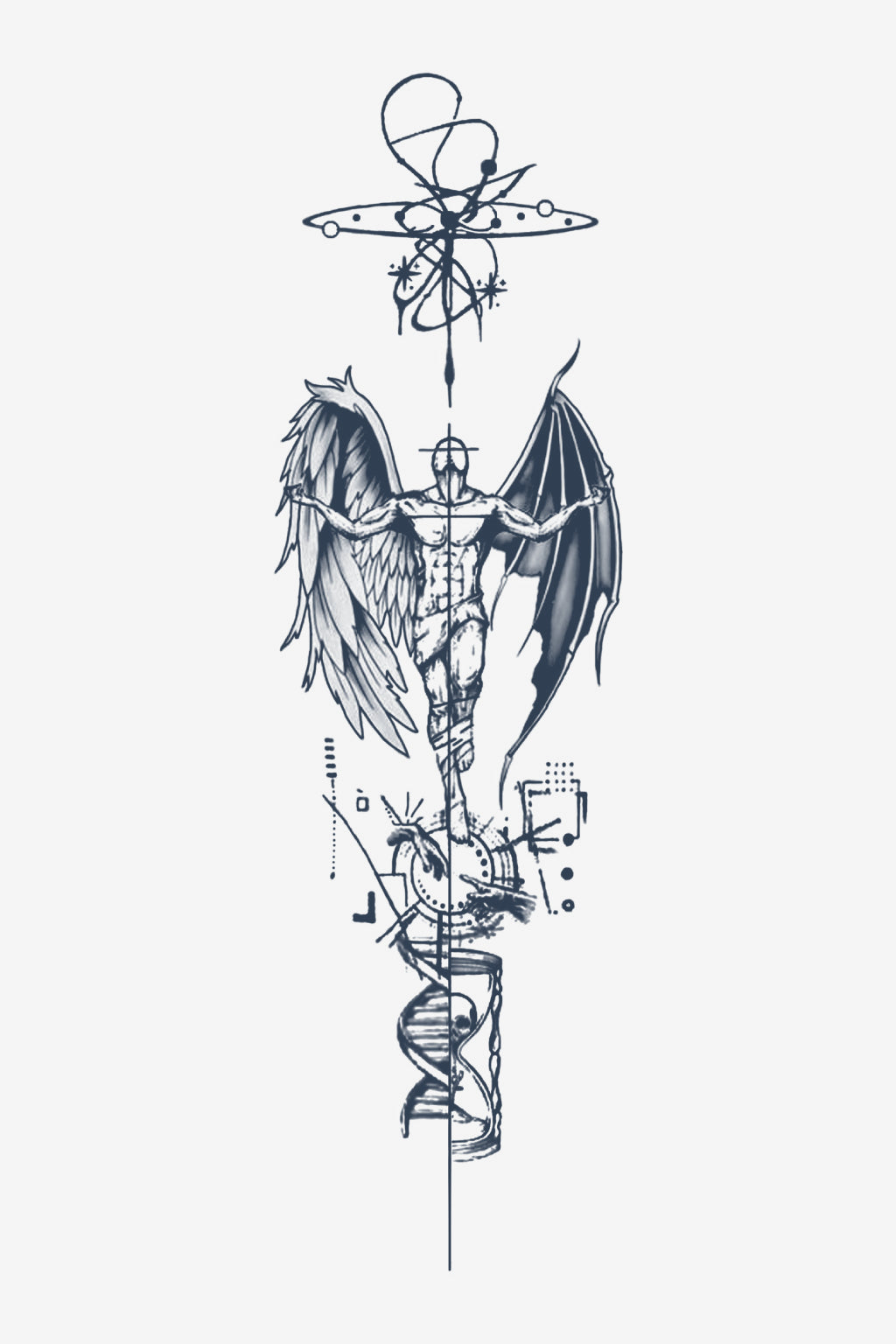
To get an idea of how a design with protective symbolism looks on the skin, this design lets you compare the size and general appearance before deciding on yours:

If you’re looking for the exact Hand of Fatima motif, the most direct option is a custom temporary tattoo featuring that specific design. If you’d rather explore other ideas with themes of faith or protection first, the Temporary Spiritual Tattoos collection brings together several options to compare.
The hamsa is not the only symbol with protective or directional meaning that is worth understanding before getting it tattooed: if you’re interested in this kind of symbolism, you can also read about the meaning of the compass rose, crow symbolism in tattoos, or, if you’re looking for something with a different message, the most common symbols in feminist tattoos.