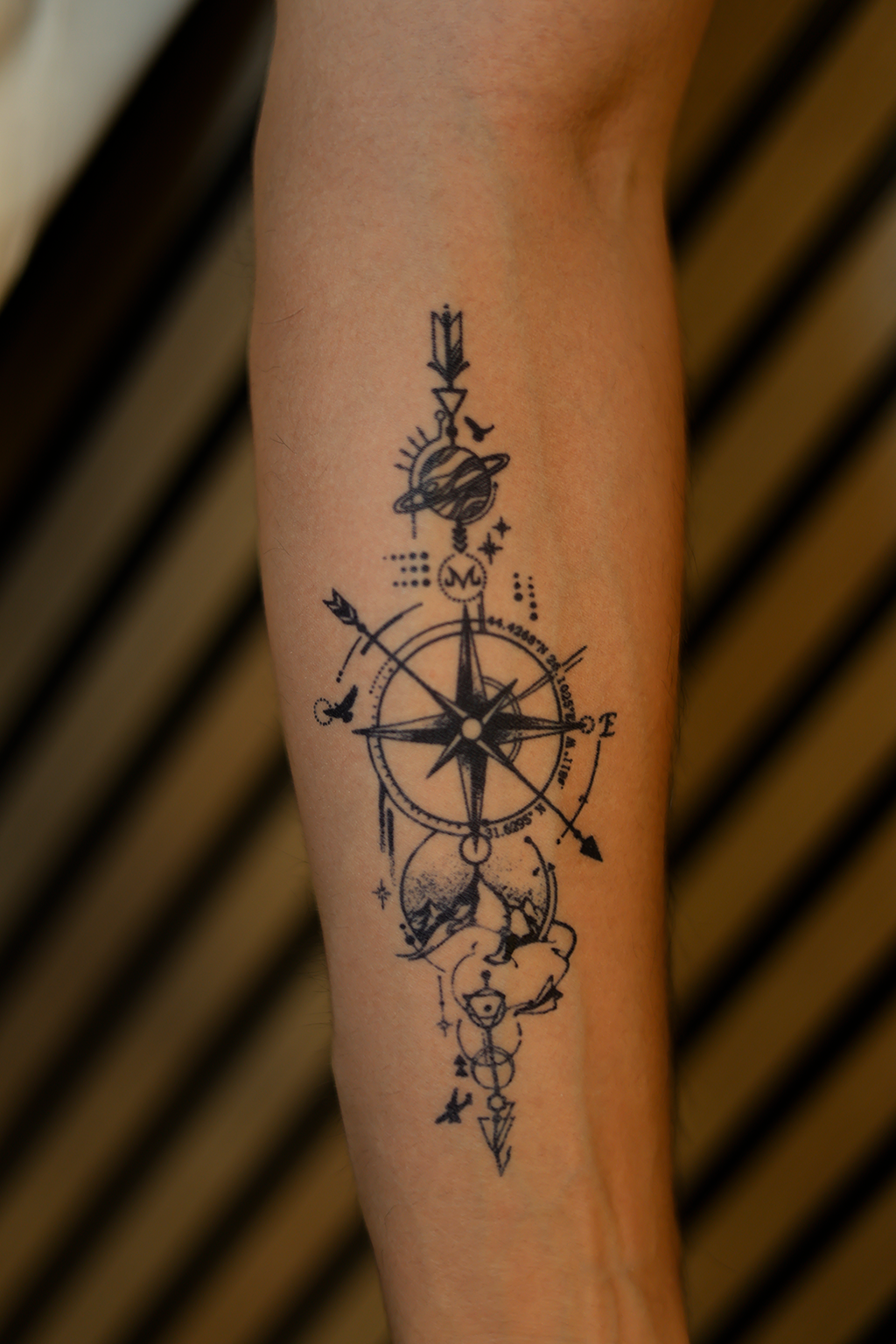


A Game of Thrones tattoo doesn’t have to be a series logo or a scanned coat-of-arms graphic to express an affinity with one of the great houses. Each of the four central heraldic animals—the direwolf of House Stark, the lion of House Lannister, the stag of House Baratheon and the dragon of House Targaryen—has its own meaning, one that existed before the series and has been found in heraldry and mythology for centuries. This article explains the meaning behind each animal, shows which approach remains legible at a small tattoo size, and explains why a temporary or semi-permanent design tests only the motif, size and placement—not the result on permanently tattooed skin.
- Each heraldic animal can be understood as a standalone symbol, independent of the series artwork: the wolf represents unity, the lion and stag represent courage and dignity, and the dragon represents power.
- For small tattoos, the level of detail determines legibility—a stylized silhouette often remains clearer than a literal rendering with lots of fine lines.
- A multi-headed dragon motif can come from its own mythological tradition, such as the Greek Hydra, rather than being a copy of the Targaryen sigil.
- A temporary or semi-permanent tattoo shows you how the motif, size and placement look in everyday life, but not what a permanent tattoo feels like or how it heals.
Game of Thrones as a source of tattoo ideas: symbols, not copies
The wolf, lion, stag and dragon are heraldic animals that predate the series that made them famous. In European heraldry, these figures had long represented qualities such as vigilance, courage or power before “Game of Thrones,” and these older layers of meaning can serve as the basis for a standalone tattoo design.
A design that draws on the meaning behind the animal needs neither the series logo nor the exact sigil graphic from the source material. It’s enough to treat the animal itself—its stance, its lines, its expression—as its own artistic interpretation, without preventing anyone from recognizing the association with the respective house.
The following sections look at one heraldic animal per house, explain its meaning and use the dragon as an example to show how detail and size affect each other.
Direwolf (House Stark): unity and vigilance
The House Stark coat of arms shows a grey direwolf running across a white field (source: House Stark - Wikipedia). This calm, running stance differs from the more upright, dramatic poses of other heraldic animals, so it can also be rendered as more understated graphic linework.
The symbolism of the wolf itself developed independently of House Stark: In numerous North American cultures, the wolf’s devotion to its pack is a central element of the beliefs and stories surrounding it (source: Wolves in folklore, religion and mythology - Wikipedia). Those who choose a wolf motif are usually choosing a symbol of unity and loyalty to their own family or group, not necessarily a reference to Winterfell.
If you’re looking for specific wolf motifs and other interpretations of their meaning, you can find more in the in-depth article on wolf tattoos, which also covers different poses and styles.
Lion (House Lannister) and stag (House Baratheon): courage, power and dignity
House Lannister bears a golden, upright lion on a purple field (source: List of A Song of Ice and Fire characters - Wikipedia). The lion is one of the most commonly used figures in heraldry and is traditionally considered a symbol of courage; in ancient Mesopotamia, it was also associated with kingship (source: Cultural depictions of lions - Wikipedia). Taken together, courage and the claim to leadership make the lion a motif that can represent a confident, assertive attitude, independent of House Lannister.
House Baratheon’s sigil is a black stag on a gold field, to which a crown was added after a family member ascended the throne (source: List of A Song of Ice and Fire characters - Wikipedia, see above). The stag, particularly in its white form, often represents a difficult, demanding quest in mythology and heraldry, as well as dignity and the burden of a position of responsibility, as in the coat of arms of Richard II (source: White stag - Wikipedia). As a tattoo, the stag can therefore work well as a symbol of determination toward a goal that isn’t easy to reach at first glance.
The catalog currently doesn’t have a motif specifically designed for either the lion or the stag; if you’d like one of these animals as a tattoo, you can request a custom design that captures its stance and meaning.
Three-headed dragon (House Targaryen): from source material to your own version
The House Targaryen coat of arms shows a red, two-legged dragon with three heads breathing fire against a black field (source: House Targaryen - Wikipedia). It’s this combination of three heads and a specific arrangement of colors and pose that makes the sigil graphic easy to recognize—and is also why it can hardly be transferred one-to-one as a standalone tattoo design without looking like a direct copy of the series version.
Dragons themselves have a presence as powerful, awe-inspiring beings in nearly every culture, independently of this: In East Asia, they were viewed predominantly positively and associated with the control of rain and waterways; in China, they served as a symbol of imperial power from the Han dynasty onward (source: Dragon - Wikipedia). This broader symbolism can be used for a tattoo design without drawing on the specific Targaryen graphic.
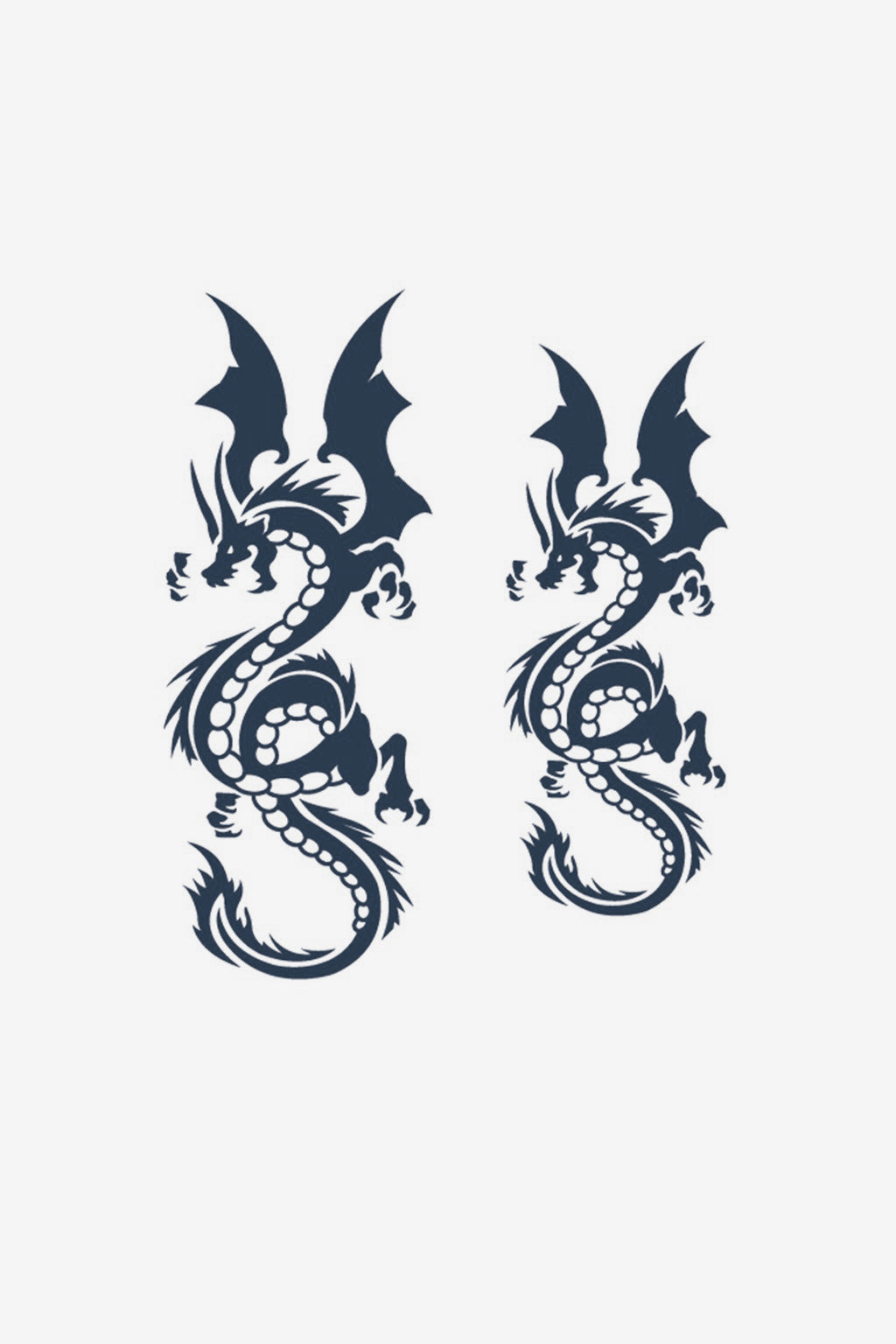
One option is a design with two symmetrical dragons, as shown in the Dragons motif: Two equally prominent figures in symmetrical poses evoke the ideas of power and balance that also lie behind the Targaryen sigil, without copying its three-headed composition.

If you’re interested in a multi-headed motif, Hydra offers a very different, standalone source of inspiration. The motif is based on the Lernaean Hydra from Greek mythology: a many-headed serpent whose heads grew back whenever they were not cauterized (source: Dragon - Wikipedia, “Ancient Greece” section, see above). Multiple heads are therefore not a reference to the Targaryen graphic, but part of its own, much older storytelling tradition.

Stylized vs. literal: what works better for small tattoos
The smaller the area, the more likely fine lines are to blur together as the skin moves or the motif loses some sharpness over time. A dragon with individually rendered scales, claws and wing veins looks impressive on a large area such as the upper arm, but on a wrist or finger it can quickly turn into an indistinct dark spot.
A stylized silhouette—reduced to the basic shapes of the body, wings and, where relevant, number of heads—remains recognizable even at just a few centimeters in size because it relies on clear, continuous outlines rather than lots of individual details. As a rule of thumb, if you’re planning a motif for a small area such as the wrist, ankle or finger, a simplified version usually works better; on the forearm, calf or back, more detail can still be easy to read.
A test run, not a preview: what a temporary or semi-permanent tattoo shows
A temporary or semi-permanent tattoo mainly answers three practical questions: How does the chosen motif look on your skin at its actual size, does the placement suit what you want to show or cover up in everyday life, and does the motif remain legible at this size when you move or look at it from a distance?
It’s just as important to know what this kind of test run doesn’t show: It says nothing about what getting a permanent tattoo feels like, how the skin heals afterward, whether an allergy to permanent tattoo ink can occur, or exactly how the finished result looks on real skin once it has fully healed. These questions depend on the tattoo technique used, the needle, the ink and your individual skin, and fundamentally can’t be answered with a temporary or semi-permanent design.
The article on getting your first tattoo explains in detail how to narrow down your choice of motif and placement for a first tattoo.
Which symbol is right for you?
In the end, it’s less about which house you belong to and more about which meaning you actually want to carry: The wolf suits unity and loyalty to the people who matter to you. The lion and stag represent courage and a dignity that doesn’t impose itself, but shows through in your bearing. The dragon represents power in a broad sense shared across cultures, reaching far beyond a single series.
If you’re looking for more fantasy and mythology motifs beyond these four animals, you’ll find them in the overview article on fantasy and mythology tattoos and in the Fantasy and Mythology collection, which includes other dragon and fantasy designs alongside Dragons and Hydra. If you’re more interested in symbols from another well-known series, you’ll find related ideas in the article on the Harry Potter tattoo.