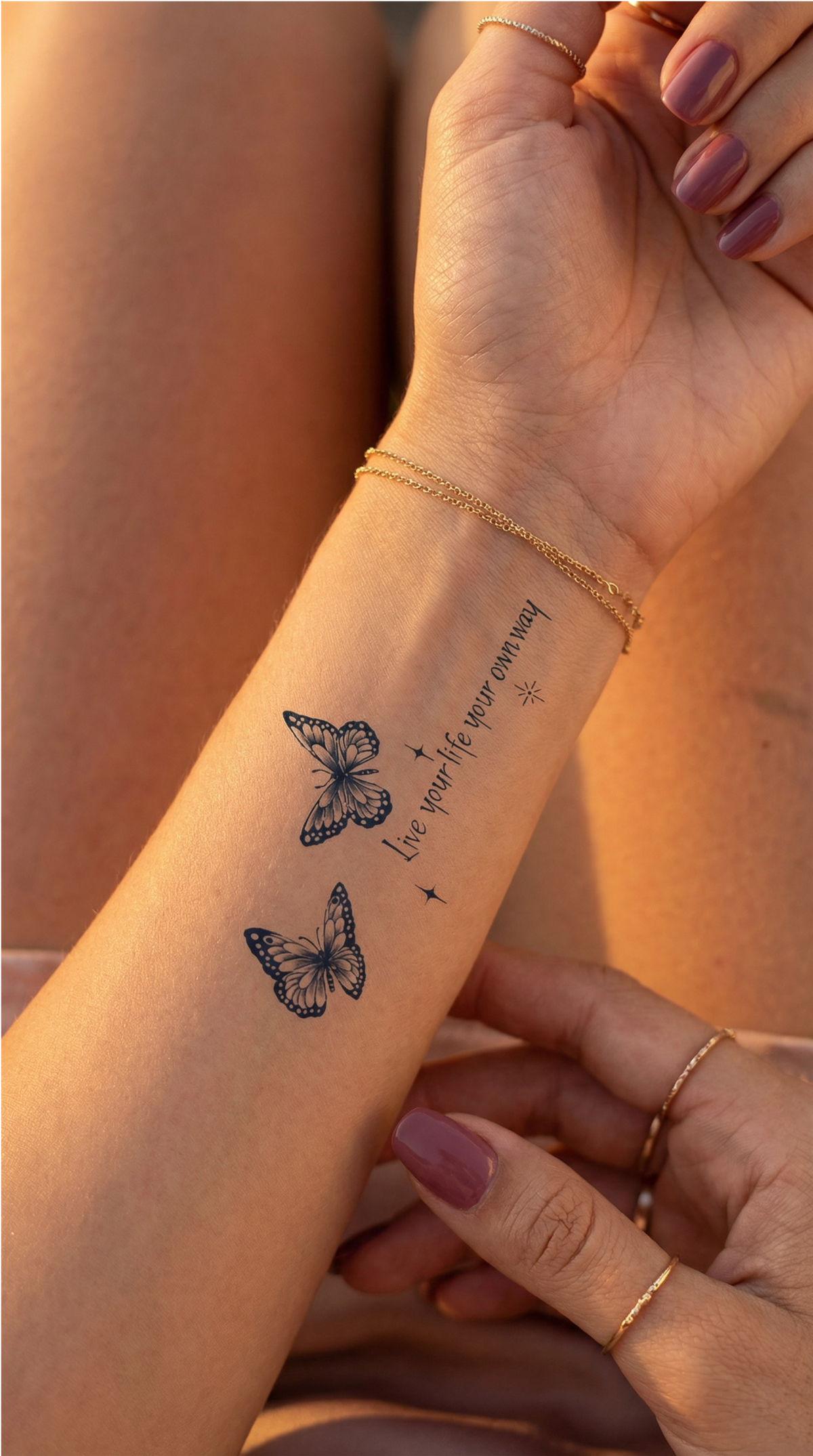


An elegant women's back tattoo comes from pairing the chosen area with the right type of composition: the spine lends itself to a vertical design that follows its natural line, the shoulder blades allow for a mirrored composition repeated on both sides, while the lower back is the smallest and most discreet area, suited to a compact motif. The right size depends on the level of detail in the design and how often you wear clothes that leave your back bare, while anyone considering a semi-permanent option can rely on verified information about color development and how long it lasts.
- Spine: it follows a vertical line that is never perfectly straight, so a design created to adapt to its curve looks more harmonious than one forced into a rigid line.
- Shoulder blades: as a symmetrical pair, they lend themselves to a mirrored motif on each side, such as wings or birds in flight.
- Lower back: this is a smaller area, often chosen for compact designs that remain legible even at a reduced size.
- Size: a design rich in fine details needs more space; otherwise, the details get lost at a normal viewing distance.
- Duration: an InkLabs semi-permanent tattoo reaches its final color after 24-36 hours and lasts up to 15 days, fading gradually.
How to choose the right area of the back
Before thinking about the subject, it's worth understanding how each area of the back works, because the same idea can work well in one spot and poorly in another. The spine, shoulder blades and lower back have different shapes, proportions and levels of visibility, and understanding them helps narrow down the options before looking at the designs themselves.
Spine: vertical lines
The spine never follows a perfectly straight line, which is precisely why a design created to follow its contours tends to look more in harmony with the shape of the body than a motif forced into a rigid line. For this reason, vertical, elongated designs work well, such as stacked mandalas, stylized branches or short lettering arranged over several lines.
Shoulder blades: symmetry and mirrored compositions
The shoulder blades form a symmetrical pair on either side of the back, and this symmetry is precisely what makes a mirrored composition feel natural: the same motif is repeated and flipped on each side, like two wings or two birds that seem to be flying in opposite directions. Anyone who wants to try this kind of composition can apply the same design twice, once on each shoulder blade, as with the flock of Birds, so that the two halves read as a single subject when the back is bare.

Lower back: compact designs
The lower back is the smallest of the three areas, which is precisely why it suits compact designs that remain clean-looking even without a lot of space: a minimalist symbol, a small geometric composition or a motif that evokes a single element. Anyone who prefers something discreet, perhaps visible only in a cropped top, tends to choose this area rather than the spine or shoulder blades.
Elegant compositions that work on the back
Once you've identified the area, the choice of composition depends on how much you want to emphasize the body's lines or, conversely, keep the design independent of the shape of the back. The designs most often chosen by women for this part of the body include floral motifs, feathers and butterflies (source: Back tattoos: 20 ideas for decorating the spine); the mirrored compositions already discussed for the shoulder blades are another option, and each of these designs is better suited to a specific area.
Fine-line floral motifs, with thin lines and minimal fill, work well on a shoulder blade or the side of the back, where space is limited but the skin is relatively flat. The Forest Face design, with a face surrounded by flowers and leaves in fine lines, is an example of this kind of delicate composition, created to remain legible even in a compact format.

For the spine, on the other hand, a vertical geometric design naturally follows the structure of the back without needing adjustments. Strength's mandala, with its precise shapes arranged along a central axis, is designed specifically for this kind of alignment: the symmetry of the design follows the line of the spine rather than working against it.

On the lower back, where space is more limited, a minimalist composition with just a few essential elements conveys the idea without crowding the area. Celestial Synchronicity, which brings the sun, moon and stars together in a simple design, is an example of how a subject with several elements can remain orderly when the composition is designed for a compact space.
Anyone who prefers words to images can consider vertical lettering, a short phrase or a few words arranged along the spine: the same principle as with vertical geometric compositions applies, with the additional consideration of the text's length in relation to the available space, because a phrase that's too long ends up looking compressed or difficult to read from a distance.
Size and legibility: how large should the design be?
The right size for a back tattoo depends not only on personal taste but also on the level of detail in the chosen design. A motif with many fine elements, such as overlapping petals, distinct feathers or complex symmetry, needs more space to remain legible: if the design is made too small, those details blur together, and from a normal viewing distance the result looks less defined than it did in the sketch (source: How Big Should a Back Tattoo Be? A Practical Guide).
For the same reason, leaving open space around the design helps more than filling every available inch: an area of skin without ink makes the composition stand out and avoids a crowded effect, which is particularly relevant on the spine and shoulder blades, where the available surface is limited compared with the entire back (source: How Big Should a Back Tattoo Be? A Practical Guide).
The clothes you wear most often also influence the choice. A backless or crisscross top reveals the entire area between the shoulder blades, while a regular T-shirt or shirt covers much of the lower back and, at most, shows the upper back when you bend over. Anyone who wants a design that is always visible with everyday clothes should consider this before even choosing the composition, because a design intended to be seen with a low-cut outfit may be almost invisible in everyday life.
How long does a semi-permanent tattoo on the back last?
For anyone considering the semi-permanent version before making a permanent decision, the color development and duration times have already been documented for the InkLabs product. The final color doesn't appear right away: in the first few hours after application, the design looks lighter, and the full shade only appears after 24-36 hours. Anyone expecting to see the final color immediately could therefore judge the result prematurely.
It lasts up to 15 days, and the design doesn't disappear suddenly: it fades gradually as the surface layer of skin renews itself, a natural process of the skin. Areas such as the shoulder blades and sides of the back, where there's less everyday friction than on the hands or fingers, tend to keep the design for longer; intense sweating, tight clothing in direct contact with the skin and frequent washing with very hot water, on the other hand, shorten how long it lasts because they speed up skin renewal in the area.
This means the same composition can last slightly different lengths of time depending on the area of the back chosen and your daily habits, a useful factor to consider alongside size and composition when choosing what to try first.
Try the design before making any permanent decision
Once you've chosen the area, composition and size, the natural next step is to see how the design actually looks on your own back, not just in a sketch or on a model with a different body shape. Applying the composition as a temporary or semi-permanent back tattoo lets you check how the curve of the spine, the distance between the shoulder blades or the space on the lower back affect the design's actual appearance, in front of a mirror or in a photo taken by someone else.
This test is about visual appearance only: where the design sits, how large it looks in relation to your body and how it goes with the clothes you usually wear. It does not predict pain, healing time, the risk of allergic reactions or what a permanent tattoo would look like years later: a temporary or semi-permanent design is a way to assess the design, size and placement, not a preview of a tattoo made with a needle and permanent ink.
Anyone who wants to start with a catalog designed specifically for this area of the body can browse the Temporary Back Tattoos collection, while those more interested in floral motifs can find more options in the collection dedicated to floral designs. For anyone looking for inspiration for areas of the body other than the back, these temporary tattoo ideas for women are also useful; those who want to explore a specific style can read more about the meanings of floral motifs, fine-line style or minimalist style. Anyone who hasn't yet decided on an area or subject can start with the guide to choosing your first tattoo, which approaches the decision more generally.
In short, the back offers three areas with different considerations, each suited to specific compositions and with precise size limits to respect. Looking at the area first, then the composition and finally the size, rather than starting with an isolated image found online, helps you understand how a design will actually look on your own back before taking any further steps.