

A tattoo needle does not place the ink in the outermost layer of skin, but much deeper: in the dermis, the layer just beneath the constantly renewing epidermis. Because the dermis does not continually shed its cells like the skin’s surface, the pigment remains there practically permanently. That is exactly what distinguishes it from a temporary transfer or a semi-permanent design: both stay in or on the epidermis and therefore work on a completely different principle.
- Two skin layers matter most for a permanent tattoo: the epidermis on the outside, which continually renews itself, and the dermis beneath it, which makes up most of the skin’s thickness.
- The ink stays in the dermis because the body’s own immune cells take up the pigment instead of carrying it away, and retain it there for decades.
- A temporary or semi-permanent design does not change this mechanism, because it does not reach the dermis at all. So it also tells you nothing about how a permanent tattoo feels, heals, or looks in a few years.
What actually happens to your skin when you get a tattoo?
For a tattoo to remain visible for years, the ink has to cross a certain boundary in the skin. The needle first pierces the epidermis and then deposits the pigment in the dermis, the layer of connective tissue directly beneath it (source: Tattoo – Wikipedia). It is difficult to give a meaningful fixed depth in millimeters, because the equipment, needle grouping, and body location all affect the result. What matters is not an exact number, but that the ink actually crosses this boundary between layers: if it stays only in the epidermis, it eventually disappears on its own.
Epidermis: the layer that constantly renews itself
The epidermis is the thin outer protective layer of the skin. Its cells move upward over several weeks and are eventually shed, a process that never stops in healthy skin. Any ink that stays only here inevitably leaves the skin once the affected cells are due to be replaced.
Dermis: the layer that holds the ink
Beneath it lies the dermis, a much thicker layer that, according to the Cleveland Clinic, accounts for around 90 percent of the total skin thickness and contains blood vessels, nerves, and connective tissue (source: Skin: Layers, Structure & Function – Cleveland Clinic). Because this layer is not constantly renewed like the epidermis, anything deposited there remains basically in place.
Why the ink stays in the dermis instead of disappearing
The fact that tattoo ink is in the dermis does not, by itself, explain why it stays there. The real reason lies in the immune system’s response: it recognizes the pigment particles as foreign material and sends in cells called macrophages, which take up the pigment instead of carrying it away. The pigment remains trapped in successive generations of these cells, which explains why the ink does not disappear with normal skin renewal (source: Tattoo – Wikipedia).
Over decades, the pigment can migrate a little deeper into the dermis. This is one reason why very old tattoos often look softer and less sharply defined than they did on the day they were inked, a gradual effect linked to the same mechanism that holds the ink in place in the first place.
Why a temporary or semi-permanent design works completely differently
A classic temporary transfer, like the kind you know from stick-on tattoos, sits on the skin rather than penetrating it. That is exactly why it rubs off relatively quickly with friction or contact with water.
A semi-permanent design in the Jagua style works on a different principle, but one that also has nothing to do with the dermis: this ink penetrates only the outer epidermis and temporarily bonds with the skin cells at the surface. It reacts with keratin and other proteins in this layer, which is why the color initially looks bluish and light right after application and only develops into its final, darker shade over about 24 to 36 hours. Because the ink is bound only to these surface cells, it fades as those cells are shed during the skin’s normal renewal cycle, and usually lasts up to about 15 days, depending on activity, placement, and skin hydration.
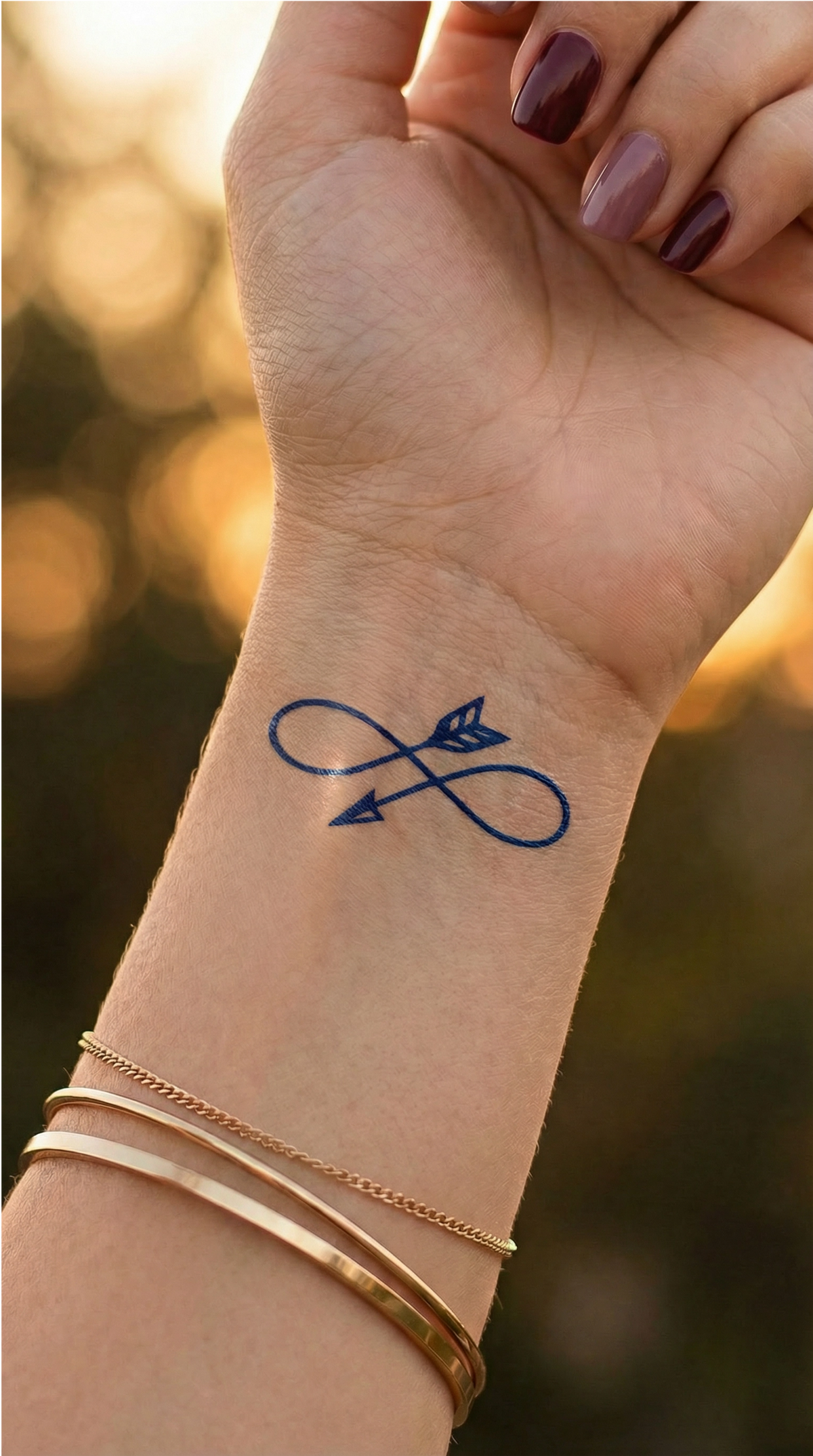
If you want to see a design in a particular spot before deciding on a permanent tattoo, you can use a temporary or semi-permanent design for this, for example a fine-line design such as the “Infinite” design or a minimalist design such as the “Butterflies” design. Both show what a design looks like at the desired size and in the desired spot, without saying anything about how it will behave in the dermis later on.


One clear distinction remains important: neither the darkening of a semi-permanent design nor its fading after a few days says anything about how painful a permanent tattoo is, how the skin heals afterward, or what the design will look like in a few years. These two options involve the epidermis, while a permanent tattoo involves the dermis, and the two layers behave in fundamentally different ways.
What you can do with this difference
The difference in depth explains why a temporary or semi-permanent design is useful mainly as a tool for figuring out size and placement, not as a preview of pain or healing. If you are not yet sure where a design will look best or how big it should be, you can answer that question independently of the later decision about the dermis, precisely because the test design does not affect that deeper layer at all.
For other questions about getting your first permanent tattoo, take a look at the comprehensive guide to everything that matters before getting a permanent tattoo, or the guide to choosing a design and placement for your first tattoo. If you want to know how the chemistry behind semi-permanent ink works in detail, you’ll find that in the in-depth explanation of semi-permanent tattoos, and a direct comparison of the two options is in the temporary vs. permanent decision guide. If, on the other hand, your main question is whether tattooing is safe for your health, you’ll find the relevant overview in the separate review of the research on tattoo inks.
The full Temporary Tattoos collection is available for trying out size and placement, and if you are specifically looking for a first design, you’ll find it in the Your First Tattoo selection.