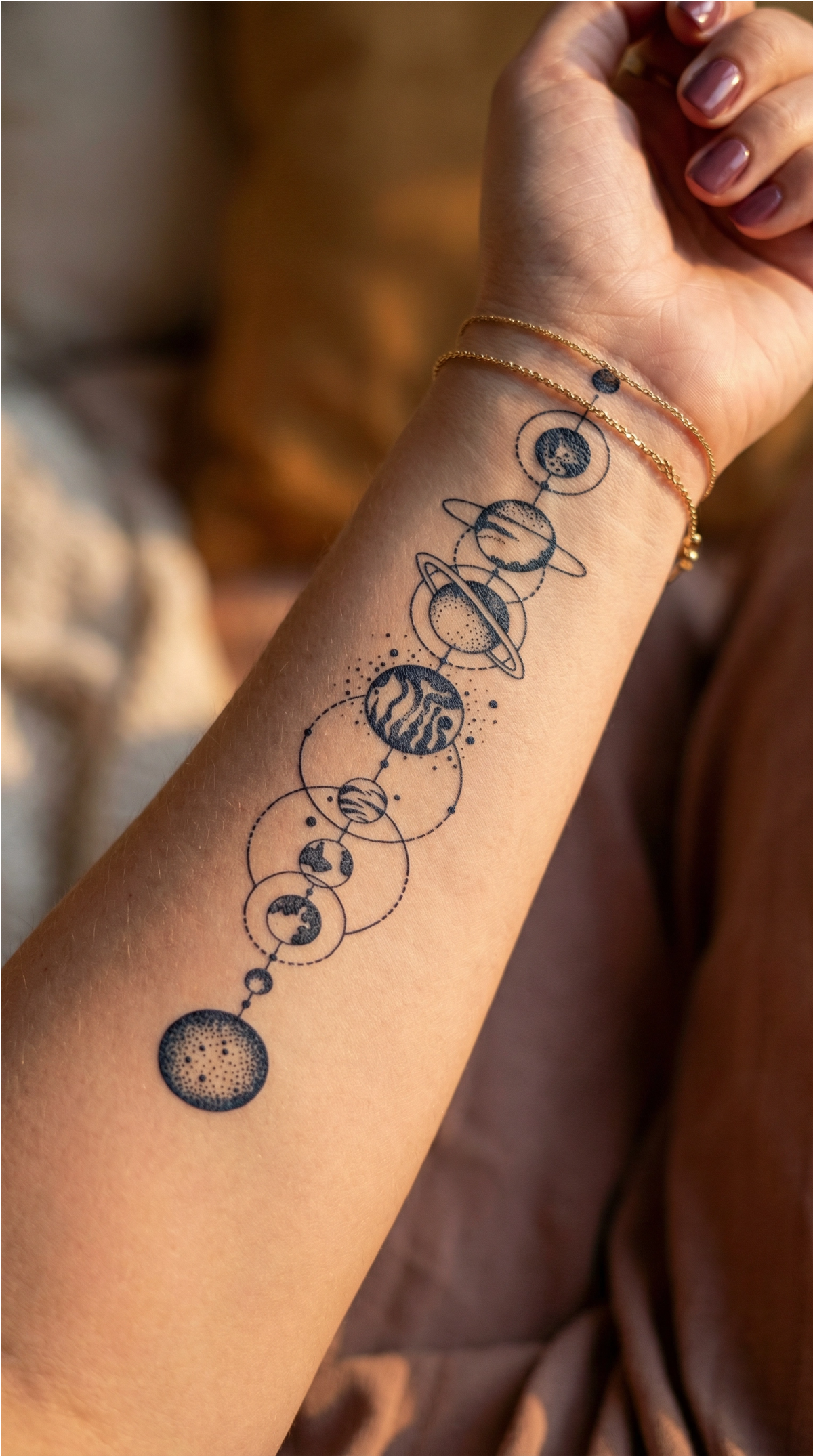


The knee has a rounded surface and a very wide range of motion, so a temporary tattoo on the knee works best with round shapes—mandalas, circles, rosettes—or fine lines that wrap around the kneecap, because they remain recognizable both with the leg straight and with the knee bent. Very large, full-body designs are harder to keep intact on a joint that folds with every step, so a medium or small design behaves more predictably here in practice.
- The knee bends much more than other areas of the leg already covered in other guides, so the design needs to work in the bent position as well as the straight position.
- Round shapes and motifs that wrap around the kneecap make use of the area’s natural curve; large, flat pieces tend to distort with every step.
- The simplest test before making any decisions: photograph the design with your leg straight, then with your knee bent at 90 degrees, and compare the two images.
- The area is subject to constant friction (jeans, kneeling), so a temporary or semi-permanent tattoo applied there usually fades faster than one on the arm or ankle.
Why the knee is a distinctive area for a temporary tattoo
Most guides to leg placement discuss the calf, thigh, or ankle—areas where the skin stays relatively flat regardless of movement. The knee works differently: the joint bends to approximately 120–150 degrees (source: Knee — Wikipedia), one of the largest ranges of motion in the entire body, so the skin above the kneecap visibly folds every time you sit down, climb stairs, or kneel.
This constant movement has two practical consequences for a temporary tattoo. The first concerns how long it lasts: the area is exposed to friction from jeans and socks, or to direct contact with the floor when you kneel, and strong friction speeds up the fading of any design applied there. The second concerns appearance: the same design looks different depending on the position of your leg—when straight, it is fully visible, and when bent, it visually “breaks” right along the crease. That is why choosing the design and testing it in both positions matter more here than on a flat area.
Which types of designs work best on the knee
The kneecap’s rounded shape and the joint’s constant movement narrow down, in practice, the types of designs that remain recognizable on the knee. Two approaches work well, while a third is worth avoiding for large pieces.
Circular designs and mandalas
Round, symmetrical shapes—mandalas, circles, rosettes—sit naturally centered on the kneecap and remain recognizable at almost any knee angle, because the design does not depend on a straight line that would distort when bent. You can already see this principle applied in the guide to mandala tattoos, where symmetry is treated as a central design element, not just decoration.
Fine designs, lace-like patterns, or thin lines
Fine-line motifs that wrap around the area make use of the knee’s curved outline instead of being distorted by it. One specific example is the Graceful Snake design, a snake silhouette drawn with fine lines and meticulous details, which suits this approach because it follows the curve of the skin instead of crossing it in a straight line.

Lace-like or geometric designs created with an intentional “break” right at the bend turn the skin’s crease into part of the design, rather than a flaw that disrupts its symmetry. By contrast, large, full-body pieces are hard to keep intact on a joint: with every step, the part of the design right on the crease stretches and compresses, so a medium or small design behaves more predictably here. If you want to compare sizes before choosing, the guide to choosing a tattoo size explains the differences between small, medium, and full-body options. The knee is not the only joint where this principle matters—the guide to elbow tattoos covers the other major area where circular designs and mandalas work for the same reason.
How to check the design with your knee straight and bent
The simplest way to evaluate a design before deciding anything else is to apply it and photograph it in both positions: first with your leg straight, then with your knee bent at 90 degrees, so you can see exactly where the crease falls across the design. It is worth repeating the test while sitting on a chair, too—the position in which the knee is most often visible in public—because the bend angle is slightly different from a full flex.
A temporary or semi-permanent tattoo applied to the knee shows you only how a particular design behaves in terms of its artwork, size, and placement in this area—not how a permanent tattoo in the same spot would hurt, heal, or look over the long term. If testing is part of your decision-making process, the guide to why it is worth testing a design before making it permanent explains in detail what you can and cannot learn from this kind of test.
Application and wear time on a mobile area
Applying an InkLabs temporary tattoo involves three steps, regardless of the area: gently exfoliate the skin and let it dry completely, wet the transfer sheet for about a minute, then slowly peel off the applicator from one corner to the other. On the knee, drying is especially important because the skin there wrinkles easily if it remains damp, which can affect how well the design adheres to the curve of the kneecap. For the first 24–36 hours, it is best to avoid strong friction and hot water—which, on the knee, means not kneeling or wearing very tight pants immediately after application.
Immediately after application, the color is lighter than it will be in the end; the final, darker shade appears only after 24–36 hours, as the ink oxidizes. If you photographed the test with your leg straight and bent immediately after application, bear in mind that the shade will darken a little more the next day.
An InkLabs semi-permanent tattoo normally lasts up to 15 days and fades gradually as the skin naturally regenerates. Areas with a lot of friction fade faster, however, than areas such as the arm or ankle, and the knee falls into this category because of its position and daily use—walking, sitting, and kneeling. If you already know that you want to keep the design visible for longer, take this into account when choosing between reapplying it more often or moving the design to an area with less friction.
Once you have figured out what type of design suits a curved, mobile area such as the knee, you can browse the Temporary Leg Tattoos collection to see other available designs, including fine-line options that suit the same placement approach. If you are also interested in the rest of the leg—the calf, thigh, or ankle—the general guide to temporary leg tattoos covers those areas in detail, although it does not cover the knee separately. And if you are a man looking for ideas for the calf or thigh, too, the guide to leg tattoos for men covers exactly those areas.