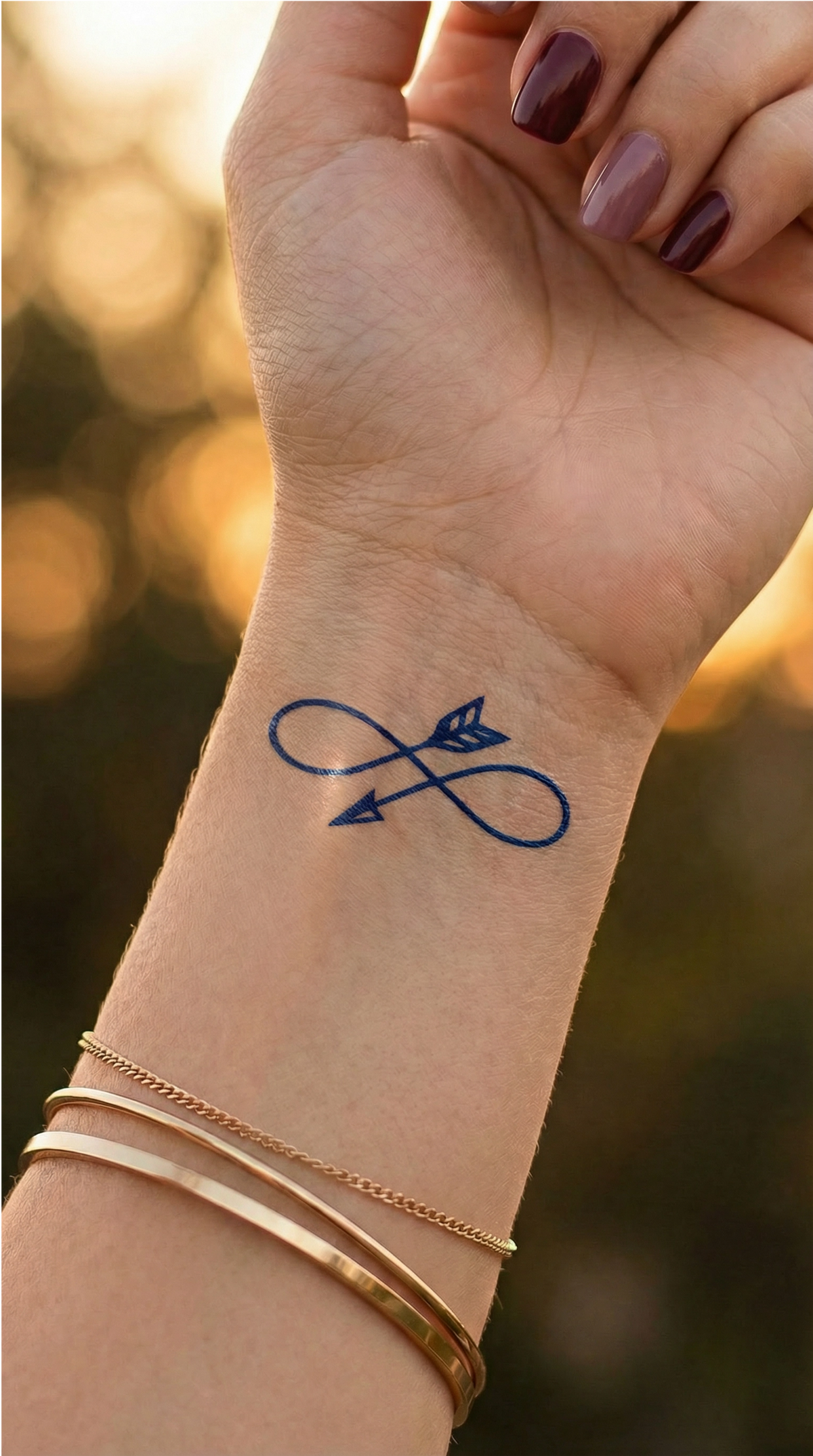


By “spiritual tattoo,” most people mean the same handful of designs: a lotus flower, an Om symbol, a mandala, a Hamsa hand, an unalome, or the yin-yang symbol. These motifs do not come from a single tradition; they are grouped together because each expresses an inner journey or personal belief. This overview looks at what each symbol really means, which culture or religion it is connected to, and how to choose one that truly suits you before making anything permanent.
- Lotus – an image of purity and rising above hardship in the Hindu and Buddhist traditions.
- Om – a sacred syllable that appears at the beginning and end of Hindu texts and is also used in other Asian religions.
- Mandala – a geometric design arranged around a center, used in meditative and ritual contexts.
- Hamsa – an open palm that symbolizes protection from the evil eye in Middle Eastern and Semitic traditions; it is not of Hindu or Buddhist origin.
- Unalome – a symbol developed from the Buddhist urna motif and popularized in tattoo culture, depicting the path to enlightenment.
- Yin-yang – a symbol from Taoist philosophy that represents the balance of complementary opposites.
What spiritual tattoo symbols have in common
You tend to group these symbols together because each carries some kind of inner or personal meaning, not because they come from a shared tradition. Several are connected to living religions and cultures – Hinduism, Buddhism, Taoism, and Jewish and Islamic traditions – so it is worth learning about each one in its own context, rather than treating them as interchangeable decorations. If you would like a broader overview beyond these six main motifs, our A–Z guide to tattoo meanings covers another eighty symbols. A temporary or semi-permanent version, meanwhile, lets you see exactly how your chosen design looks, in a particular size and on a particular part of your skin, before making any further decisions.
Lotus: rising above hardship with purity
In both the Hindu and Buddhist traditions, the lotus flower rising pure from the mud represents a mind or soul rising above hardship (source: Padma (attribute) – Wikipedia). The Hindu tradition sees its opening petals as the unfolding of our inner potential. In the Buddhist tradition, color matters too: white is associated with purity and awakening, while pink is traditionally considered the Buddha’s own lotus – a longstanding cultural association, not a rule that applies to everyone.
Om (Aum): the sacred sound of the self
Om is a sacred syllable at the heart of the Hindu tradition: it is understood as the sound of ultimate reality and the self, and it opens and closes sacred texts such as the Vedas and the Upanishads (source: Om – Wikipedia). Buddhism, Jainism, and Sikhism also use the same syllable, each in its own meditation and recitation practices. Since it is shared by so many traditions, it is worth treating it as a sacred sound rather than an arbitrary decorative character.
Mandala: a centered design for meditation
Mandala is a word of Sanskrit origin meaning “circle”: the classic form builds a circle around a center, enclosed in a square with four gates (source: Mandala – Wikipedia). In Hindu rituals, related yantra diagrams represent the dwelling place of a deity or cosmic principle. In Vajrayana Buddhist practice, monks create sand mandalas while meditating, then ritually destroy them – expressing impermanence, not lasting decoration. If you would like to read more about mandala symmetry and placement options, our article about mandala tattoos explains these in detail.
Our catalog also includes the Multitudo design, which the product description presents as a multi-armed Eastern deity, a symbol of harmony and balance. This is the retailer’s own description, not a verified iconographic identification, but it gives a good sense of how Eastern-inspired spirituality appears in our collection.
Hamsa: an open palm for protection
The Hamsa depicts an open palm, often with an eye in the center, and is traditionally worn for protection against the “evil eye” (source: The Hamsa Hand Symbol – My Jewish Learning). Its name comes from the Arabic word “khamsa,” meaning five, and it has significance in Islamic folk belief, as an amulet in Sephardic Jewish tradition, and more broadly in Middle Eastern visual culture. It is neither a Hindu nor a Buddhist symbol, so it is worth choosing it for its own meaning, rather than because it appears in the same collection as the lotus or Om.
Unalome: the Buddhist path to enlightenment
The unalome is a stylized form of the urna: the spiral- or circle-shaped mark painted on the forehead as an auspicious symbol in Buddhist depictions (source: Unalome – Wikipedia). Its shape is generally interpreted as follows: the winding spiral represents life’s uncertainty and struggles, while the straight line represents the clarity that comes with finding a path. An important distinction is that the unalome developed in tattoo culture from this Buddhist-origin motif, so it is not an ancient, canonical religious symbol in the same way as Om or the lotus. Our article about the meaning of the unalome explains in detail how the spiral and the end of the line vary from one design to another. If you are interested specifically in depictions of the Buddha rather than the motif behind the unalome, our guide to Buddha tattoos discusses the subject, including respectful placement.
Yin-yang: balance between opposites
Yin and yang describe pairs of inseparable opposites – such as dark and light, or passive and active – which are treated as existing together, not as competing forces (source: Yin and Yang – World History Encyclopedia). Each side contains a small dot of the opposite color, showing that neither exists entirely on its own. The idea was popularized by the Chinese School of Yin-Yang around the 3rd century BCE, as part of a broader philosophy about balance in nature. Our article about yin-yang tattoos offers more insight into creative variations of the concept and its deeper meaning.
Choose your symbol respectfully, and try it out first
Since several of the symbols above are connected to specific cultures or religions, it is worth choosing one whose actual meaning resonates with you, not just the one that looks best. Our spiritual collection also includes designs that express faith or commitment more generally, without naming a specific religion. These include the Prayer design below, a floral composition that represents prayer and hope, and the Faith design, which the product description presents as a combination of a watchful eye and wings. These represent a different kind of choice from looking specifically for a lotus or a Hamsa hand.

Where these designs are commonly worn
Spiritual designs are often worn on the wrist or forearm, where it is easy to check their size and how visible they are in everyday situations. The upper back is a more discreet option that offers a larger area if you do not want the design to be constantly visible. A temporary or semi-permanent version helps with this decision: it shows how your chosen symbol looks in that placement and size before you consider anything permanent. It does not, however, tell you in advance how it would hurt, how it would heal, or exactly how a permanent tattoo of the same motif would look.
Once you have chosen the symbol that truly expresses what you want, you can browse our spiritual tattoos collection and try the design on your wrist or upper back to see its size and placement before deciding on anything further. If this would be your first tattoo, our guide to choosing your first tattoo offers additional considerations for choosing a design and placement.