

A tattoo featuring the hussars draws on one of the most recognizable chapters in the military history of the Polish-Lithuanian Commonwealth, so before choosing a specific design, it is worth knowing what the hussars’ wings really were and where their legend came from. This article takes you through the source-based history of the formation, explains why the function of the wings is still debated among historians rather than established fact, and shows how to translate this information into a specific design and a choice between the upper arm and forearm.
- The hussars were the elite heavy cavalry of the Polish-Lithuanian Commonwealth, adopting the heavily armored form known today under the rule of Stephen Báthory in the second half of the 16th century.
- The function of the hussars’ wings has not been conclusively established - historians point to frightening enemy horses, making it harder to throw a lasso, and ceremonial use, while most surviving hussar armor does not have wings at all.
- Kircholm (1605) and the relief of Vienna (1683) are the two battles that most strongly cemented the formation’s legend and can be cited with confidence based on historical sources.
- The choice between the upper arm and forearm mainly depends on whether the design should focus on a single wing in a simple line or on a fuller motif that follows the shape of the arm.
Who were the winged hussars?
The hussars were the elite heavy cavalry of the Polish-Lithuanian Commonwealth, serving in its army from the beginning of the 16th century. The formation began as light cavalry modeled on Serbian cavalry and transformed into heavier shock cavalry under the rule of Stephen Báthory in the second half of the 16th century (source: Polish hussars - Wikipedia). It is this later, heavily armored version that we associate today with wings and great battles.
The hussar’s primary weapon was the lance - a hollow lance about 4.5 to 6.2 meters long - and the hussar saber, used in combat after the lance was broken or discarded. Many riders also wore the hide of an exotic animal, most often a leopard, over one shoulder, which, together with the wings, created a distinctive, recognizable silhouette on the battlefield and during parades (source: Polish hussars - Wikipedia).
Where did the wings come from, and what did they actually mean?
The fashion for wings and animal hides most likely reached the Polish-Lithuanian Commonwealth through Ottoman influence, and the documented use of this style by Polish cavalry dates back to around the middle of the 16th century, including the period when Stephen Báthory was recruiting troops (source: About the Hussar Wings - National Museum in Kraków). This does not mean, however, that every hussar wore wings in every battle - this is a detail often lost in simplified accounts of the formation.
Historians still debate what the wings were actually used for. The theories include frightening enemy horses with the noise and movement of feathers, making it harder for riders fighting in the Tatar style to throw a lasso, and a purely ceremonial function - decoration worn at parades and funerals as the formation’s role became increasingly representative. Importantly, most surviving examples of hussar armor do not have wings at all, and those that have survived with wings mostly date from the 18th century (source: About the Hussar Wings - National Museum in Kraków). Polish-language sources confirm the same theories and add the correct equipment terminology: lance, karacena (parade armor worn mainly by commanders), armor, and hussar saber (source: Hussars - Wikipedia). These terms are worth knowing if your tattoo design is meant to refer to a specific piece of equipment rather than just a general association with wings.
Two battles that built the legend: Kircholm and Vienna
Of the dozens of battles in which the hussars took part, two come up most often in discussions of the formation because they are well documented and easy to verify in historical sources.
The Battle of Kircholm (1605)
On September 27, 1605, an army of the Polish-Lithuanian Commonwealth numbering about 3,600 soldiers, including around 2,600 cavalry, defeated a Swedish army nearly three times its size, with close to 10,868 soldiers. The Swedish cavalry was routed within about 30 minutes of the hussars’ charge, making Kircholm one of the most frequently cited examples of the formation’s effectiveness (source: Battle of Kircholm - Wikipedia).
The relief of Vienna (1683)
On September 12, 1683, King Jan III Sobieski led part of an allied charge of about 18,000 cavalrymen, which descended from the Kahlenberg hills and broke through the Ottoman lines, ending the siege of Vienna. The charge is described as the largest cavalry attack in history, which conveys the scale of the event, not just its symbolic significance for Polish military history (source: Battle of Vienna - Wikipedia).
What does a hussar tattoo symbolize today?
For many people who wear this kind of tattoo, the motif is now read primarily as a sign of connection to Polish heritage and resilience, rather than as a literal military statement. However, since the motif is based on real national and military history, it deserves the same context and care as any other symbol of heritage, rather than being treated as a generic patriotic decoration without substance.
If you are interested in other Polish patriotic symbols, the White Eagle and the Anchor of Fighting Poland have their own histories and are discussed in a separate article about patriotic tattoos. If you are more drawn to the earlier, pre-Christian layer of heritage, designs such as Perun or Slavic runes can be found in the article about Slavic tattoos - this is a different period and a different symbolism from the hussars.
Design elements: wings, lance, helmet
Knowing the history makes it easier to choose consciously which elements of hussar equipment to translate into a tattoo design. The wing itself can be rendered in a stylized way, for example as a fan of feathers or a geometric shape, or represented more literally - both approaches keep the reference recognizable without pretending to be a museum reconstruction.
A single line depicting a lance or saber adds a clear reference to the formation’s main weapon without overloading a smaller design with extra details. A fuller suit of armor or a helmet works better on a larger area of skin, while a smaller tattoo usually reads better when it focuses on the wing alone.

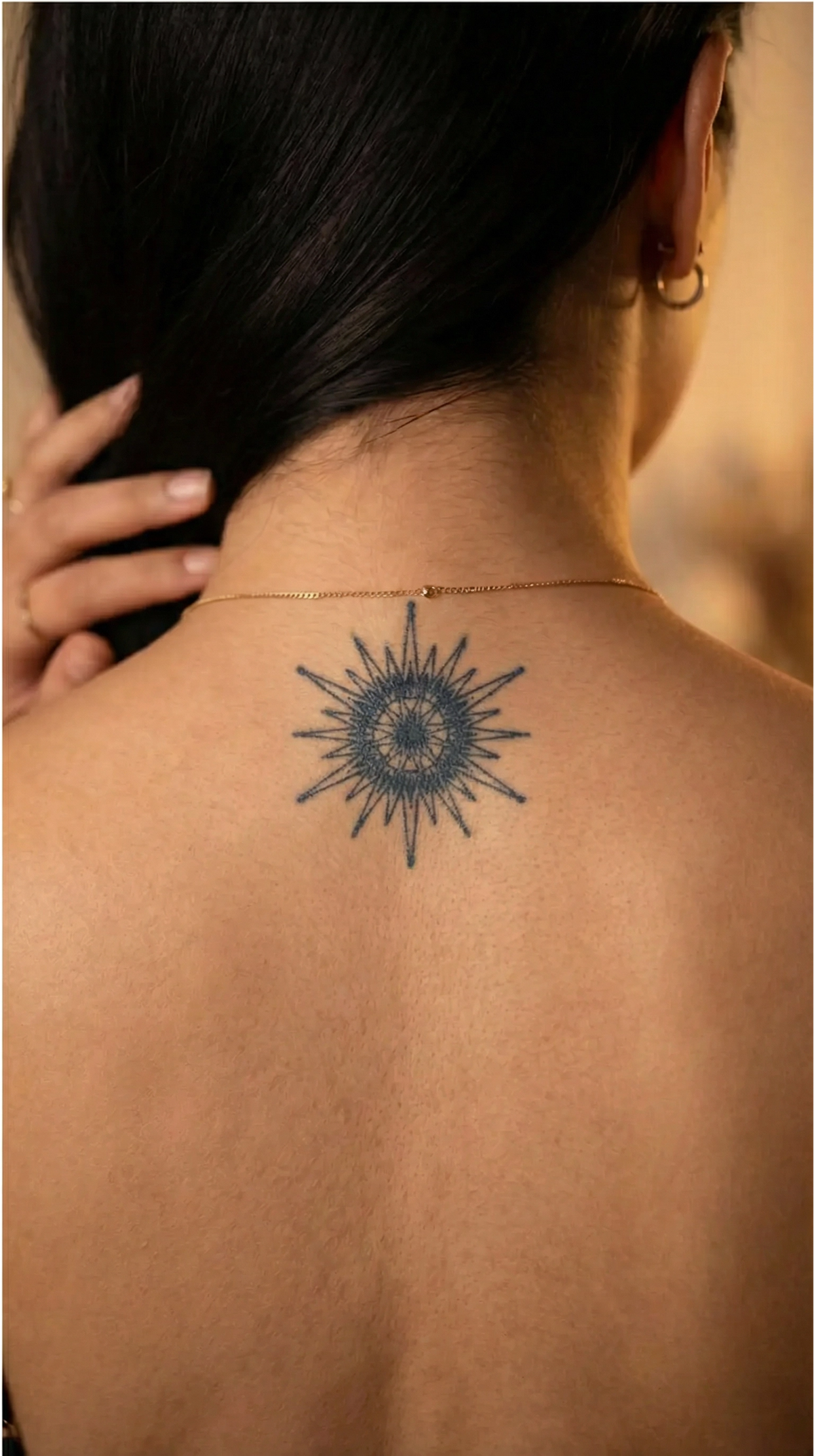
If you want a larger, more complex arrangement, a wing motif combined with an eye or another symbolic element shows how this kind of shape reads at a larger scale, for example on the shoulder or back.

Before deciding on a permanent design, it is also worth reading the general guide to your first tattoo, which helps you organize your choice of design and placement before moving on to details specific to the hussars.
Upper arm or forearm: how to choose a placement
The forearm’s flat, elongated shape works well for a single wing or a wing paired with a line depicting a lance, because the motif reads clearly when you look at the arm from the front. It is also easy to show or cover this placement depending on the situation, which can matter for a first, larger design of this kind.
The rounded shape of the upper arm is a better fit for a fuller design with both wings, especially if you want the motif to follow the arm’s natural curve rather than simply sit on a flat surface. Fuller compositions featuring a helmet or part of a suit of armor usually need this extra space to keep the details clear.
A temporary or semi-permanent tattoo lets you compare both placements and different sizes before deciding on a larger, more detailed design - it is a way to test the design itself, its scale, and its placement, not a way to predict exactly how skin will look, heal, or react with a permanent tattoo. You can find out more about how semi-permanent tattoo ink changes and fades in the article about how semi-permanent tattoos work, and see a full overview of designs for the upper arm and forearm in the guide to temporary tattoos for the upper arm and forearm. If you are specifically interested in the forearm, it is also worth browsing the Temporary Forearm Tattoos collection, where you will find more designs in a similar scale.
Summary
The hussars were a formation with a rich and well-documented history, but the wings most strongly associated with them are in fact the subject of historical debate, not a single, established military specification. The formation survived in various forms for some time longer, although sources differ on the exact date of its final dissolution, so it is better to think of the end of the hussars as a gradual decline rather than a single clear-cut date. Knowing these nuances - the debate about the wings, specific battles such as Kircholm and Vienna, and the correct terminology for the equipment - makes it possible to design a tattoo that pays respect to this history rather than relying on a simplified association. The rest comes down to deciding on the scale of the motif and whether it will work better on the forearm or the upper arm.