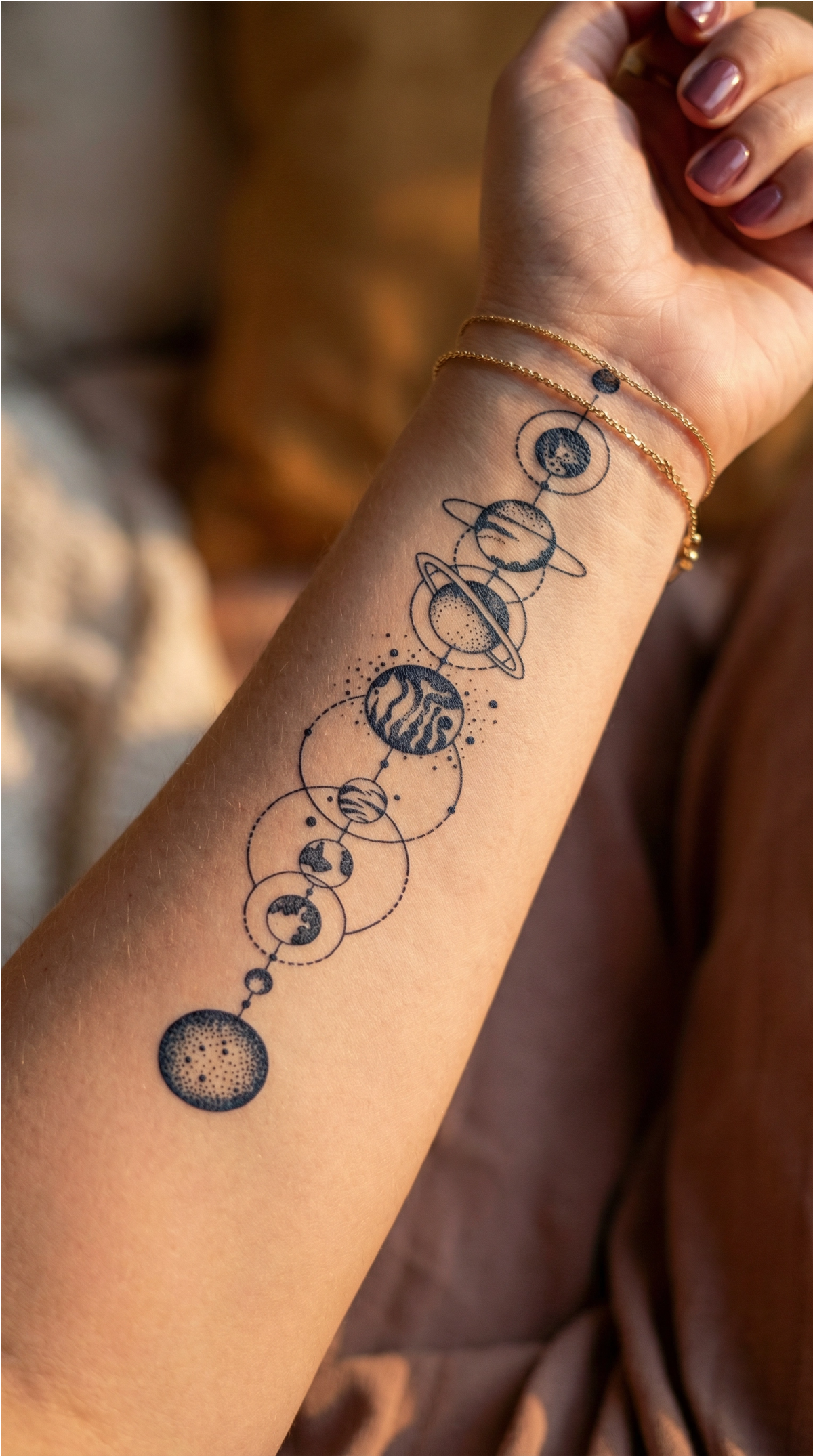


An ornamental tattoo is not a fixed style with a single silhouette, but a family of elegant, precisely symmetrical patterns that bring to mind jewelry, lace or architectural ornamentation. What they have in common is the precision with which the individual elements are aligned: each motif is mirrored or repeated around a clear axis, so the whole design looks like one cohesive pattern rather than a collection of separate drawings. Below, you’ll learn which techniques build this style, how it relates to mandalas, lace and geometric tattoos that have already been covered separately, and where on the body a symmetrical design really comes into its own.
- Ornamental is an umbrella style family built from blackwork, dotwork and fine linework, not a fixed look with one recognizable image.
- Symmetry works best in places that already offer a centre line or a flat surface, such as the back, sternum or thigh, and less well in irregular or narrow areas.
- The more detailed the motif, the more physical space it needs to remain readable; a small, highly intricate pattern fades faster than a more spacious design.
What makes a tattoo 'ornamental'?
The ornamental style consists of complex patterns with clean lines and strict symmetry between the individual elements. This precision is usually achieved with one technique or a combination of three: blackwork, where large areas are filled with solid black; dotwork, where the density of the dots determines the contrast and builds a detailed geometric pattern; and fine linework, with precise, often broken lines that give the design its delicate structure (source: iNKPPL Tattoo Magazine). The technique that takes the lead largely determines whether a design looks crisp and graphic or soft and layered.
Some ornamental designs are explicitly inspired by jewelry: they borrow the visual language of necklaces, bracelets and body jewelry and translate it into ink on the skin, so that the skin itself becomes a setting for jewelry. Other designs in the same family draw on architecture or textile patterns, such as decorative motifs on buildings or fabrics (source: Monolith Studio). These sources explain why two ornamental tattoos can sometimes look very different while still belonging to the same style: it is symmetry and precision that define the style, not one fixed motif.
Mandalas, lace and geometric designs: how ornamental relates to styles already covered
A mandala tattoo is one specific type within the ornamental family: a circular design that radiates outward from a central point. Ornamental is the broader category that mandalas fall under, along with lace patterns, floral motifs and geometric linework that is not itself a mandala (source: Monolith Studio). If you mainly want to understand the meaning and symmetry of mandala designs, the article about mandala tattoos covers that specifically, so there’s no need to cover it again here.
If you’d like to explore the geometric side of the style more broadly, the guide to geometric tattoos is separate from mandalas and focuses on shapes, lines and the use of space in general. Since fine linework is one of the three techniques that can build an ornamental design, the article about fine line tattoos is also a natural next step if you want to understand that delicate, broken linework in particular. If you’re more drawn to lace- or textile-like patterns, an upcoming article about lace tattoos explores that structure in detail, and anyone curious about the dotting technique itself can look out for the upcoming article about dotwork tattoos.
Where a symmetrical pattern really works
Symmetry looks best in a place that already offers a stable centre line or an even surface, not simply in the first spot where there happens to be enough bare skin (source: Sortra). In practice, that points to a few body areas that often feature in ornamental designs.
Back and spine
The upper back offers a wide, even surface, with the spine as a natural centre line, making it suitable for a radiating or vertically symmetrical design. Because the skin here is largely flat, a pattern built around a central axis remains easy to read even when you move.

Chest and sternum
The sternum naturally divides the torso into a left and a right half, making it well suited to a centred design. That natural midpoint works in symmetry’s favour, but it also makes small differences between the two halves immediately visible, so precision in the design matters even more here.
Thigh
The thigh offers a larger, flatter surface than most other areas of the body, giving room for a more elaborate or layered pattern that would quickly look too crowded in a narrower spot (source: Sortra). For a detailed ornamental design, that extra surface is often exactly what the pattern needs to show its structure.
Match complexity to size and placement
Very small, highly detailed ornamental patterns can fade over time because fine lines gradually spread a little in the skin; a more spacious design with a little more room between the lines generally stays crisp and legible for longer (source: Canggu Ink Club). This rule is especially important if you’re choosing between a small motif with lots of detail and a slightly larger motif with the same structure.
Detailed motifs such as chandelier-like drops, medallions or mandala-like centres work best on larger, flatter areas, while narrower zones such as the wrist or forearm are better suited to simpler, band- or line-shaped ornamental patterns (source: Canggu Ink Club). A compact, symmetrical motif such as a circular Yin Yang design shows how simplicity and balance can go together without the pattern losing its recognizability in a smaller area.

If your choice falls somewhere between those two extremes, a minimalist geometric design with interconnected planets offers a middle ground: enough structure to stay interesting, but built from clean lines that retain their shape even in a somewhat smaller area. If a motif doesn’t fit the spot you have in mind, a simpler version of the same idea is usually a better choice than a detailed design scaled down until it fits.
Try the design out first
A temporary or semi-permanent version of an ornamental design lets you see the pattern, size and placement on your own skin before making a final choice, and you can also judge whether the symmetry works once the design is on a curved surface such as the chest or thigh. A trial version like this tells you something about how the pattern looks and fits, but nothing about how a permanent tattoo feels while it’s being done, how the skin heals or exactly how the design will look years later: those are questions only a permanent tattoo can answer. If you’re ready for more options in this style after trying one out, the geometric designs collection offers more examples of precisely constructed, symmetrical patterns to compare.