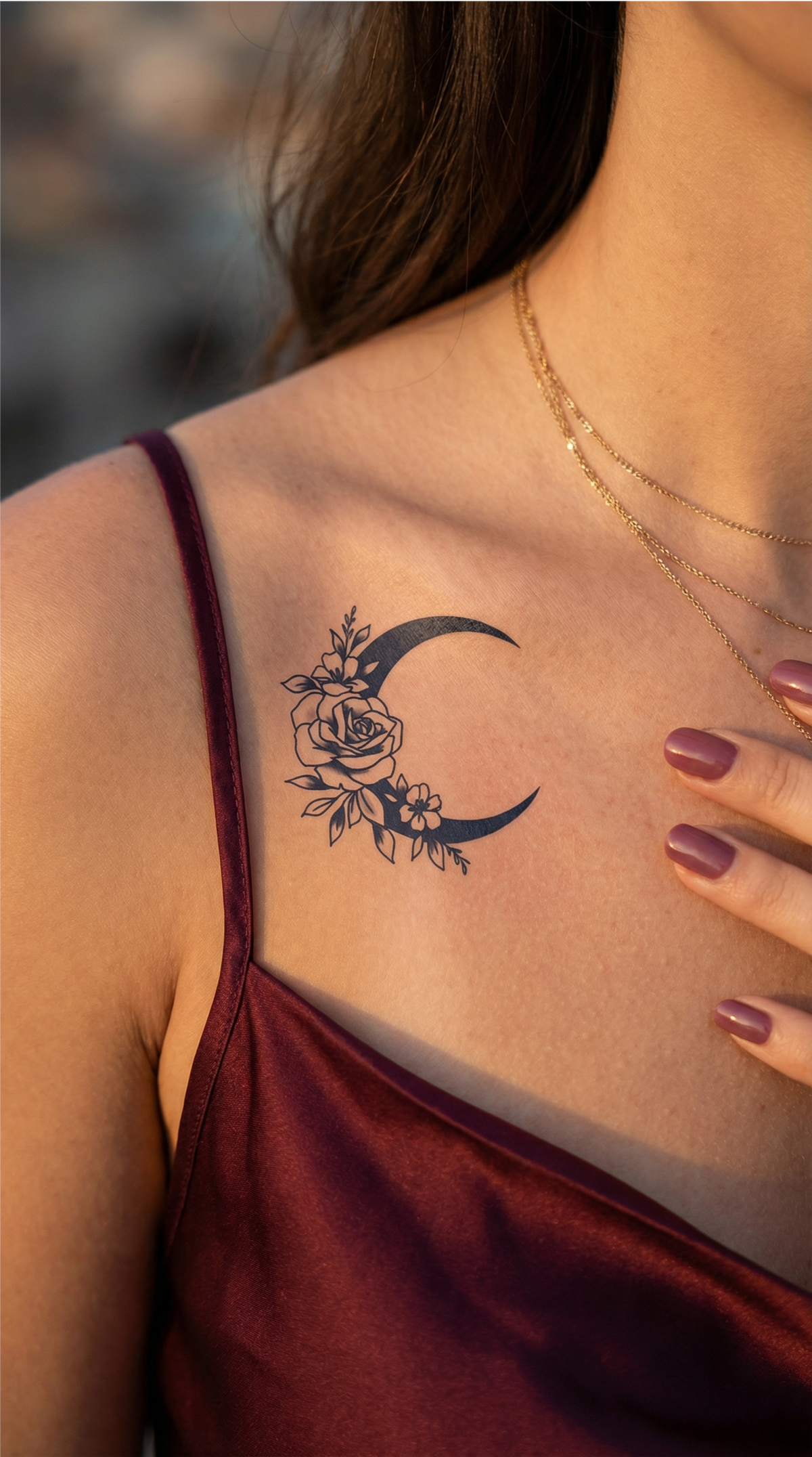


The neck is not one single area but several, and this distinction should guide your choice before the design itself. The side of the neck changes in visibility depending on your hairstyle and collar, the front and throat stay exposed in almost every situation, and the back is easy to hide under your hair or clothing. Once you have chosen the area, the size and style of the design follow fairly naturally, and you can still check over the course of a few days exactly how visible a design is in your own daily life before considering a permanent tattoo.
- The side of the neck is the most flexible area from day to day: whether your hair is down or tied back, and your collar is open or closed, its visibility changes completely.
- The front of the neck and the throat stay visible almost all the time, making simple, centered shapes a better fit than highly detailed compositions.
- The back of the neck is easy to hide under your hair, a collar or a jacket, making it a good spot for a small, discreet symbol.
The side of the neck: the most versatile area
On the side of the neck, the same area can go completely unnoticed or become the first thing people notice, depending on something as simple as how you wear your hair that day. With your hair down, a design disappears beneath it; with your hair up or tied back, it becomes the first thing that catches the eye. Clothing collars play the same role: a turtleneck or scarf covers almost everything, while an open collar or a low neckline leaves the design fully visible.
This variability makes the area particularly well suited to someone who wants to stay in control of their day-to-day visibility without giving up a tattoo that is clearly visible whenever it is uncovered. The vertical line running from the ear down toward the jaw and then the collarbone lends itself to fine lettering, a single-line design or a small floral or symbolic composition—styles that naturally follow this curve rather than working against it (source: Sortra, Neck Tattoo Placement Guide).
The front of the neck and the hollow of the throat: the most exposed area
The front of the neck and the hollow of the throat are almost impossible to cover during a normal day: neither your hair, a regular collar nor jewelry covers this area without immediately drawing attention to it. This is the most exposed area of the neck, and it is better to start with that in mind than to discover it afterward.
The throat is also constantly in motion, with every word, swallow and turn of the head. A highly detailed design intended to be viewed while still gets visually distorted with every movement, whereas a centered or symmetrical image remains legible even when the skin stretches or creases (source: Sortra, Neck Tattoo Placement Guide).
Why simplicity matters more here than elsewhere
A small, simple design generally ages better on the throat than a busy composition because it remains identifiable even when viewed at an angle or partly hidden by the chin. This is an area where choosing a more understated design is not an aesthetic compromise: it is what allows the tattoo to stay clear over time, despite the constant movement of the skin in that spot.
The back and lower neck: the easiest area to cover
Unlike the front of the neck, the back and lower nape are easy to hide: your hair, a raised collar or a jacket are enough to cover almost the entire area whenever you want. That is why this spot often features small symbols, initials or minimalist designs—motifs intended to stay discreet when your hair is down while remaining visible when it is up (source: Sortra, Neck Tattoo Placement Guide).
For the precise placement just behind the ear, which has its own size and visibility considerations, the article dedicated to this very specific area covers the subject in more depth than this guide, which looks at the neck as a whole.
Choosing the size for each area
The skin on the neck moves more than skin in flatter areas such as the forearm or calf, which affects how clearly a design holds up over time. A design that is too small can lose its definition more quickly here than elsewhere, simply because the skin it sits on is rarely still (source: Sortra, How Big Should a Neck Tattoo Be?).
The neck's natural curve also plays a role: it can slightly compress a design, which is why a slightly larger or simpler version often stays more legible than one that is very fine and highly detailed. General principles for choosing a size based on placement are covered in more detail in the temporary tattoo size guide, which is useful for comparing the neck with other areas of the body.
Testing visibility before deciding: a simple test over a few days
Before choosing an area based on a single photo or a test in front of the mirror, wearing a small temporary tattoo on the intended area for a few ordinary days gives you a much more reliable picture of how visible it really is. A typical day, with changes in hairstyle, clothing and activities, reveals things a one-off test does not.
What to observe each day
It is useful to note, day by day, how visible the design is with your hair down and then up, with your collar open and then closed, and with a scarf or turtleneck. Taking one photo in daylight and another indoors helps you compare, because perceived visibility sometimes changes more than expected between the two lighting conditions.
Adapting the test to your work environment
Some environments expose the neck to more friction from a collar, a scarf strap or a necklace, which wears down a temporary design faster than elsewhere (source: Ink Bond, How Long Do Temporary Tattoos Last?). Recreating your work clothes and movements during the test therefore gives you a more accurate idea of what the area would look like day to day. This test answers a question of visibility and style only: it says nothing about pain, healing or the exact appearance of a permanent tattoo, and it should never be interpreted as doing so. For the actual duration of a semi-permanent tattoo, the article on how long semi-permanent tattoos last offers practical guidance rather than guessing here.
The neck and work: why it is worth thinking ahead
Whether a clearly visible tattoo is accepted at work depends mainly on the industry and company culture, rather than on a universal rule that applies everywhere in the same way. Anyone already working in an environment with a strict dress code would be wise to check the employee handbook or talk to their manager before making a choice that is difficult to hide (source: Indeed, Your Guide to Tattoos in the Workplace).
That is exactly what the test described above helps you anticipate in practice: wearing the temporary design through a real workday in your usual outfit shows you what colleagues or clients would see far better than simply imagining it.
Styles that work well on a small area
On a narrow, mobile area like the neck, fine lines and fairly simple illustrative designs generally stay more legible over time than dense compositions or ones packed with detail. A minimalist geometric shape, like this single-line Infinite design, stays clear even as the skin moves, making it a practical example of a design suited to a small area.

A small illustrative design, like this symbol inspired by a heartbeat, works well near the spot where you can feel the pulse under the skin, complementing the area's anatomy rather than working against it.

For a broader first look at designs and placements suited to a woman's silhouette, the first tattoo guide helps you compare areas of the body other than the neck. And if you are more interested in an area around the décolletage or collarbone, the guide to this area of the chest focuses specifically on this extension of the neck.
Making your choice without rushing
Comparing the three areas of the neck, adjusting the design's size to the curve and movement of the skin, and then testing its visibility over a few real days gives you a much firmer basis for deciding than a single photo or a test in front of the mirror. The same design can look very different depending on the area you choose, and this practical comparison, rather than a single moment of enthusiasm, helps you choose a placement that will feel comfortable day to day.
To keep comparing designs organized by body area and narrow down your choice at your own pace, the guide to temporary tattoos for women and the collection organized by body area are the two most useful places to start.