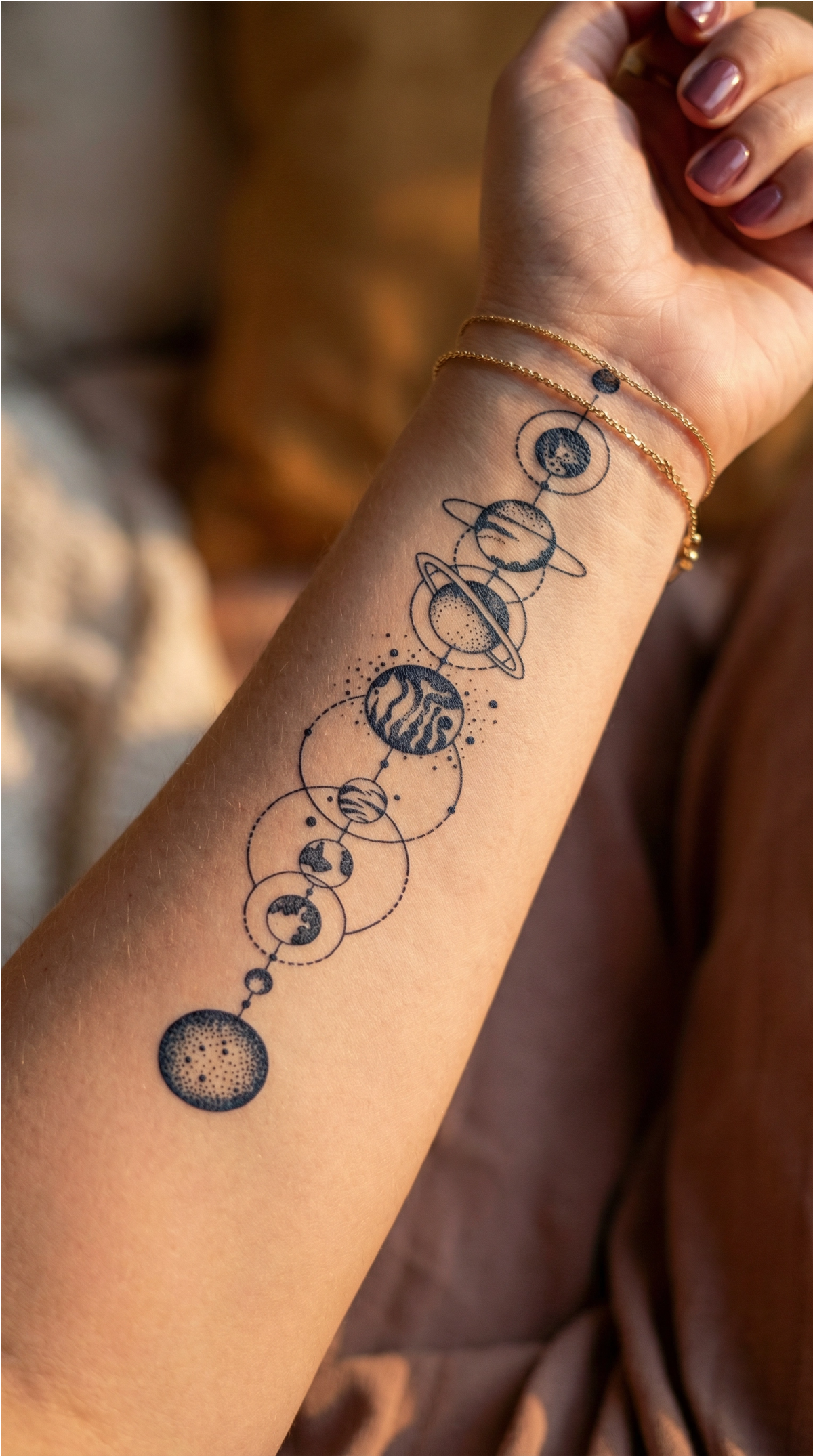


A French tattoo phrase sometimes consists of three or four words, but two checks should come before choosing a font: spelling, because a forgotten or misplaced accent remains visible for as long as the tattoo, and copyright status, because an orally transmitted proverb can be tattooed without reservation, whereas a quote by an author whose work is still protected should not be presented as free to use without checking. This article brings together verified French proverbs, grouped by theme, as well as a few quotes by authors whose work has clearly entered the public domain, along with a method for checking spelling and choosing a font and placement based on the length of the text. For a tattoo built around a date or number rather than a phrase, our guide to birth date tattoos covers that format separately.
- An anonymous proverb, passed down orally for generations, raises no copyright questions; a quote by an author must be checked case by case before it is presented as free of copyright.
- Copying the text from a reliable written source, rather than typing it from memory, significantly reduces the risk of an accent or punctuation mistake.
- Choose the font and text length together with the placement, not afterwards: a long phrase needs an elongated area, such as the forearm or ribs, while a single word works well in a shorter area.
- Seeing the phrase on your own skin, in its actual font and size, often changes how you judged it on paper.
Before choosing your phrase: what to check
A forgotten or misplaced accent cannot be corrected like a typo: once the tattoo is applied, it stays that way, whether it is a temporary tattoo worn for a few days or a semi-permanent tattoo designed to last longer. Paying attention to the spelling matters just as much as choosing the text itself, so check it before approving a design, not afterwards.
The second precaution is to check what the text you found online actually says. A phrase quoted on a social network or quote website almost never indicates whether it is free of copyright. An anonymous proverb, because it does not belong to any identifiable author, raises no such question. A signed phrase, however, depends on the author's date of death and the relevant French rules, detailed later in this article: it is better to check this before choosing a quote than to assume it is free to use because it circulates widely.
Finally, since a phrase in a calligraphic font or in a small size does not always read the way it looked on a screen, trying it as a temporary or semi-permanent tattoo lets you judge its actual legibility before making a final decision.
Short French proverbs, grouped by theme
The proverbs below are anonymous, have been passed down orally for a long time, and do not belong to any identifiable author, so they raise no copyright questions. Grouping them by theme helps you find a phrase that fits a specific intention, rather than choosing a simple stylistic effect.
Strength and perseverance
These sayings are often chosen to mark a difficult period that has been overcome or a resolve maintained over time.
- “Time will tell.” — acknowledges uncertainty without giving up, making it useful for marking a period of waiting or a decision that is still in progress.
- “Little by little, the bird builds its nest.” — connects patience with a concrete result rather than an effort that remains abstract.
- “Where there's a will, there's a way.” — remains complete in just a few words, unlike a phrase cut off partway through.
Life and fate
Other proverbs speak of time passing and the things we cannot entirely control, a common theme for marking a stage in life.
- “After the rain comes sunshine.” — suggests a change for the better without specifying what it will be, leaving the person free to give it their own meaning.
- “Everything in its own time.” — suits anyone who wants a reminder that a decision should wait for its moment rather than be rushed.
- “All things come to those who wait.” — conveys the same idea in a longer construction, suited to a larger placement such as the ribs.
Love and connection
The best-known proverb in this category was verified directly for this article: “Out of sight, out of mind.” (source: Proverb — Wikiquote), often chosen to mark geographical distance or a relationship that mattered despite the separation. Two other proverbs round out this category.
- “Love is blind.” — comes from an old saying, not an advertising slogan, despite its wide circulation today.
- “Birds of a feather flock together.” — is better suited to a shared tattoo for two people who are close than to a design worn alone.
Family and roots
These sayings speak of lineage and inherited resemblance, a common theme for marking a family bond without detailing a specific story.
- “Blood will tell.” — evokes an inherited trait or resemblance, making it useful for a tattoo about family lineage.
- “The apple doesn't fall far from the tree.” — conveys the same idea in a more vivid and direct way.
- “You can't choose your family.” — makes no judgment about that bond, suiting anyone who wants to mark it without commenting on it.
Quotes by French authors: what is really in the public domain
In France, a work enters the public domain 70 years after its author's death (source: Public domain (intellectual property) — Wikipedia), which in practice covers authors who died in 1956 or earlier. However, this general rule has exceptions: some works benefit from extensions related to the wars, notably those by authors recognized as having “died for France” (same source). Antoine de Saint-Exupéry is a direct example of this exception: he died in 1944 and was recognized as having “died for France” the following year (source: Antoine de Saint-Exupéry — Wikipedia), meaning the status of his writings does not simply follow the general 70-year rule. This is not a reason to avoid his work in principle, but it is a reason not to present it as automatically free to use without checking case by case. For a tattoo, it is therefore better to stick to authors whose works are clearly old enough.
Victor Hugo
Victor Hugo is among the authors whose work clearly predates the 70-year limit. In Les Châtiments, he writes: “Those who live are those who fight.” (source: Victor Hugo — Wikiquote). The phrase remains short as a tattoo while retaining its complete construction, which matters for legibility at a small size.
La Rochefoucauld
François de La Rochefoucauld, author of the Maxims, offers an even shorter phrase: “Our virtues are, more often than not, only vices in disguise.” (source: François de La Rochefoucauld — Wikiquote). Its tone, more ironic than that of the preceding proverbs, suits anyone looking for a phrase that invites reflection rather than making a direct statement. This longer version still works in a placement that can accommodate a full line rather than a single word, such as the forearm or ribs mentioned later in this article.
Voltaire
Voltaire rounds out this selection with the final sentence of Candide: “We must cultivate our garden.” (source: Voltaire — Wikiquote). Taken out of its narrative context, it still has a meaning of its own on the skin: taking care of what truly depends on you.
Spell your phrase correctly before getting it tattooed
The most reliable method is to copy the text from a written source, such as a printed edition or a reference page, rather than typing it from memory or copying it from a screenshot that may already be inaccurate. Check each accent (é, è, ê), each cedilla, and the spacing around French-style double punctuation, such as before colons or semicolons, separately, because a mistake in one of these places can easily go unnoticed in a quick mock-up. Having another person proofread the text before applying it is a simple precaution, particularly for text intended to last several weeks or longer.
Choose the font and length to suit the placement
A fine, delicate font remains legible in a small design, but it requires more precise rendering of accents and punctuation, two details that quickly disappear if the text is too small. Our guide to fine-line style explains this level of fineness for anyone deciding between this style and more pronounced lettering.

By contrast, more pronounced calligraphic or handwritten lettering is better suited to a longer phrase placed in a larger area, where the thick and thin strokes stay crisp without crowding one another.

Choose the text length and the width of the body area together, not one after the other: deciding on the phrase first and then looking for somewhere to fit it often means reducing the font until it is hard to read. When a whole phrase is not necessary to say what matters, a single strong word in a minimalist font can be enough.

Where to place a tattoo phrase
An elongated placement, such as the forearm or ribs, fits a complete phrase more easily than a short, wide area, where the text would have to be broken up or made much smaller to fit. Our temporary tattoo size guide explains these relationships between design size and body area for other types of designs.
Everyday visibility matters just as much as the look of the font when making this choice: a wrist or exposed forearm is always in view, including in situations you might not have anticipated, while a phrase placed on the ribs is visible only when you choose.
Try your phrase before making it permanent
Seeing the phrase on your own skin, in its actual font and size, often changes how you judged it on paper or on a screen: a word that seemed balanced in a mock-up may look too crowded or too stretched once transferred onto a curve of the body. Trying it as a temporary tattoo lets you adjust the length, font or placement before it becomes permanent, and trying a tattoo before making it permanent remains a useful step whatever phrase you choose.
If you want to wear a phrase longer than a classic temporary tattoo before deciding, a semi-permanent tattoo extends the trial period; the actual lifespan of a semi-permanent tattoo depends on several factors detailed in this guide, which are useful to know before choosing between the two options.