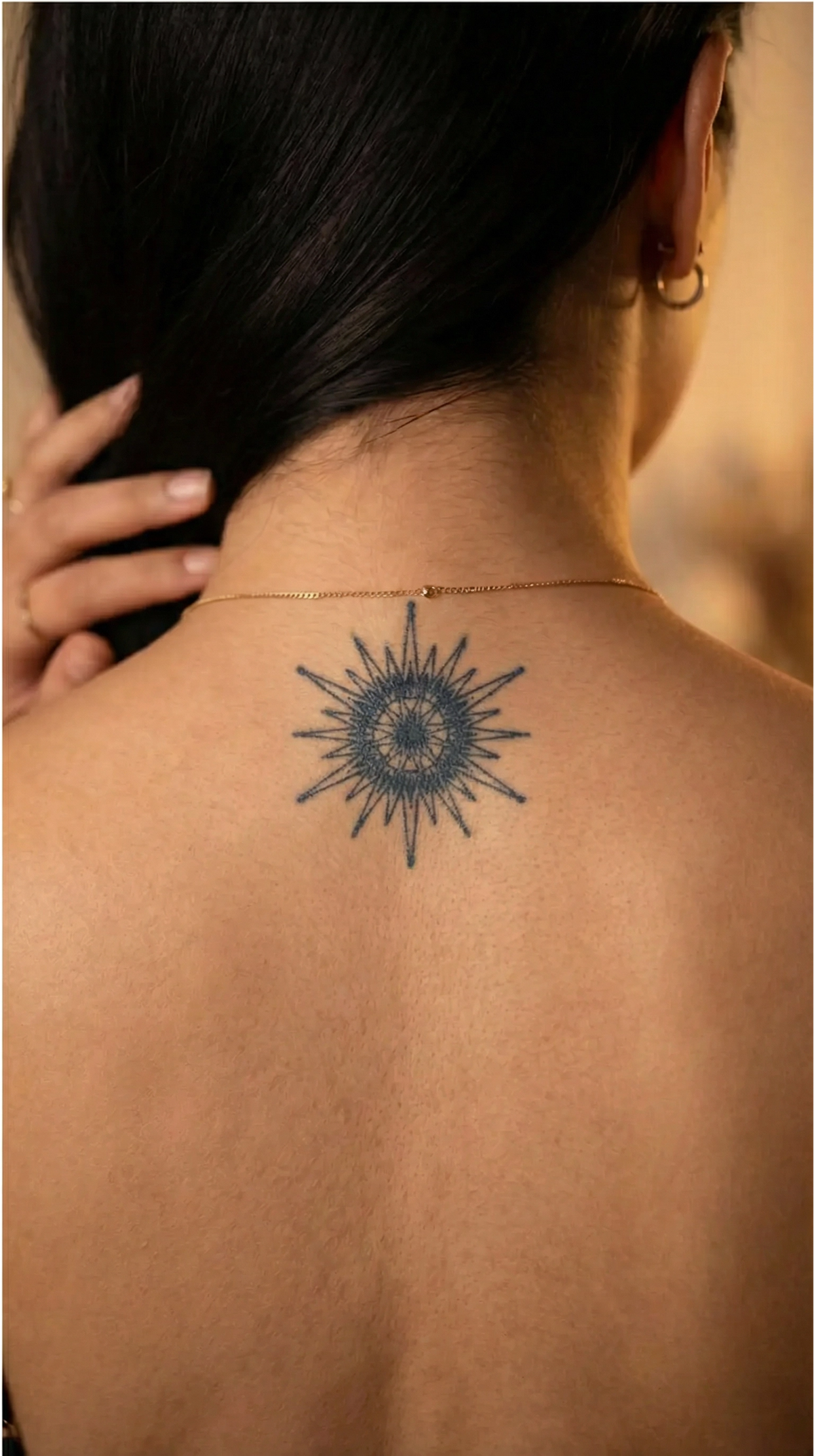


The Flower of Life tattoo features a precise geometric pattern: several equal circles, overlapping and connected center to center, arranged in hexagonal symmetry—a pattern documented in art history long before anyone spoke of the “Flower of Life.” Its name and most of the meanings attributed to it today—interconnection, the cycle of life, creative force—are much more recent than the design itself and belong to symbolic interpretations associated with certain movements, not to established historical facts. This guide traces the pattern’s origins, distinguishes its main variations (Seed of Life, Egg of Life, Metatron’s Cube, Flower of Life within a circle), and helps you choose a suitable size and placement before checking the symmetry of a design on your own skin.
- The pattern of overlapping circles is a documented geometric construction that predates the name “Flower of Life” by several centuries.
- The meanings associated with it are symbolic interpretations linked to certain traditions, not universal historical facts.
- Five variations are distinguished mainly by their number of circles and the resulting line density.
- The most suitable size and placement depend directly on the complexity of the chosen design.
- A temporary or semi-permanent tattoo lets you check a design’s actual symmetry and scale on your skin, without telling you anything about a permanent tattoo.
Where the Flower of Life pattern comes from
Technically, a Flower of Life is a figure made up of several equal circles, placed side by side and connected center to center, with the most common design bringing together seven or more circles arranged in hexagonal symmetry (source: Flower of Life — Wikipedia). This type of grid of overlapping circles is considerably older than the name used for it today.
The oldest documented example of this kind of pattern is found on the threshold of the palace of the Assyrian king Ashurbanipal at Dur-Sharrukin, dated to the 7th or 6th century BCE and now held at the Louvre (source: Overlapping circles grid — Wikipedia). A similar pattern, made up of nineteen overlapping circles and engraved in red ochre, also appears on a column in the Temple of Osiris at Abydos, Egypt. Its date is still debated: most evidence points to the first few centuries CE, but researchers do not rule out a later origin, in the Middle Ages or even the early 20th century. This is a useful nuance to know before repeating the idea that the pattern at Abydos is “several thousand years old.”
Leonardo da Vinci also studied the mathematical proportions of this kind of figure in the pages devoted to geometry in his Codex Atlanticus, written between 1478 and 1519.
The name “Flower of Life,” on the other hand, is a modern label. It is associated with the New Age movement and commonly attributed to Drunvalo Melchizedek’s book The Ancient Secret of the Flower of Life, published in 1999 (source: Overlapping circles grid — Wikipedia). The design and its name therefore belong to two distinct histories, which are best not confused when choosing a tattoo design. To see how the Flower of Life fits among the other geometric designs we offer, our guide to geometric tattoos provides a useful overview.
What the Flower of Life represents: a symbolic interpretation, not an established fact
“Sacred geometry” refers to a practice found in several cultures and religious traditions: assigning symbolic or spiritual meaning to certain geometric shapes and proportions (source: Sacred geometry — Wikipedia). It is an interpretive tradition, passed down and reinterpreted over time, not an established scientific fact.
According to the movements that draw on it, the Flower of Life is interpreted as a symbol of interconnection among living things, of a perpetual cycle, or of creative force. These interpretations differ from one tradition to another, and none is more “true” than the others historically: you choose according to what resonates with you, not according to a hierarchy of truth. If you’re looking for a circularly symmetrical design with a different story behind it, our guide to mandala tattoos explains a symbolism built around a different logic.
Variations to know before choosing
Before choosing a design, it helps to distinguish between figures often given the same generic name, “Flower of Life,” even though they do not have the same density or history.
Seed of Life
The Seed of Life brings together seven circles arranged in sixfold symmetry: it is the simplest and most compact geometric construction in the family, and the one from which more complex designs develop (source: Flower of Life — Wikipedia).
Egg of Life
The Egg of Life takes seven circles from the Flower of Life pattern and arranges them to suggest the shape of a developing embryo (source: Flower of Life — Wikipedia). The result remains compact, with a look that is less regular than the Seed of Life at first glance.
Complete Flower of Life
The complete Flower of Life adds several circles around the Seed of Life to create the densest design in the family, still in hexagonal symmetry. It is the most recognizable version, but also the one that needs the most space to keep each line distinct on the skin.
Metatron’s Cube
Metatron’s Cube starts with a section of thirteen circles from the Flower of Life, called the “Fruit of Life.” Connecting the centers of these thirteen circles with straight lines creates a network that reveals the five Platonic solids (source: What Is Metatron’s Cube? — Gaia). This variation has the most straight lines, which directly affects the minimum size needed to keep it crisp.
Flower of Life within a circle
The Flower of Life within a circle encloses the pattern in an outer border that visually closes the design in on itself. It is a common version in jewelry and fine-line tattoos because the outer border makes the pattern easier to read, even at a small size. This perfectly symmetrical circular design shows how a round, centered design looks once applied to the skin: the same visual constraint applies to a Flower of Life within a circle, which helps you estimate the scale of a comparable design before deciding.

Choosing the size and placement to suit the pattern’s complexity
The number of circles or lines in your chosen design directly determines how much surface area you need. The more intricate a pattern is, like Metatron’s Cube or the complete Flower of Life, the more space it needs to keep the lines from touching and ensure they remain distinct once applied to the skin.
A Seed of Life or Flower of Life within a circle, more compact by design, works well in small areas such as the wrist or ankle, where a denser design would be harder to read. A more intricate pattern such as the complete Flower of Life or Metatron’s Cube, on the other hand, reads better on a larger, flatter area such as the shoulder blade or upper back, where the available space lets each line breathe.
The sternum requires particular attention: it is an area where the skin moves with your breathing and posture, which can make a slight asymmetry in the design more noticeable. A centered design, checked before application, remains the safest choice for this placement.
| Variation | Line density | Recommended size | Suitable placement |
|---|---|---|---|
| Seed of Life | Compact, seven circles | Small to medium | Wrist, ankle, finger |
| Egg of Life | Compact, seven circles | Small to medium | Wrist, forearm |
| Flower of Life within a circle | Pattern enclosed by a border | Small to medium | Wrist, ankle, nape |
| Complete Flower of Life | Dense, hexagonal symmetry | Medium to large | Shoulder blade, upper back, full forearm |
| Metatron’s Cube | Very dense, internal straight lines | Medium to large | Shoulder blade, upper back, sternum |
How to check symmetry and scale before deciding
Once you’ve chosen a design, two simple checks can help you avoid an unpleasant surprise once it’s applied.
- Compare the two halves of the design as if looking in a mirror to spot any misalignment before approving it.
- Look at the design from several angles and in different lighting once it is positioned on your chosen area: the natural curve of the skin changes how symmetry appears, especially on a curved area such as the shoulder blade or wrist.

A temporary or semi-permanent tattoo lets you judge the actual size and placement of a geometric design on your own skin, before making any final decision. It does not, however, tell you anything about pain, healing, a possible allergic reaction or the exact look of a permanent tattoo: these are separate questions, covered in our article on why it’s worth testing a design before going permanent.
If you’re still unsure which variation or placement to choose, our collection of geometric designs lets you compare other patterns by density and scale, our guide to temporary tattoo sizes explains the available options, and our first tattoo guide explains how to choose a design and placement step by step.