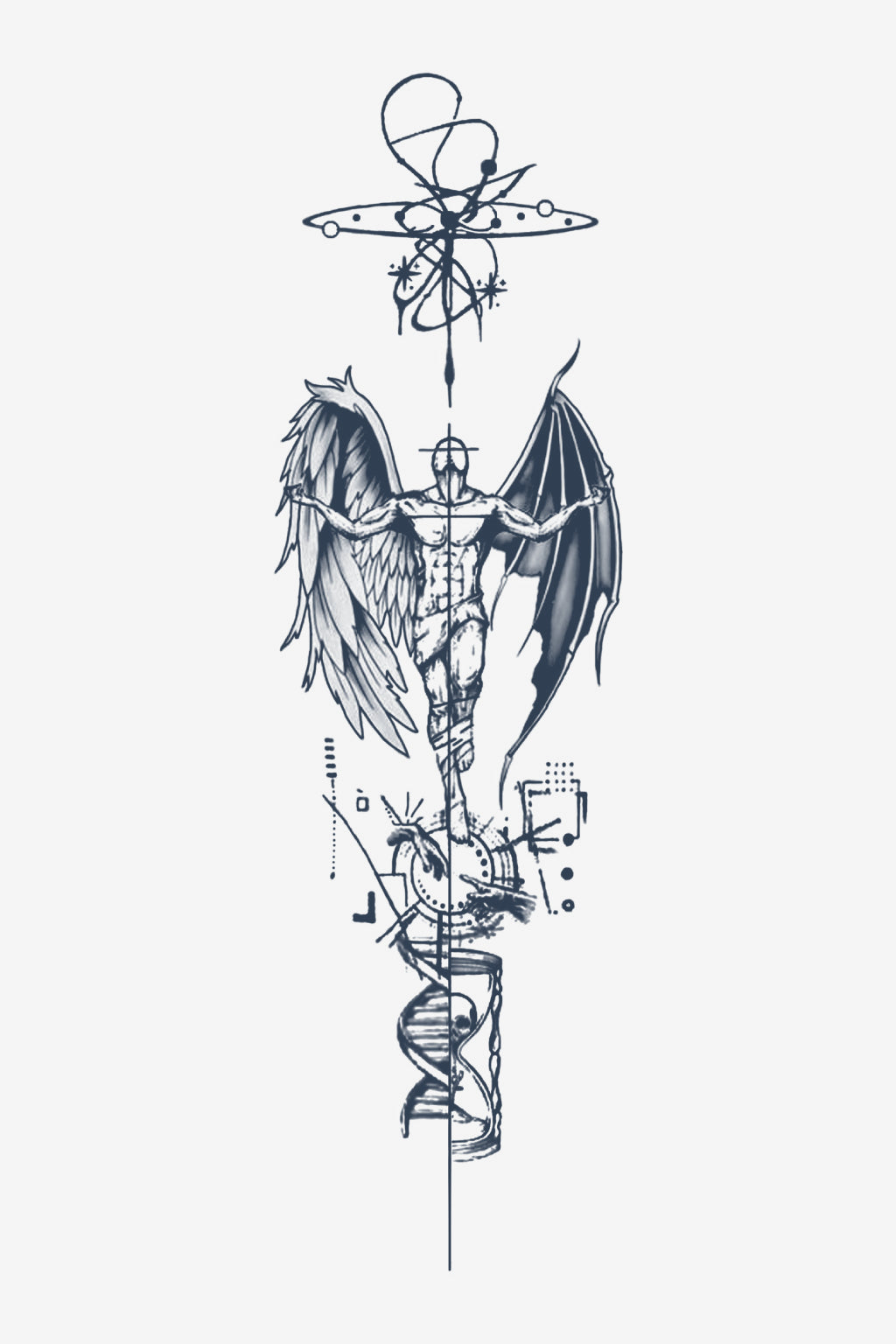


A 3D tattoo is, in fact, a completely flat drawing that uses the contrast between light and shadow to trick the eye into perceiving volume where the skin remains smooth. The effect of depth comes from how the artist grades the color from light areas to dark ones, the perspective chosen for the elements in the design, and the way the composition follows the natural curve of the arm, leg, or chosen area. Someone searching for “3D tattoo” usually wants to understand this visual mechanism, find out what types of designs are available, and, above all, get a realistic idea of what a semi-permanent tattoo trial can reproduce before considering a permanent version.
- The illusion of depth is created through shading and perspective, not through actual raised skin.
- There are several categories of 3D or optical-illusion designs, from layered compositions to geometric patterns with strong contrast.
- InkLabs semi-permanent ink develops into a single blue-black shade, so the colored gradients sometimes used in professional permanent tattoos cannot be reproduced identically.
- The size and placement on an area with or without curvature affect how well the illusion of depth holds up in the short term.
What is a 3D tattoo and how is the illusion of depth created?
Unlike a sculpted relief, a “3D” tattoo remains, physically, just as flat as any other design on the skin. What changes the perception is the shading technique: the light and shadow areas are separated analytically so that the brain interprets the color’s tonal gradation as volume (source: Chiaroscuro). The same logic underlies trompe-l'œil murals, where perspective and the foreshortening of elements make a flat surface appear to have real depth (source: Trompe-l'œil). For anyone new to semi-permanent tattoos, the InkLabs guide to what semi-permanent tattoos are explains the basics; here, we focus strictly on the 3D style and optical illusions.
The role of light and shadow in the perception of depth
How much a design appears to “stick out” or “sink into” the skin depends on how abruptly the artist moves from a light shade to a dark one. A gradual transition suggests a gentle curve, while strong contrast, with clear edges between light and shadow, creates the impression of an edge or a sudden break. Perspective matters just as much: an object drawn as if viewed slightly from above or from the side appears to have volume even when the lines remain simple. Placement on a curved area, such as the forearm or calf, can enhance this effect if the design is oriented to follow the curve, or distort it if the orientation does not take the area’s natural shape into account.
Popular types of 3D and optical-illusion designs
Among the most sought-after categories are designs that make the skin look “torn” or “cracked,” created with firm outlines and strongly contrasting shadows that suggest an opening where the skin is, in fact, intact. Another category is based on creatures or objects illustrated with realistic shadows, making them appear to rest on the surface of the skin or emerge from it, without requiring a fully photorealistic style. Geometric patterns can also suggest depth, this time through repetition and line contrast, in a way that differs from the pure symmetry discussed in the guide to geometric tattoos. A fourth approach, very popular in illustrative collections, combines several overlapping elements, such as wings, objects, or figures, so that the visual layers create a sense of depth without complex photorealistic shading.
When overlapping layers create depth without photorealistic shading
A specific example from the Illustrative collection is the Power and Healing design, which brings together wings, a sword, and two coiled snakes in a composition with several visual planes. The depth here does not come from complex photorealistic shading, but from the way the elements overlap and the contrast between the thick outline strokes and the finer details inside them. This type of layered composition is a useful starting point for someone who wants a visible sense of depth at first glance, without relying on a very fine photorealistic transition between light and shadow.

What semi-permanent ink can and cannot reproduce
Before choosing a design intended to create a sense of depth, it is worth knowing how InkLabs semi-permanent ink actually behaves. Immediately after application, the design is a light, slightly bluish shade, and the color gradually intensifies to a final blue-black over approximately 24–36 hours, as described in the article about how semi-permanent tattoos work. This development also corresponds to the chemistry of jagua-based ink, whose components react with proteins in the skin and form the characteristic blue-black pigment (source: Jagua tattoo).
The palette, however, remains limited to this single shade, as also confirmed by the article about the real color of InkLabs temporary tattoos: there are no colored options, such as red, green, or gold, and no metallic finishes either. This means that colored gradients, sometimes used by tattoo artists working directly on the skin for permanent tattoos, cannot be reproduced identically with a semi-permanent tattoo trial. Line and outline contrast can still suggest depth, but a very fine photorealistic transition from shadow to light remains difficult to match exactly as a tattoo artist adjusts it live during a session. This limitation does not make the design the wrong choice; it simply shows that a semi-permanent tattoo trial faithfully reproduces the outline and composition, while the exact shading finish remains specific to a permanent tattoo created by an artist.
Important to remember: a semi-permanent tattoo trial with this type of design shows only how the composition and size work on your own skin. It does not simulate or predict how a similar permanent tattoo would heal, how much it would hurt, or how it would fade over time; these are aspects related to the needle and permanent ink, to discuss directly with a licensed tattoo artist.
How to choose the placement and size so the 3D effect shows clearly
A design intended to suggest depth generally needs a surface large enough for the shading details to remain visible from a normal viewing distance, not just up close. A very small version may lose precisely the nuances that create the illusion, because the transition between light and shadow needs space to unfold gradually.
Areas with a natural curve, such as the forearm, upper arm, or calf, can enhance the sense of depth when the design is oriented to follow the body’s line, but they can also distort it when the orientation does not account for how the skin curves with movement. A semi-permanent tattoo trial is useful for exactly this reason: it lets you test the size and placement of a composition with several visual layers before making a permanent decision, on your own skin and with your own clothes, not just in a reference photo.
Another example from the same collection is the Protecting Hand design, a pictorial composition featuring an adult hand and a young hand, designed with a clear perspective between planes. For someone comparing several options with a sense of depth, this type of scene shows how perspective and the proportions between elements can create depth without relying on just one type of shading.

If you want to browse more examples before deciding, the Illustrative collection brings together designs with multiple visual layers and complex compositions, useful as a starting point for a semi-permanent tattoo trial. Readers who want an overview of all available styles, not just the 3D effect, can find a summary in the guide to tattoo styles. Whatever direction you choose, a semi-permanent tattoo trial remains a realistic way to see, at actual size, what a design intended to suggest depth looks like before making a permanent decision.